Industrial absorbents are the materials that keep factories, workshops, and ports clean and safe by capturing oil, chemicals, and other liquids before they spread. From a single pad under a machine to booms across a harbor, they are a system of products matched to different spills and settings. Choosing the right ones is a practical decision that affects safety, cost, and compliance across an operation, and it is easier than it first appears once you understand the system.
This guide covers the full family of industrial absorbents — the types and formats, the materials they are made from, the grades that match them to liquids, and the industries that rely on them. Whether you manage one site or many, the same principles apply. By the end you will be able to read an absorbent by its type and grade and choose confidently for your facility. The aim is a practical mental model, not a catalogue to memorise.
What Are Industrial Absorbents?
Industrial absorbents are sorbent products used across industry to soak up oils, chemicals, coolants, and water from surfaces and water bodies. Most are made from meltblown polypropylene, a synthetic that traps liquid in a dense web of fine fibers and holds many times its own weight. They are produced in a range of formats and grades to suit different spills.
Their role is both routine and critical. Day to day they catch drips and small leaks that would otherwise create slip hazards and stained floors, and in an emergency they contain and recover a major spill. That dual role makes them a basic part of any industrial safety programme.
They also carry a compliance dimension. Regulators and insurers expect facilities that store or handle oils and chemicals to have spill-control measures in place, and a stocked set of industrial absorbents is a visible, practical part of meeting that expectation. Getting the range right is as much about being prepared and inspection-ready as it is about cleaning up.
For the material science behind them, see our guide on what oil absorbent pads are made of. This article focuses on the full range and how to choose the right products for your operation.
The Main Types of Industrial Absorbents
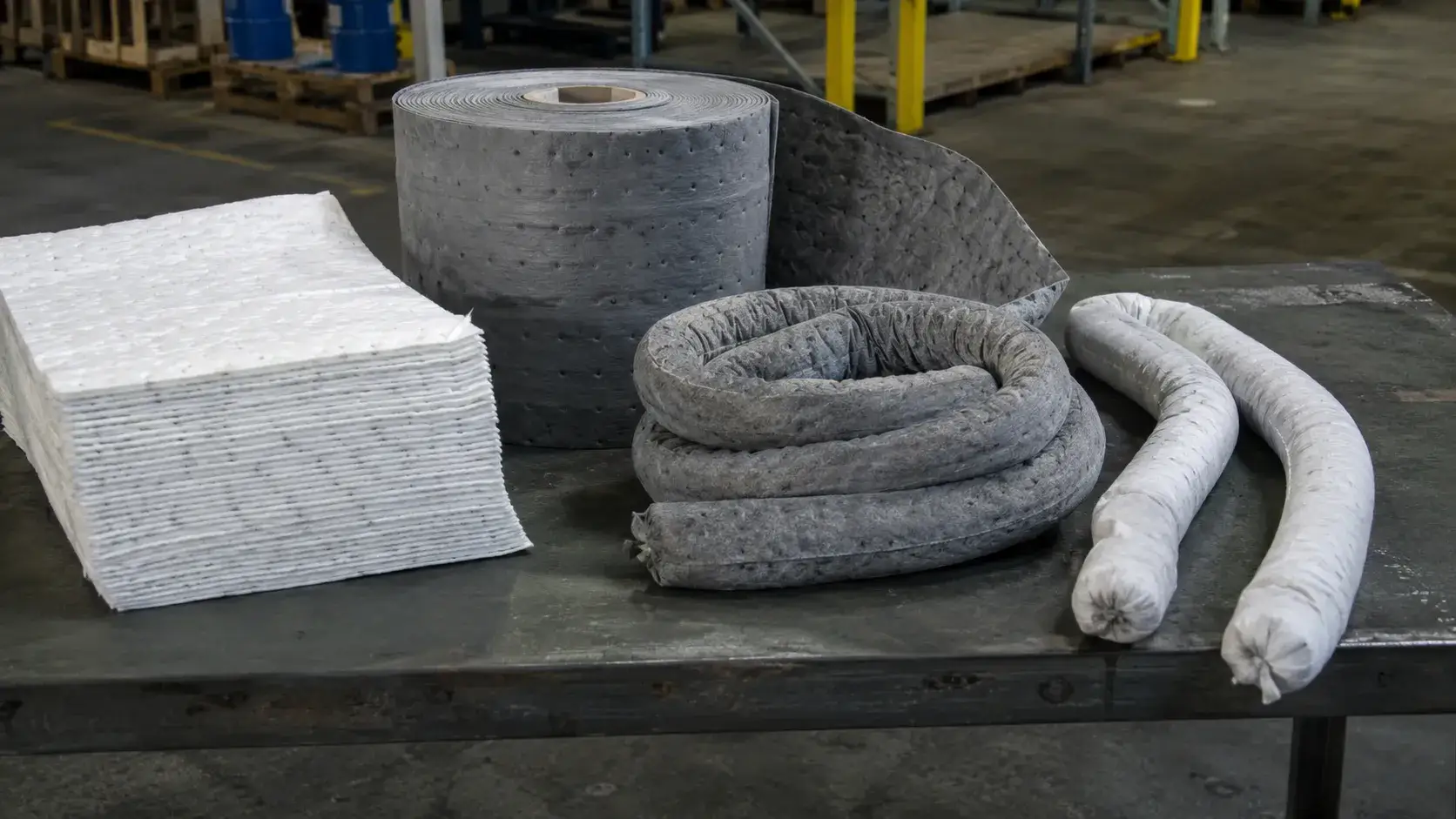
Industrial absorbents come in several formats, each shaped for a different job. Pads and rolls are the flat, everyday workhorses; socks and booms are long tubes for containment; pillows target concentrated drips; and granular absorbents cover rough or uneven ground. Most facilities combine several rather than relying on one.
The table below summarises the core types and where each performs best. Below it, we look at the materials and grades that further define them.
| Type | Form | Best for |
| Pads | Flat sheets | Everyday spills, drips, wipe-downs, floors |
| Rolls | Continuous sheeting | Large-area coverage, walkways, custom lengths |
| Socks | Flexible tubes | Surrounding machines and drains, containment |
| Booms | Large floating tubes | On-water spills, harbors, containment at scale |
| Pillows | Filled cushions | Concentrated drips, sumps, tight spaces |
| Granular | Loose particles | Rough ground, cracks, uneven outdoor surfaces |
Materials: Synthetic vs. Natural Absorbents
Industrial absorbents fall into two material families. Synthetic absorbents, dominated by meltblown polypropylene, offer high capacity, water resistance in their oil-only form, and consistent performance, which is why they lead the professional market. They hold up to many times their weight in liquid and stay clean to handle, and their consistency from batch to batch makes them predictable to work with at scale.
Natural absorbents — clay, cellulose, cotton, and peat — have a place where biodegradability is a priority or spills are small and simple. They tend to absorb water along with oil and hold less per kilogram, and granular clay in particular can leave a dusty residue. For most industrial use, synthetic wins on capacity and cost-per-spill.
Our guide on what oil absorbent pads are made of compares these materials in more detail.
Absorbent Grades and the Colour Code
Beyond format and material, industrial absorbents come in grades that determine which liquids they handle, and an industry colour code makes them easy to grab. Oil-only absorbents are white, repelling water and capturing only oil, which makes them ideal for spills on or near water. Universal absorbents are gray and, thanks to a surfactant treatment, soak up both oil and water-based fluids.
Chemical absorbents are yellow and built to withstand aggressive liquids such as acids, caustics, and reactive solvents. Using the wrong grade wastes material or creates a hazard, so the colour code exists to match grade to spill at a glance. Many facilities keep all three where their risks call for it.
The colour code also simplifies training and stocking. When staff learn that white means oil, gray means universal, and yellow means chemical, they can respond correctly without pausing to read labels during an incident. Keeping the grades visibly separated at the spill station reinforces that habit and prevents a chemical spill ending up on a pad that cannot handle it.
Our guides on oil only absorbents, universal absorbents, and chemical absorbents cover each grade in depth.
Applications Across Industry
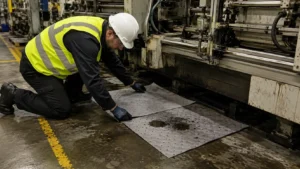
Because the same materials come in oil-only, universal, and chemical grades, industrial absorbents solve problems across very different settings. In automotive and machine shops they catch oil and coolant under engines and machinery, while on manufacturing and production lines they keep floors clear of lubricant and hydraulic fluid.
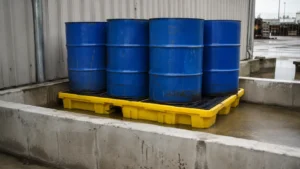
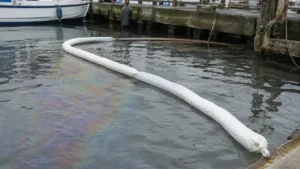
In marine and port operations, oil-only booms and pads float on water to recover fuel and oil sheens, and at oil and fuel storage sites they contain leaks at tanks, drums, and transfer points without soaking up rainwater. Warehousing, logistics, labs, and chemical plants each use the grade and format suited to their liquids.
This breadth is why a single supplier’s range can serve an entire operation. Matching product to the specific hazard at each point is what makes the system work.
It is worth mapping your own site the same way. Walk the floor and note where oil, coolant, chemicals, and water actually appear, then place the matching grade and format at each of those points. That simple exercise usually reveals a few risk spots that were being ignored and a few kits that were in the wrong place.
How to Choose Industrial Absorbents
Choosing industrial absorbents comes down to three questions: what is the liquid, how big is the spill, and where is it. The liquid sets the grade — oil-only, universal, or chemical — which is the decision that prevents most wasted material and safety risk. Identify the liquid first, guided by its safety data sheet where relevant, before anything else.
Spill size and location then set the format and weight. Small spills suit pads, rolls, and pillows; larger or spreading ones call for socks, booms, or granular absorbents to contain them, and heavier GSM grades handle bigger volumes with fewer changes. Indoor floors favour pads, outdoor or uneven ground favours socks and granular, and anything on water demands oil-only booms and pads.
Answer those three questions and the rest is fine-tuning. A balanced facility usually stocks pads and a roll for daily use, socks and booms for containment, and a few pillows and some granular for the awkward spots.
Weight is the last variable to set once the format and grade are fixed. Heavier, higher-GSM products hold more and resist tearing under load, which suits big leaks and high-traffic areas, while lighter grades wick fast and suit routine drips and wipe-downs. Stocking a couple of weights in your most-used format lets crews grab the right tool for the spill in front of them.
Prevention and Housekeeping
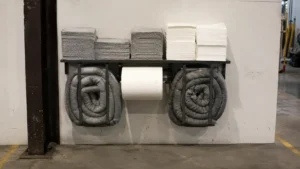
Industrial absorbents are as valuable for prevention as for response. Placing pads or mats under drip-prone machines and socks around equipment catches leaks at the source, keeping floors clean and cutting slip risk. This everyday housekeeping quietly prevents most of the mess a facility would otherwise deal with, and it keeps oil out of concrete before it can stain.
A stocked, clearly marked spill station keeps the right absorbents within reach for the unexpected. Pairing prevention with fast response is what separates a well-run operation from one that is always mopping up. For continuous drips, a reusable mat can be more economical than repeated single-use pads, especially under a machine that leaks predictably every shift.
Our guide on maintenance absorbents covers the daily-leak routine in detail.
Buying Industrial Absorbents in Bulk and OEM
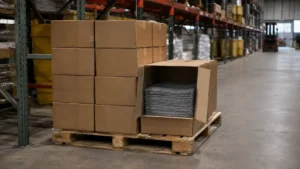
For distributors and multi-site operators, consistency is what keeps a range performing across a full order. Reliable GSM, clean meltblown fiber, low lint, and dependable grade treatment batch to batch are the specs to confirm, because inconsistent quality generates complaints no matter how low the unit price. Buy on tested performance, not price alone.
As a Shenzhen-based manufacturer, AbsorbentX produces the full range of industrial absorbents — pads, rolls, socks, booms, pillows, and spill kits — in oil-only, universal, and chemical grades, with private-label and OEM options for bulk orders. Matching product and grade to your customers’ real operations is what drives repeat business. Browse the range on our absorbent pads collection, or read how to choose an oil absorbent pads supplier before ordering at volume.
The Bottom Line
Industrial absorbents are a system, not a single product. Pads and rolls handle everyday spills, socks and booms contain larger or on-water events, and pillows and granular absorbents cover the special cases — all in oil-only, universal, or chemical grades matched to the liquid.
Choose by liquid, spill size, and location, back it up with prevention and housekeeping, and buy on consistency rather than price alone. Do that, and whatever the spill, your facility already has the right industrial absorbent within reach.
If you are building a programme from scratch, start by identifying your highest-risk liquid and point, then work outward from there. A well-chosen core range covers the vast majority of real-world spills, and it scales cleanly as the operation grows. The goal is simply to have the right grade and format ready before you need it, not after.
Frequently Asked Questions
What are industrial absorbents?
Sorbent products used across industry to soak up oils, chemicals, coolants, and water. Most are meltblown polypropylene and come as pads, rolls, socks, booms, pillows, and granular, in oil-only, universal, and chemical grades.
What are the main types of industrial absorbents?
Pads and rolls for everyday spills, socks and booms for containment and on-water use, pillows for concentrated drips, and granular absorbents for rough or uneven ground.
What is the difference between the absorbent grades?
Oil-only (white) repels water and absorbs only oil; universal (gray) absorbs both oil and water-based fluids; chemical (yellow) withstands aggressive acids, caustics, and solvents. The colour code matches grade to spill.
How do I choose the right industrial absorbent?
Match three things: the liquid (which sets the grade), the spill size (pads for small, booms/socks for large), and the location (pads indoors, booms on water, granular on rough ground). Then pick the weight to suit the volume.
Which industries use industrial absorbents?
Automotive and machine shops, manufacturing, marine and ports, oil and fuel storage, warehousing and logistics, and labs and chemical plants — each using the grade and format suited to their particular liquids and settings.