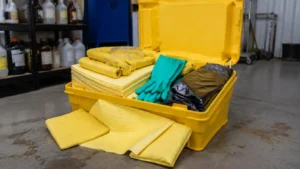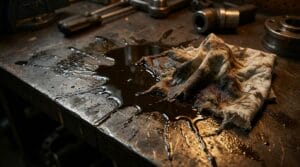
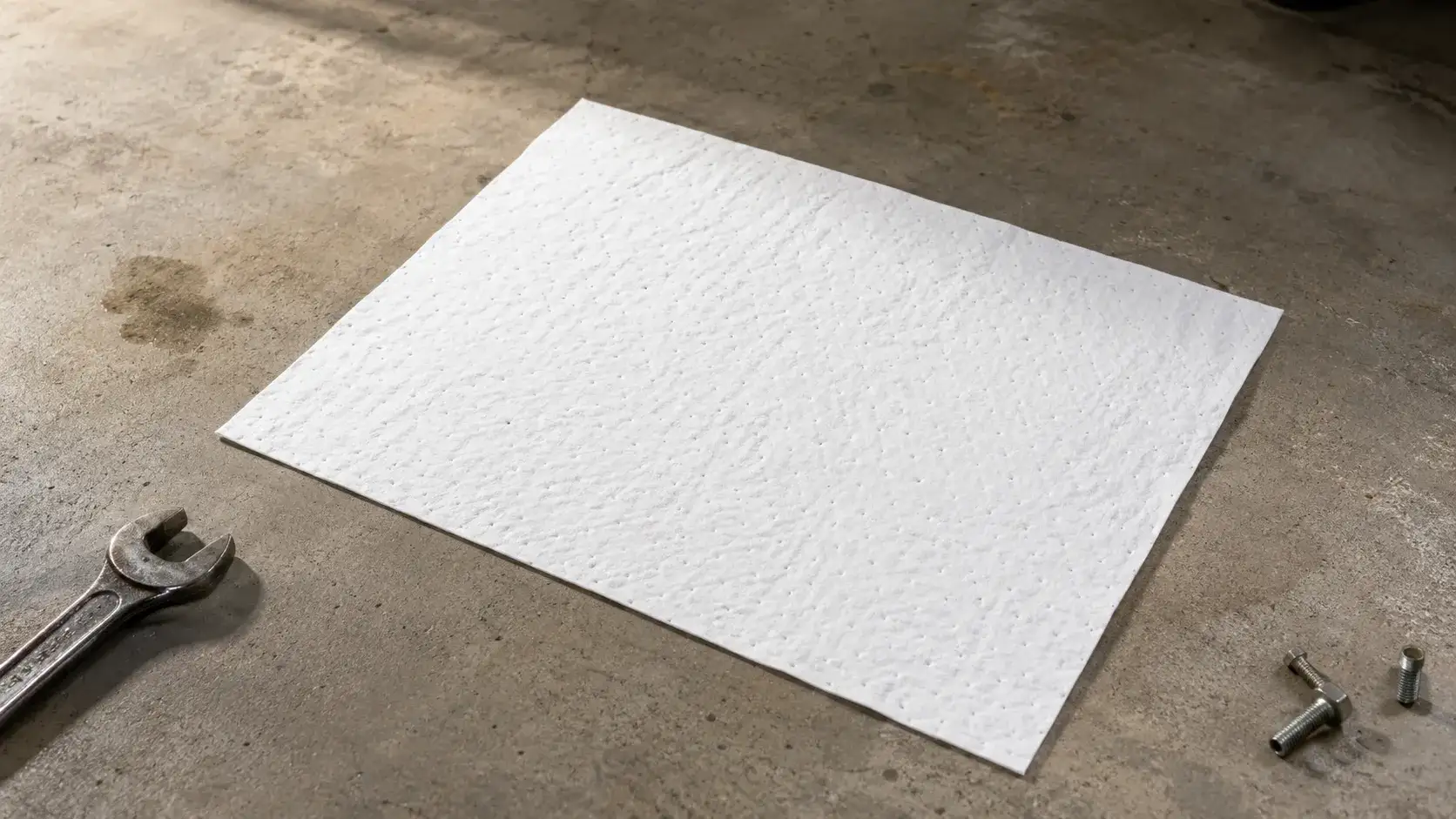
Oil absorbent pads are made of meltblown polypropylene, a thermoplastic polymer spun into fine, randomly layered fibers. Polypropylene is the dominant material because it is both hydrophobic (repels water) and oleophilic (attracts oil), so the pad pulls in oil, fuel, and other hydrocarbons while pushing water away. A small share of pads use natural fibers such as cotton, wool, cellulose, or peat, but for industrial spill control, polypropylene is the standard.
That single property – oil-loving, water-hating – is what makes these pads work on wet floors, in the rain, and even floating on water, where a cotton rag would soak up everything and sink. The rest of this guide breaks down the exact materials, how the pads are manufactured, how construction and GSM change performance, and how to read pad material like a buyer rather than a guesser.
Why Polypropylene Became the Standard Material
Before synthetic sorbents, spills were handled with sawdust, clay granules, sand, and rags. They worked, but they soaked up water along with oil, were heavy to handle, created dusty or messy residue, and added a lot of weight to disposal. Meltblown polypropylene changed that by absorbing oil selectively, holding far more per kilogram, and staying clean to handle.
The material won out for a few concrete reasons:
- Hydrophobic: repels water, so pads keep absorbing oil on wet surfaces and on water.
- Oleophilic: chemically attracts hydrocarbons – oil, diesel, hydraulic fluid, lubricants.
- High surface area: meltblown fibers are micro-thin, creating huge internal area to trap oil – pads hold up to ~15-25x their own weight in oil.
- Chemically stable and inert: does not break down on contact with most oils and many chemicals.
- Lightweight and low-lint when bonded: easy to handle, fewer fibers left behind.
Polypropylene is also one of the most widely produced plastics in the world, which keeps the raw material affordable and consistent. For a technical overview of the polymer and its properties, see the Encyclopaedia Britannica entry on polypropylene.
Polypropylene vs. Natural Fiber Absorbents
Not all pads use the same base material. Synthetic and natural absorbents behave very differently, and the right choice depends on the spill and the setting:
| Factor | Meltblown Polypropylene | Natural Fiber (cotton/cellulose/peat) |
| Water resistance | Repels water (oil-only grades) | Absorbs water too |
| Oil capacity | High (~15-25x weight) | Lower, inconsistent |
| Best for | Industrial, marine, on-water spills | Light, eco-focused cleanups |
| Chemical resistance | Good | Limited |
| Eco profile | Synthetic, disposable | More biodegradable |
| Cost-in-use | Low (high capacity) | Higher (more material needed) |
For most workshops, factories, marine operators, and distributors, polypropylene wins on capacity, water resistance, and cost-per-spill. Natural-fiber pads have a place where biodegradability is the priority and spills are small and oil-only.
The Fibers Inside: Fine vs. Coarse Layers
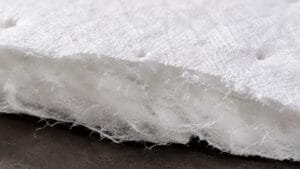
“Meltblown polypropylene” is not a single fabric. Quality pads combine two fiber types, which is why some pads wick faster and hold more than others at the same weight:
- Fine fibers: ultra-thin, tissue-like, with enormous surface area. They wick fast and grab the last film of oil off a surface.
- Coarse fibers: thicker, lofty, and bulky. They form the core that stores the volume of absorbed oil.
A well-built pad sandwiches a fine-fiber surface over a coarse-fiber core (fine / coarse / fine). The surface grabs oil quickly while the core holds it, giving both speed and capacity. Cheaper single-grade pads skip this and either wick slowly or saturate fast.
How Oil Absorbent Pads Are Made (Manufacturing Process)
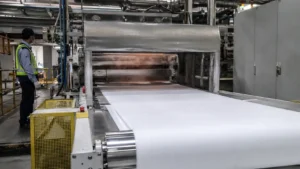
Understanding the process explains why quality varies between suppliers. Meltblown production runs in three main stages:
- Extrusion: Polypropylene resin is melted and forced through a fine die. High-velocity hot air blows the molten polymer into ultra-fine fibers that land randomly on a moving belt, forming a lofty non-woven web.
- Bonding: The web is thermally bonded (heat and pressure) to lock loose fibers in place. This controls strength, lint, and how well the pad holds its shape when saturated. Some pads are sonically (ultrasonically) bonded for a low-lint, high-strength finish.
- Finishing: Sheets are dimpled, perforated (so crews can tear pads to size), cut to standard sizes such as 40 x 50 cm, and packed. Multi-layer pads bond a fine-fiber surface to a coarse-fiber core for faster wicking and higher capacity.
For universal (gray) pads that must also absorb water, a surfactant is added to the polypropylene. The surfactant lowers the surface tension of water so the normally water-repelling fiber can take up water-based liquids and coolants as well as oil. This single additive is the difference between an oil-only pad and a universal one.
Construction Types of Oil Absorbent Pads
The same polypropylene can be built into several constructions, each tuned to a different job:
| Construction | How It Is Made | Best Use |
| Bonded | Single meltblown layer fused by heat/pressure | Low-lint, durable, general use |
| Meltblown (basic) | Single lofty fiber web | Fast, economical absorption |
| Laminated / multi-layer | 2+ meltblown layers bonded together | Highest capacity, heavy spills |
| Fine fiber | Very thin fibers, tissue-like surface | Rapid wicking, polishing wipe-down |
| Dimpled and perforated | Embossed plus tear lines | Less waste, tear-to-size use |
Oil-Only vs. Universal vs. Chemical: Material Differences
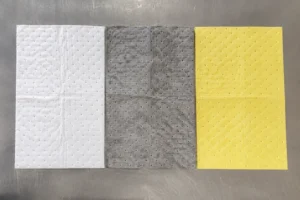
The base fiber is similar, but additives and treatment change what each color-coded pad can handle. The color code is an industry convention so crews can grab the right pad fast:
| Type | Color | Material Note | Absorbs |
| Oil-Only | White | Untreated hydrophobic PP | Oil, fuel, hydrocarbons (repels water) |
| Universal | Gray | PP + surfactant | Oil, water, coolants, mild chemicals |
| Chemical | Yellow | Chemically resistant PP | Acids, bases, aggressive solvents |
This is why the question does not have one answer – the polymer is the same family, but the treatment defines the job. See the full breakdown in our oil absorbent pads guide .
How Material Affects Performance: GSM and Absorbency
Material weight is measured in GSM (grams per square meter). Heavier GSM means more fiber, more capacity, and more durability:
- Light pads: ~200 GSM – wipe-downs, drips, daily housekeeping.
- Medium pads: ~300-350 GSM – everyday workshop and production spills.
- Heavy / heavy-duty: ~400-500 GSM – large leaks, marine recovery, high-volume spills.
Across the range, a well-made polypropylene pad absorbs roughly 15-25 times its own weight in oil. Cheaper pads with poor bonding shed lint, lose shape when saturated, and force you to use more pads per cleanup – which raises real cost even when the unit price looks low. When you compare suppliers, compare absorbency per pad and lint behaviour, not just the price per case.
Material Quality: What Separates a Good Pad From a Cheap One
Two pads can both be “100% polypropylene” and perform very differently. The material signals worth checking:
- Consistent GSM: a heavier, even fiber mat holds more and tears predictably.
- Low lint: properly bonded or sonic-bonded pads do not shed fibers into the spill.
- Wet strength: a quality pad keeps its shape fully saturated; a poor one falls apart.
- Fine + coarse layering: the fine-over-coarse build wicks fast and stores more.
- Clean, uniform perforation: tears cleanly to size, cutting waste.
For bulk buyers and private-label brands, these are the specs to confirm before committing to an order. Our supplier selection guide and OEM pad guide cover how to vet a manufacturer on exactly these points.
Where the Material Gets Used: Industry Examples
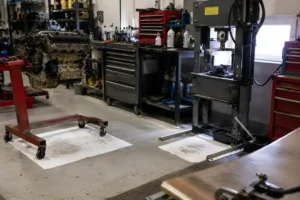
Because the material is oil-selective and water-repelling, the same polypropylene pad solves problems across very different settings:
- Automotive and machine shops: catch oil and coolant drips under engines and machinery.
- Manufacturing and production lines: keep floors clear of lubricant and hydraulic fluid.
- Marine and ports: float on water to recover fuel and oil sheens.
- Oil and fuel storage: contain leaks at tanks, drums, and transfer points without soaking up rainwater.
- Warehousing and logistics: line shelving and spill stations for unexpected leaks.
How to Choose a Pad Based on Its Material
- Spill on or near water / outdoors: choose oil-only white polypropylene (repels water, floats).
- Mixed oil + water + coolant: choose universal gray (surfactant-treated).
- Acids, bases, solvents: choose chemical yellow (resistant PP).
- High-volume or heavy leaks: choose higher GSM, laminated/multi-layer construction.
Match the material to the spill first, then the GSM to the volume. Getting those two right is most of the decision.
Sustainability: Is the Material Recyclable?
Polypropylene itself is recyclable, but once a pad is saturated with oil or chemicals, contamination usually rules out conventional recycling. In practice, the material is managed in a few ways: clean offcuts can be reprocessed, some oil-only pads are wrung and reused or sent for energy recovery, and a growing number of suppliers offer pads made with recycled polypropylene content to reduce footprint. If sustainability is a priority for your buyers, ask suppliers about recycled-content options and end-of-life programs.
Disposal and Environmental Considerations
Because polypropylene is a synthetic plastic, used oil-soaked pads are generally treated as oily or hazardous waste. Disposal depends on what they absorbed and local rules – saturated oil-only pads can sometimes be wrung or sent for energy recovery, while pads holding hazardous chemicals must follow regulated disposal. In the United States, review the EPA guidance on managing used oil before disposing of saturated pads, and always confirm requirements with your local authority.
For a practical routine, see our companion post how to dispose of oil absorbent pad.
The Bottom Line
Oil absorbent pads are made of meltblown polypropylene – engineered to grab oil and reject water – with construction, fiber layering, GSM, and additives all tuned to the job. The material is the same family across oil-only, universal, and chemical pads; the treatment and build are what set them apart. As a direct manufacturer, AbsorbentX produces all three types in multiple GSM grades and custom or private-label specs, so buyers can match material to their exact spill type and volume. Browse the full range on our oil absorbent pads category.
FAQ
What material are oil absorbent pads made of?
Most are made of meltblown polypropylene, a hydrophobic, oleophilic plastic that absorbs oil while repelling water. Some lower-grade pads use natural fibers like cotton or cellulose.
Why is polypropylene used instead of cotton?
Polypropylene repels water and attracts oil, holds 15-25x its weight, and stays effective on wet or floating surfaces – cotton absorbs everything and saturates quickly.
Do oil absorbent pads absorb water?
Oil-only (white) pads repel water. Universal (gray) pads are treated with a surfactant so they absorb both oil and water.
What does GSM mean on an absorbent pad?
GSM is grams per square meter – the fiber weight. Higher GSM (400-500) means more capacity and durability; lighter GSM (200) suits drips and wipe-downs.
Are oil absorbent pads recyclable or biodegradable?
Polypropylene pads are synthetic and not biodegradable; they are usually disposed of as oily/hazardous waste. Natural-fiber pads are more biodegradable but less effective.
What is the difference between bonded and laminated pads?
Bonded pads are a single meltblown layer fused for low lint and durability. Laminated pads bond multiple layers together for higher capacity on heavy spills.
How much oil can one pad absorb?
A quality polypropylene pad absorbs roughly 15-25 times its own weight in oil, depending on its GSM grade and construction.