
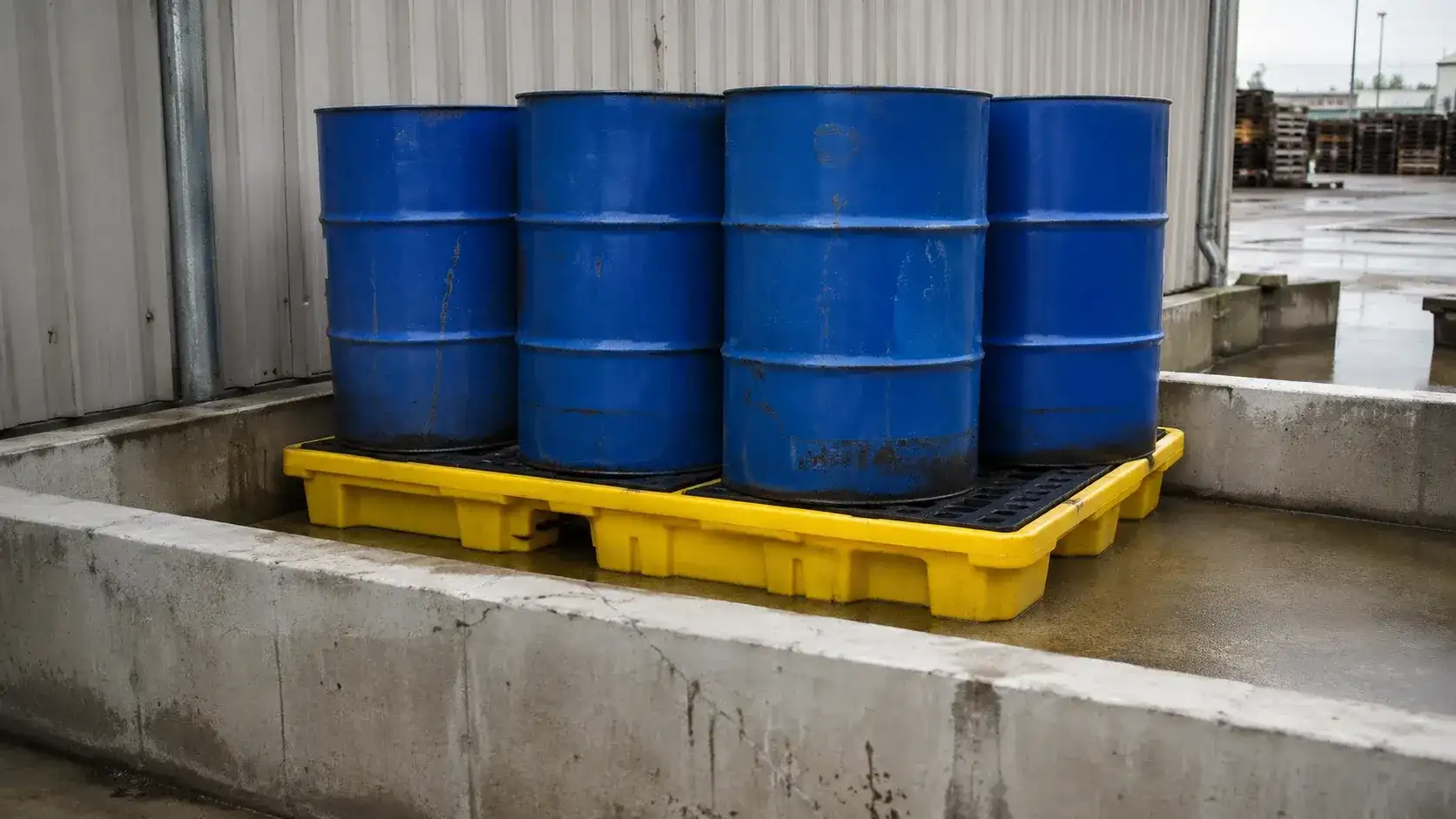
Secondary containment is the backup that catches a leak when the container holding a liquid fails. A drum is the primary container; the bund, tray, or pallet underneath it is the secondary containment. The whole idea rests on a simple assumption — that containers eventually fail — and on the judgement that catching the contents is far cheaper than cleaning up after them.
For most facilities this is not optional. Storing oil or chemicals above certain quantities brings regulatory requirements for containment capacity, construction, and inspection, and the penalties for a discharge that reaches drainage or a watercourse are considerably larger than the cost of a bund.
This guide covers what secondary containment means in practice, when it is required, how capacity is calculated, the main system types and where each suits, and the maintenance failures that quietly render existing containment useless. It is written for anyone storing drums, IBCs, or tanks rather than for compliance specialists.
What Secondary Containment Actually Means
Secondary containment is any system designed to capture liquid escaping from its primary container long enough for someone to deal with it. It is a physical barrier — a wall, a tray, an impermeable floor, or a second skin around the tank — rather than a procedure or a response plan.
The defining requirement is that it must actually hold the liquid. A containment system built from material the stored substance dissolves, or a bund with a cracked floor and an open drain valve, provides the appearance of containment without the function, and that distinction is where most real-world failures sit.
It also has to keep the primary container out of the captured liquid. A drum sitting in a pool of its own leaked contents corrodes faster and the situation deteriorates, which is why proper containment pallets hold drums on a grid above the sump rather than flat on the base.
Why Secondary Containment Matters
The environmental case is the obvious one. A leaking drum on bare yard concrete will reach a surface-water drain within minutes, and once oil or chemical enters a drainage system it becomes a reportable pollution incident with remediation costs, agency involvement, and potential prosecution attached.
The financial case is usually more persuasive internally. Containment costs are small, predictable, and one-off, while a discharge brings clean-up contractors, possible soil or groundwater investigation, lost production, and insurance consequences. Very few site investments have such an asymmetric payoff.
There is a safety dimension too. Contained leaks stay in one place instead of spreading across a floor where they become a slip hazard, a fire risk with flammable liquids, or a source of vapour in an occupied area. Containment buys the time needed to respond calmly rather than urgently.
When Secondary Containment Is Required
For oil storage in the United States, the main trigger is the EPA’s Spill Prevention, Control, and Countermeasure rule under 40 CFR 112. Its oil spill prevention regulations apply to facilities that could discharge oil into navigable waters and that exceed a total aboveground storage capacity of 1,320 gallons, or a buried capacity of 42,000 gallons.
The aggregate nature of that threshold catches people out. It counts total capacity across the site rather than any single container, and it counts container capacity rather than how much is currently in them, so a yard holding a scattering of part-empty drums and a small tank can cross the line without anyone noticing.
Flammable liquids bring a separate set of requirements. The OSHA standard on flammable liquids (29 CFR 1910.106) addresses storage area drainage and containment for fuels and solvents, and local fire codes frequently impose stricter conditions than the federal baseline.
Below any regulatory threshold, containment remains good practice rather than a legal duty. A single drum of hydraulic oil in a workshop does not trigger SPCC, but it will still ruin a floor and reach a drain if it splits, and a drip tray costs very little.
How Containment Capacity Is Sized
The general rule for a single container is that containment must hold the full volume of the largest container within it, not the combined volume of everything stored. The logic is that simultaneous failure of every container is not a credible scenario, whereas failure of one is.
Outdoor containment needs freeboard on top of that — additional capacity to hold rainfall without displacing the contained liquid over the wall. The EPA recommends allowing for a 25-year, 24-hour storm event, which in practice means sizing meaningfully above the bare container volume rather than to the exact litre.
A worked example makes it concrete. A bund holding four 205-litre drums must contain at least 205 litres, not 820, plus freeboard if it is outdoors and open to the sky. Multiple-container bunds serving bulk tanks are often specified at 110 percent of the largest tank as a practical working figure.
The critical operational point is that rainwater fills containment continuously, and a bund brim-full of rainwater has no remaining capacity for a spill. Managing accumulated water is not housekeeping — it is what keeps the containment functional.
Types of Secondary Containment
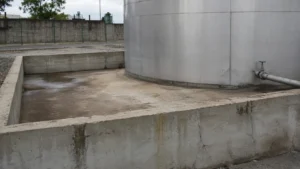
Bunds and dikes are the permanent option for bulk storage — concrete or earthen walls surrounding tanks, sized to the largest tank plus freeboard. They are durable and high-capacity, but they are civil works, expensive to retrofit, and they fail quietly through cracked floors, degraded joint sealant, and drain valves left open.
Spill containment pallets and drum decks are the standard answer for drums and IBCs. Moulded polyethylene units with a sump beneath a removable grid, they are inexpensive, need no construction work, and can be repositioned as storage changes, which makes them the practical default for most workshop and warehouse storage.
Drip trays and small bunded shelves handle point sources — a decanting station, a leaking pump, a machine with a known drip. Portable berms, usually a flexible liner with a raised edge, cover temporary needs such as vehicle maintenance in the field or short-term drum storage during a project.
Double-walled tanks build containment into the vessel itself, with an interstitial space between the inner and outer skin, often monitored for leaks. They avoid the footprint and rainwater problems of an open bund entirely, at higher initial cost, and they suit permanent installations where space is constrained.
Choosing the Right System for Your Storage
Match the system to how the storage actually behaves rather than to the largest thing on site. Drums and IBCs that move around suit pallets and decks, because containment can move with them. Fixed bulk tanks justify a permanent bund or a double-walled vessel, since neither the tank nor the risk is going anywhere.
Consider material compatibility explicitly. Polyethylene units handle most oils, fuels, and many chemicals well, but strong oxidisers and certain solvents need steel or specific polymer grades, and a containment unit degraded by its own contents is worse than none because it creates false confidence.
Indoor and outdoor placement changes the calculation substantially. Indoor containment needs no freeboard for rain and can be sized tightly, while anything outdoors and uncovered needs either extra capacity or a cover, and covering the storage is frequently cheaper than oversizing the containment.
Our application guidance on drum and tank storage and oil and fuel storage covers how containment and absorbent placement work together in each setting.
Where Absorbents Fit — and Where They Do Not
Absorbents are not secondary containment and should never be presented as a substitute for it. A pad under a drum does not hold 205 litres, and no regulator will accept a stack of absorbents in place of a required bund. Being clear about that distinction matters more than any product recommendation.
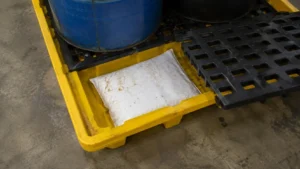
What absorbents do is complete the system. Absorbent pads or pillows placed inside a containment sump capture small leaks before they pool, making routine clean-out a matter of lifting a pad rather than pumping out a contaminated puddle, and giving a clear visual indicator that something upstream is leaking.
They also handle what containment misses. Socks around the outside of a storage area, drain protection at nearby gullies, and a stocked spill kit deal with splashes during decanting, overfills at the top of a tank, and the transfer operations that happen outside the bund entirely.
Pillows suit containment sumps because they hold volume in a small footprint — see the absorbent pillows range — while the absorbent socks range and absorbent booms range handle perimeter containment and drain protection around the storage area.
Common Secondary Containment Mistakes
The most frequent failure is an open drain valve. Bunds are often fitted with a valve so rainwater can be released, and once it is left open — usually after a routine drain-down — the bund is decorative. The valve should be locked closed and opened deliberately, never left open as the default state.
The second is capacity lost to rainwater and clutter. A bund half full of standing water, or used to store empty drums, pallets, and equipment, has lost the volume it was built to provide. Containment areas are not storage space, and treating them as such quietly removes the protection.
Deterioration is the slow one. Concrete cracks, joint sealant perishes, polyethylene goes brittle under UV, and liners tear, all without any obvious moment of failure. A bund that passed inspection five years ago may hold nothing today, and nobody will know until it is tested by an actual spill.
Finally, the overfill blind spot. Containment catches leaks from a container, not liquid sprayed from a hose disconnection or poured past the top of a tank during filling. Transfer operations need their own controls — drip trays, automatic shut-offs, and an attended filling procedure.
Inspection and Maintenance
Containment needs a routine visual check rather than an annual formality. Walk the area looking for standing liquid, cracks in the floor and walls, the position of the drain valve, corrosion at the base of containers, and anything stored inside the bund that should not be there.
Remove accumulated rainwater promptly, and inspect it before release rather than draining automatically. Water sitting in a containment area around oil drums may carry a hydrocarbon film, and releasing it to a surface-water drain turns a working containment system into the source of a pollution incident.
Keep a simple record of checks, repairs, and drain-down events. Beyond satisfying an inspector, the log is what reveals a slow leak — three drain-downs showing an oily sheen in a month points at a container problem long before it becomes a visible failure.
Our guide on how to control oil leaks in industrial facilities covers the inspection habits that catch container problems early, and the maintenance absorbents guide deals with the routine drips that containment is there to catch.
The Bottom Line
Secondary containment is the assumption that containers fail, built into your site as physical hardware. Size it to the largest container plus freeboard for rainfall if it is outdoors, choose a system matched to how the storage actually behaves, and check the material is compatible with what you store.
Keep it functional rather than merely present. A locked drain valve, an empty sump, and an uncluttered bund are what separate working containment from the appearance of it, and those are maintenance habits rather than capital costs.
Use absorbents to complete the system, not to replace it — pillows in the sump, socks at the perimeter, and a stocked kit for transfer operations. Our oil spill kits guide covers how to size that kit, and the oil spill guide sets containment in the context of wider spill response.
Frequently Asked Questions
What is secondary containment?
A physical system — a bund, tray, pallet, or double-walled vessel — designed to capture liquid escaping from its primary container. The container holding the liquid is primary containment; whatever catches a leak from it is secondary. It must be impermeable to the stored substance and keep the container out of any captured liquid.
How much capacity does secondary containment need?
Generally the full volume of the largest single container within it, not the combined total of everything stored. Outdoor containment also needs freeboard for rainfall, and the EPA recommends allowing for a 25-year, 24-hour storm. A bund holding four 205-litre drums needs at least 205 litres plus freeboard.
When is secondary containment legally required?
For oil storage in the US, the EPA SPCC rule under 40 CFR 112 applies to facilities that could discharge oil to navigable waters and exceed 1,320 gallons total aboveground capacity, or 42,000 gallons buried. The threshold is aggregate across the site and based on container capacity, not current contents.
Do absorbent pads count as secondary containment?
No. Absorbents are a backstop layer, not containment, and no regulator will accept them in place of a required bund. They belong inside a containment sump to catch small leaks and around the perimeter to handle splashes and transfer spills, complementing containment rather than substituting for it.
What is the difference between a bund and a spill containment pallet?
A bund is permanent civil construction — a concrete or earthen wall around bulk tanks, high capacity but expensive to retrofit. A containment pallet is a moulded polyethylene unit with a sump beneath a removable grid, suited to drums and IBCs, inexpensive and repositionable as storage changes.
Why does rainwater matter in secondary containment?
Because a bund full of rainwater has no capacity left for a spill. Outdoor containment fills continuously, so accumulated water must be removed to keep the system functional — and inspected before release, since water around oil drums often carries a hydrocarbon film that must not reach a surface-water drain.