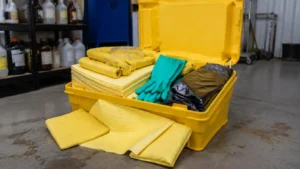
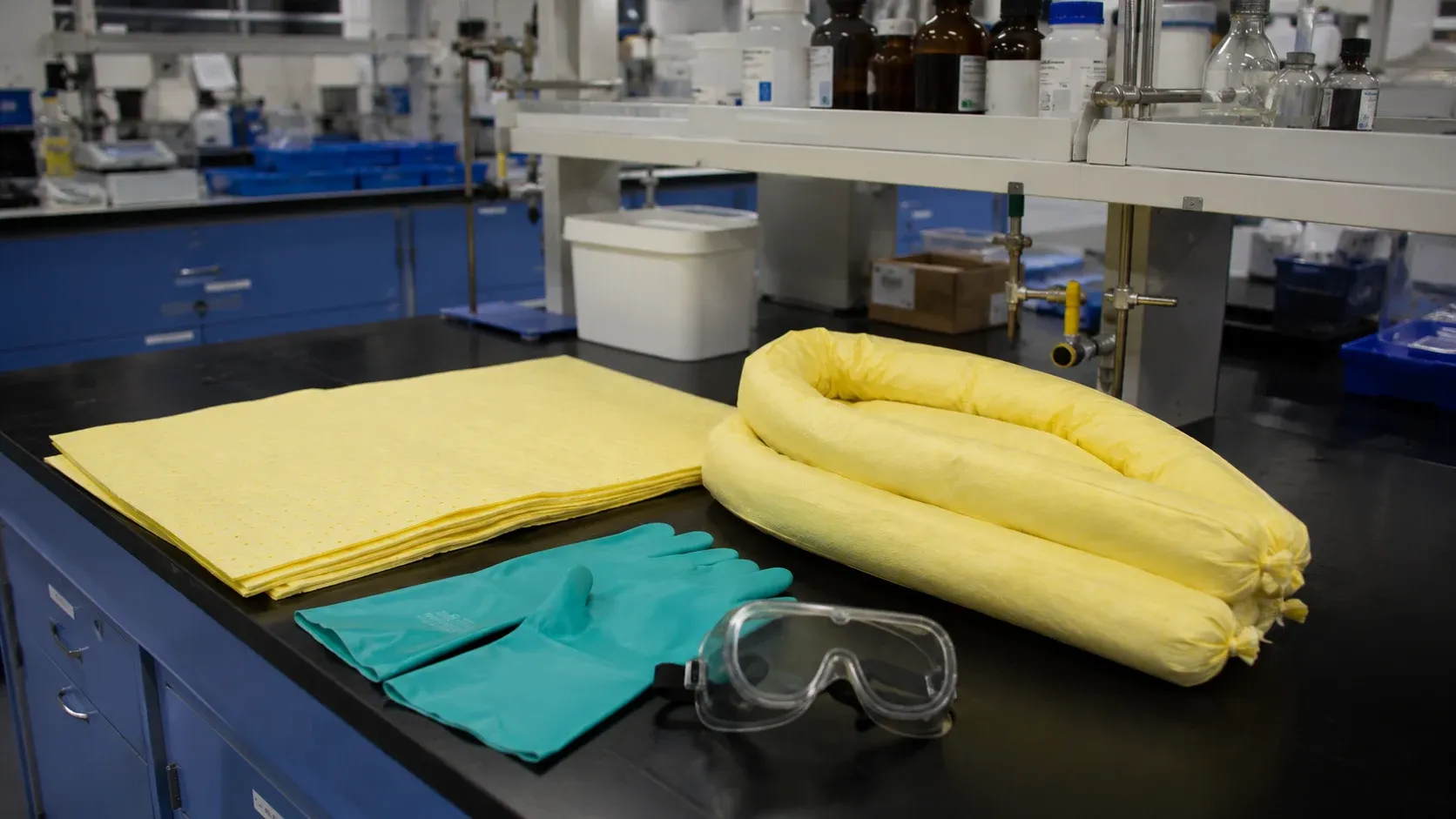
Chemical absorbents are the specialised, chemically resistant members of the sorbent family, built to safely soak up the aggressive liquids that would degrade an ordinary absorbent. Their yellow colour marks them out as hazmat-grade, for acids, caustics, and reactive chemicals that oil-only and universal products cannot handle. Understanding the types, their uses, and their limits is essential to using them safely.
This guide explains what chemical absorbents are, the main types available, what they safely handle, and the honest limits every user should know. Whether you run a lab, a chemical store, or a transfer area, the same principles apply. By the end you will know when a chemical absorbent is the right tool and when a spill is beyond it.
What Are Chemical Absorbents?
Chemical absorbents are sorbent products engineered to withstand and soak up aggressive chemicals without degrading or reacting dangerously. They follow the industry colour code by being yellow, which distinguishes them from white oil-only and gray universal products so responders can identify them instantly during a stressful incident. The material is chosen for chemical resistance rather than simple absorbency, which is the key difference from an everyday pad. A general-purpose sorbent might soak up a chemical at first but then break down, releasing what it captured and creating a worse hazard than before.
The defining trait is durability under attack. Where universal sorbents would swell, break down, or react when they meet a strong acid or caustic, chemical absorbents hold up long enough to absorb and contain the spill. That resistance is why they belong wherever hazardous chemistry is handled, and why they cannot be substituted with a cheaper general-purpose pad.
For a wider view of how chemical grade fits alongside oil-only and universal, see our oil absorbents guide. This article focuses on the chemical grade in detail.
Types of Chemical Absorbents
There are two broad approaches to chemical absorbents, and knowing the difference matters. The most common are chemically resistant sorbents — yellow pads, socks, and pillows made from materials that physically absorb and hold aggressive liquids without breaking down. These simply contain and soak up the spill for disposal, just as other sorbents do with oil or water, but without breaking down on contact with the chemical.
The second type are neutralising absorbents, which chemically react with a spill to render it safer as they absorb it. Acid and caustic neutralisers, for example, often change colour to signal when a spill has been neutralised, which helps a responder judge when it is safe to clean up. These are valuable for specific known chemistries where a matched neutraliser exists and staff are trained to use it.
There is an important safety point in that difference. A chemically resistant sorbent contains the spill unchanged, so the recovered liquid is still hazardous and must be handled as such, whereas a neutraliser aims to make the chemistry safer before disposal. Neither is universally better; the right choice depends on the specific chemical and on whether a matched neutraliser exists for it.
Most facilities rely on chemically resistant sorbents for general chemical spills and add neutralisers where they routinely handle a specific acid or base. Matching the type to your chemistry is part of building a safe response.
What Do Chemical Absorbents Handle?
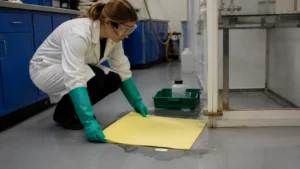
Chemically resistant absorbents are made to safely soak up aggressive fluids that ordinary sorbents cannot, including strong acids, caustics and bases, aggressive solvents, and many reactive or unknown chemical spills. They belong anywhere chemicals are mixed, stored, or transferred, from laboratories to production and chemical-handling areas, and near tanks, drums, and pumps that hold hazardous liquids. In each of those settings, the right chemical absorbent is a basic part of being prepared.
Because these products deal with dangerous chemistry, they are as much a safety tool as a cleanup one. The sorbent contains and absorbs the spill while the responder’s PPE provides protection, and the disposal materials ensure the waste is sealed for regulated handling. Every part of the response is chosen with the hazard in mind, from the sorbent material to the glove and the disposal bag.
It also helps to plan for the specific chemicals your site holds rather than buying a generic product. Two facilities can both need a “chemical absorbent” yet require different materials and gloves depending on whether they handle acids, solvents, or oxidisers. Matching the product to your actual chemical inventory, guided by safety data sheets, is what makes it genuinely protective rather than compliant only on paper.
That said, “chemical grade” does not mean “handles anything.” The limits section below explains the spills that even a chemical absorbent should not be used on without specialist support.
The Limits: What Chemical Absorbents Cannot Do
A chemical absorbent is powerful within its range, but it is not a licence to tackle any spill. It is designed for small, manageable chemical spills that a trained responder can safely contain, not for large releases, highly toxic or reactive substances, or spills that give off dangerous vapours. Those situations call for evacuation and specialist emergency response.
The material must also match the chemistry. A sorbent that resists one acid may not resist a strong oxidiser or a particular solvent, so you cannot assume a single “chemical” product handles every chemical. Identifying the substance and checking its safety data sheet is essential before choosing an absorbent and gloves.
The safe rule is to treat chemical absorbents as a trained-responder, first-response tool within clear limits. When a spill is large, unknown, unstable, or beyond your training, secure the area and call for help rather than reaching for a pad.
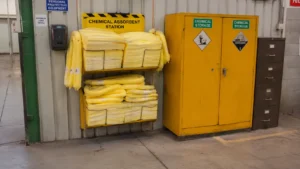
Chemical Absorbent Formats
Chemical absorbents come in the same range of formats as other grades, each suited to a different job. Yellow pads handle the bulk of a spill, yellow socks contain and isolate it, and yellow pillows soak up deep puddles and sit around leaking containers. Larger needs are met with rolls for wide coverage.
The table below summarises the formats and where each fits. As with any spill, containment comes first with socks, then absorption with pads and pillows.
| Format | Form | Best for |
| Pads | Flat sheets | Absorbing the bulk of a chemical spill |
| Rolls | Continuous sheeting | Wide-area coverage and lining surfaces |
| Socks | Flexible tubes | Containing and isolating a spill, ringing drains |
| Pillows | Filled cushions | Deep puddles and around leaking containers |
| Neutralisers | Granular / powder | Reacting with and rendering a known acid or base safer |
How to Choose and Use Chemical Absorbents
Selection begins with identifying the chemical and confirming the sorbent and gloves are rated to resist it, guided by the safety data sheet. Choose chemically resistant sorbents for general chemical spills, and a neutraliser only where you routinely handle a specific acid or base and want the added safety of a reaction-based product.
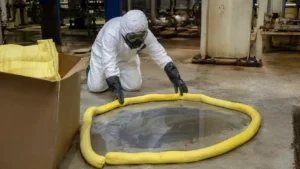
In use, safety comes before speed. Put on the matched PPE, contain the spill with socks working from the outside in so it cannot reach drains, then absorb it with pads and pillows. Never mix incompatible chemicals in one container, as this can create heat, gas, or a reaction, and keep others clear of the area throughout.
Only proceed at all if the spill is within your training and the absorbent’s limits. If it is not, secure the area and call for specialist help rather than attempting the cleanup yourself. There is no shame in stopping; the responder who recognises a spill is beyond them prevents a far worse outcome.
Disposal of Used Chemical Absorbents
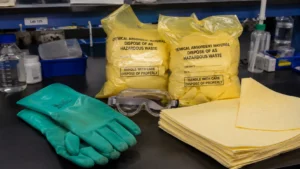
Disposal of chemical absorbents is strictly regulated because the waste is hazardous. Seal the used sorbents and PPE in labelled disposal bags, keep them separate from other waste streams, and route them through a licensed hazardous-waste process rather than general waste. The specific chemical determines the exact requirements.
Never assume a chemical waste is safe to bin, and never mix incompatible chemical wastes in one container. Confirm the requirements for the specific substance with your waste contractor and local authority before disposal, and keep records of what was spilled and how it was handled.
Storage of the sealed waste matters too, in the short window before collection. Keep chemical-waste containers separate, clearly labelled, away from drains and incompatible materials, and closed when not in use. Treating the waste with the same care as the original chemical is what keeps the whole response compliant from spill to disposal.
Our guide on how to dispose of oil absorbent pads covers the general disposal principles, though chemical waste always follows the stricter regulated route.
Buying Chemical Absorbents in Bulk and OEM
For distributors and multi-site operators, chemical absorbent quality is a safety matter, not just a performance one. Genuinely chemical-resistant material, consistent construction, and clear grade identification are what make these products safe to rely on, and cutting corners here is a real hazard. Verify the specifications and resistance data before committing to an order.
As a Shenzhen-based manufacturer, AbsorbentX produces chemical-grade absorbents — pads, socks, pillows, and rolls — with private-label and OEM options for bulk orders and custom configurations. Building chemical response around dependable sorbents is what earns trust and repeat business. Browse the range on our absorbent pads collection, or read how to choose an oil absorbent pads supplier before ordering at volume.
The Bottom Line
Chemical absorbents are the yellow, chemically resistant grade for the aggressive spills that oil-only and universal products cannot safely handle. They come as chemically resistant sorbents for general chemical spills and neutralisers for specific known acids and bases, in the usual range of formats — pads, socks, pillows, and rolls.
Just as important, respect the limits: identify the chemical, match the material and PPE to it, stay within your training, and evacuate and call experts for large, toxic, or unknown spills. Dispose of the waste through the regulated route, and a small chemical spill stays controllable.
Above all, treat chemical absorbents as one part of a wider safety programme rather than a standalone answer. Paired with trained responders, current safety data sheets, and clear escalation procedures, they protect people and property. On their own, without that context, even the best sorbent cannot make a chemical spill safe.
Frequently Asked Questions
What are chemical absorbents?
Yellow, chemically resistant sorbents engineered to safely absorb aggressive chemicals such as acids, caustics, and reactive solvents without degrading. They are the hazmat grade, distinct from white oil-only and gray universal absorbents.
What types of chemical absorbents are there?
Two main types: chemically resistant sorbents (pads, socks, pillows) that physically absorb and hold the spill, and neutralising absorbents that chemically react with a known acid or base to render it safer, often changing colour to signal completion.
What do chemical absorbents handle?
Strong acids, caustics and bases, aggressive solvents, and many reactive or unknown chemical spills — wherever chemicals are mixed, stored, or transferred. Always match the specific sorbent to the chemistry using its safety data sheet.
What are the limits of chemical absorbents?
They are for small, manageable spills a trained responder can contain. They are not for large releases, highly toxic or reactive substances, or spills giving off dangerous vapours, which require evacuation and specialist response.
How do you dispose of used chemical absorbents?
As regulated hazardous waste. Seal used sorbents and PPE in labelled bags, keep them separate, and route them through a licensed hazardous-waste process — never general waste — confirming requirements for the specific chemical with your authority.