Once a pad has done its job and soaked up a spill, it becomes a waste-handling question — and getting it wrong can mean fines, contamination, or a failed inspection. Knowing how to dispose of oil absorbent pads correctly comes down to a few clear decisions: what the pad absorbed, whether it still holds free liquid, and which disposal route your local rules allow. This guide walks through the whole process in plain language, from classifying the waste to storing, labelling, and choosing between landfill, laundering, and energy recovery.
First, Classify the Waste: Hazardous or Not?
The single most important step is deciding whether your used pads count as hazardous waste, because that determines every rule that follows. In most cases, pads that have only absorbed common oils and lubricants — motor oil, hydraulic fluid, cooking oil — are not classified as hazardous waste. The picture changes if the pad has touched a listed hazardous material or if the absorbed substance itself carries a hazardous characteristic such as being ignitable, corrosive, reactive, or toxic. A pad soaked in a listed solvent, an acid, or a regulated chemical must be treated as hazardous and disposed of through a licensed hazardous-waste route, not the general trash.
If you are ever unsure what a pad absorbed, treat it as the more hazardous option until you can confirm otherwise. Guessing “non-hazardous” to save effort is exactly the mistake that turns a routine cleanup into a violation. Check the safety data sheet for whatever was spilled, and when in doubt, ask your waste contractor or local environmental authority.
It also helps to think about classification before the spill rather than after it. If your site regularly handles both machine oil and aggressive solvents, keeping those cleanups on separate, colour-coded pads from the start makes the disposal decision obvious later — white oil-only pads go down one route, chemical pads down another, and nothing has to be re-tested because it got mixed. Building that habit into how crews grab pads is far easier than untangling a contaminated drum after the fact, and it is the foundation everything else in this guide sits on.
The Free-Liquid Test: Is the Pad Still Dripping?
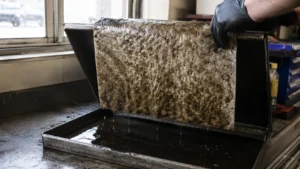
Even a non-hazardous pad usually cannot go to landfill while it still releases free liquid. The common standard is simple: there should be no visible free-flowing oil coming out of the pad. A pad that drips when lifted or squeezed still holds recoverable liquid and is not ready for disposal. The practical fix is to let the pad drain fully — hang or rack it over a drip tray so the excess oil runs off into a container for proper recovery — until no more liquid comes out. Once the pad passes this “no visible free liquid” check and is confirmed non-hazardous, landfill disposal is typically permitted, subject to your local rules.
Disposal Route 1: Landfill (Non-Hazardous Only)
For pads that are confirmed non-hazardous and hold no free liquid, general landfill disposal is often the simplest legal route. In practice this means bagging the drained pads and sending them out with regulated solid waste, where they are compacted and covered like other non-hazardous material. This route is only valid once both conditions are met — non-hazardous content and no free-flowing oil — so it should never be the default for a pad you have not checked. Some regions add their own restrictions on oily waste in landfill, which is why confirming local requirements before you bin anything is part of doing this correctly.
Landfill is the most common route precisely because it is easy, but easy is not the same as free of responsibility. If an inspector later finds oily pads dripping in a general waste bin, the fact that they were “probably non-hazardous” will not help you. The safe habit is to keep a simple record of what each batch of pads absorbed and to make the drain step non-negotiable, so that anything reaching the landfill stream has genuinely passed both tests. For low-volume shops with clean oil-only spills, this route is usually all you need; for anything heavier or mixed, one of the recovery routes below is often the better call.
Disposal Route 2: Laundering and Reuse
The route regulators generally prefer is keeping the material out of the waste stream altogether through laundering or reuse. Purpose-built reusable pads and mats can be wrung out, cleaned, and used again, and in many jurisdictions absorbents sent for professional laundering are treated as exempt from full waste-regulation oversight, which cuts both cost and paperwork. This is most practical for facilities with steady oil recovery and access to a laundering service or an in-house wring-and-dry routine. We cover this in detail in our guide on are oil absorbent pads reusable. Standard disposable pads are not good candidates for this route, since wringing tends to destroy them.
Disposal Route 3: Energy Recovery
Oil-soaked pads still hold energy, and a well-established option is sending them for energy recovery rather than landfill. In this process the recovered oil and the polypropylene itself are used as fuel — for example to help power an industrial process or a cement kiln — after water and physical contaminants are removed. Because polypropylene is a petroleum-derived plastic with a high calorific value, oil-only pads in particular burn cleanly in controlled industrial facilities. This route needs a licensed provider and is usually arranged through a waste contractor, but it turns a disposal cost into recovered energy and avoids landfill entirely.
Energy recovery is especially attractive for facilities generating a steady volume of oil-soaked pads, where the combined weight of recovered oil and plastic is enough to interest a licensed processor. It also sidesteps the free-liquid and landfill-restriction concerns that complicate the bin route, since the material is being burned under controlled conditions rather than buried. The main requirement is simply working with a properly permitted facility and documenting the handoff, so that your waste is accounted for from your dock to their furnace. For many mid-sized operations, a mix of laundering the reusable items and sending the rest for energy recovery is the cleanest overall answer.
How to Store Used Pads Before Disposal
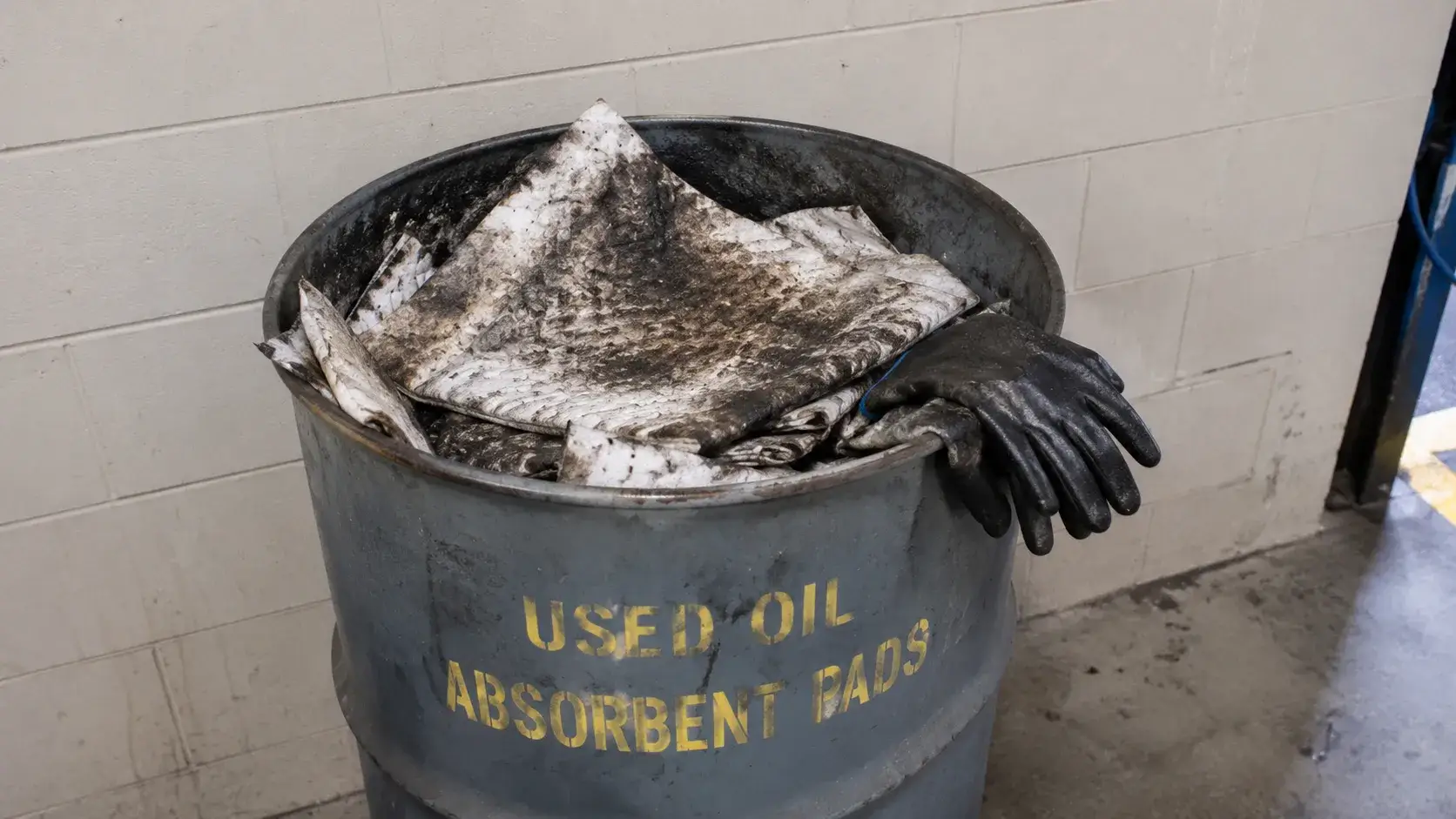
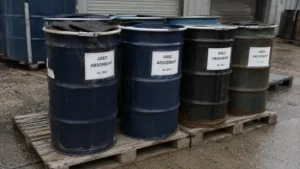
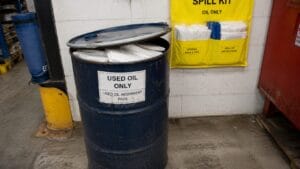
Between the spill and the pickup, how you store used pads matters as much as the final disposal. Collect saturated pads in a dedicated, covered container — a lidded steel or poly drum is standard — and keep it separate from other waste streams so nothing gets cross-contaminated. Clear labelling is essential: marking the drum with the words “used oil” or the appropriate waste description prevents a non-hazardous batch from being mixed with hazardous material and prevents mistakes at collection. Keep the container closed when not in use, store it away from drains and ignition sources, and do not let oil-only and chemical pads share a drum, because mixing waste types can force the whole container to be treated as the most hazardous item in it.
Common Disposal Mistakes to Avoid
A handful of errors account for most disposal problems. The first is binning pads that still drip free oil, which fails the landfill standard and can contaminate the waste stream. The second is assuming every pad is non-hazardous without checking what it absorbed — a single solvent-soaked pad in an otherwise clean drum can reclassify the whole load. The third is mixing pad types and waste streams in one unlabelled container, which erases the distinctions regulators rely on. The fourth is ignoring local rules and assuming the federal or national baseline is the whole story, when many regions add stricter requirements. Avoiding these four is most of what compliant disposal actually involves.
Setting Up a Repeatable Process for Facilities
For any operation that handles spills regularly, disposal should be a documented routine rather than a decision made in the moment. A workable setup has a labelled drainage and collection point, separate clearly marked drums for oil-only and chemical waste, a simple rule that pads must pass the no-free-liquid check before they leave the drainage area, and a standing arrangement with a licensed laundering or waste contractor. Training staff to recognise which pad went into which spill keeps the classification honest. Built once, this process removes guesswork, keeps you inspection-ready, and usually lowers cost by steering recoverable material toward laundering or energy recovery instead of straight to landfill.
Choosing Pads That Are Easier to Dispose Of
Disposal is easier when the pad itself is well made. High-quality, properly bonded pads hold their oil without dripping and keep their shape when saturated, so they drain cleanly and do not shed contaminated lint into the waste stream. Consistent GSM means predictable capacity, so crews use the right number of pads and generate less waste per spill. As a Shenzhen-based manufacturer, AbsorbentX produces oil-only, universal, and chemical pads in multiple GSM grades, with private-label and OEM options for bulk buyers who want dependable, easy-to-manage absorbents. Browse the range on our oil absorbent pads collection, or see how to choose an oil absorbent pads supplier before ordering at volume. For the science of what you are handling, see what oil absorbent pads are made of.
The Bottom Line
Disposing of oil absorbent pads correctly is a short chain of decisions: classify the waste as hazardous or not, drain it until no free liquid remains, then send it to landfill, laundering, or energy recovery according to your local rules, storing and labelling it properly in between. Non-hazardous, well-drained oil-only pads are usually straightforward, while anything touched by chemicals needs the regulated route. Set it up as a routine, keep waste streams separated and labelled, and always confirm the requirements in your own region before the truck arrives. Handled that way, disposal stops being a risk and becomes just another predictable, low-cost step in your spill-response process.
Frequently Asked Questions
How do you dispose of used oil absorbent pads?
Classify them first: pads holding only common oils are usually non-hazardous, drain them until no free liquid remains, then dispose via landfill, laundering/reuse, or energy recovery according to your local rules. Pads touched by chemicals must go through a licensed hazardous-waste route.
Are oil-soaked absorbent pads considered hazardous waste?
Not usually — pads with common oils and grease are generally non-hazardous. They become hazardous if they contact a listed hazardous material or if the absorbed substance is ignitable, corrosive, reactive, or toxic.
Can you throw oil absorbent pads in the trash?
Only if they are confirmed non-hazardous and hold no visible free-flowing oil, and your local rules allow it. A dripping or chemically contaminated pad cannot go in general trash.
How should used pads be stored before disposal?
In a dedicated, covered, clearly labelled drum kept separate from other waste, away from drains and ignition sources, with oil-only and chemical pads kept in separate containers.
What is the most environmentally friendly disposal option?
Laundering and reuse where possible, followed by energy recovery, which uses the oil and polypropylene as fuel. Both keep pads out of landfill.
Do disposal rules vary by location?
Yes. Many states and regions add their own requirements on top of the national baseline, so always confirm the rules in your specific location before disposing of used pads.