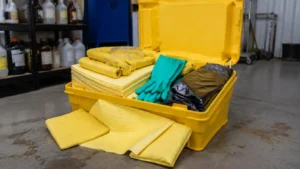

If you go through boxes of pads every month, it is natural to ask whether oil absorbent pads are reusable. The short answer is that some are and most are not. A specific category of heavier, purpose-built pads and mats is designed to be wrung out and used again, while the thin single-use pads most shops buy are meant to be used once and disposed of as oily waste. This guide explains which pads can be safely reused, how to do it, how many times you can realistically expect, and when trying to reuse a pad costs you more than it saves.
The Short Answer: It Depends on the Pad
There are two broad categories, and the reuse answer flips completely between them. Standard disposable pads are thin, low-cost polypropylene sheets built to absorb a spill quickly and then be thrown away; wringing them tends to tear the fibers and returns little oil. Reusable or wringable pads and mats are made thicker and tougher, often with a reinforced structure, specifically so the absorbed oil can be squeezed out and the pad used again. So before you try to reuse anything, the first question is simply which of these two you bought.
It helps to understand why the everyday pad resists reuse in the first place. A standard oil-only pad captures oil by drawing it into a delicate web of fine melt-blown fibers through capillary action. That structure is brilliant at soaking up a spill fast, but it is not built to be squeezed: pressing it hard collapses the pores, breaks the fibers, and leaves much of the oil trapped inside anyway. A wringable mat, by contrast, is engineered from the start to give up its oil under pressure and spring back into shape afterward, which is exactly what makes repeated use possible. Recognizing that difference saves you from ruining a stack of pads that were never meant to be reused.
Which Pads Can Be Reused?
Purpose-built reusable pads are usually sold as “wringable” or “re-usable” mats and are noticeably heavier and denser than everyday pads. Their construction is designed to survive repeated squeezing without falling apart, and the manufacturer will state clearly that they can be wrung and reused. If the packaging or product page does not say a pad is reusable, you should assume it is single-use. Thin economy pads, dimpled utility pads, and most oil-only sheets used for quick cleanup are made to be disposable, and pushing them through reuse cycles usually shreds them and creates a bigger mess than it prevents.

How to Reuse an Oil Absorbent Pad Safely
If you are working with a genuinely reusable, wringable pad, the process is straightforward but worth doing correctly. Once the pad is saturated, wring it out thoroughly to recover the absorbed oil, using a mechanical press or gloved hands, and collect that oil in a sealed container for proper recycling or disposal. If the pad handled anything other than clean oil, rinse it as directed. Then let the pad air-dry completely in a clean, ventilated space away from heat and direct sunlight before storing it in a dry, covered container. The drying step is the one people skip and regret: a pad put away while still damp can develop mold or mildew and become unusable.
A few cautions keep reuse safe. Always wear gloves, since used pads hold contaminants that irritate skin. Never reuse a pad that is torn, thinning, or heavily damaged, because it will shed fibers and re-release oil. And never wring or store recovered oil carelessly — the recovered fluid is still hazardous waste and has to be handled under the same rules as the original spill. We cover end-of-life handling in our guide on how to dispose of oil absorbent pads.
It also pays to set up a small, dedicated station for the routine rather than improvising each time. A designated wringing area with a press or bucket, a labelled container for recovered oil, and a ventilated rack for drying turns reuse from a messy chore into a repeatable process your team can follow safely. Keeping clean and used pads separated avoids cross-contamination, and posting the basic steps nearby means new staff do it right without guesswork. The facilities that get real savings from reusable pads are almost always the ones that treat it as a proper procedure instead of an occasional afterthought.

How Many Times Can You Reuse a Pad?
This is where honesty matters. High-end wringable mats are marketed for many cycles, and the best of them can be reused a large number of times when cared for well. Ordinary “reusable” pads are more modest: a common real-world pattern is three to five reuses, with absorbency dropping noticeably — often on the order of thirty percent — with each cycle as fibers compress and residual oil clogs the pores. In practice you should judge by performance, not a number on the box. When a pad no longer wicks quickly, stays heavy after wringing, or starts to fall apart, it has reached the end of its useful life and should be retired.
The type of oil also shapes how many cycles you get. Light oils and fuels release fairly cleanly when wrung, so a pad handling diesel may survive more rounds than one loaded with thick, sticky gear oil that never fully lets go. Temperature plays a part too, because cold oil is more viscous and harder to squeeze out, leaving more residue behind to clog the pad. Keeping a rough log of how each pad performs — how fast it absorbs and how much it weighs after wringing — quickly tells you when reuse has stopped paying off, and it prevents the false confidence of assuming a pad rated for “many uses” is still working when it is not.

When Reuse Is a False Economy
Reuse looks like an obvious saving, but it is not always worth it. The labour of wringing, rinsing, drying, and storing pads has a real cost, and dedicating floor space and ventilation to air-drying used absorbents is not free either. For small shops handling occasional spills, the time spent reclaiming a cheap pad can easily outweigh the price of a new one. Reuse also carries risk: a pad that fails partway through a job, or one stored damp and gone moldy, can turn a small saving into a bigger problem. And in some regulated or food-adjacent environments, reusing a contaminated pad is simply not acceptable. The right call is to weigh the true all-in cost of reuse against the low unit price of single-use pads, rather than assuming reuse always wins.
A simple way to sanity-check the decision is to price out one full reuse cycle: add the staff minutes for wringing and drying, the cost of any water and cleaning supplies, and a share of the storage space, then compare that total to the cost of a fresh pad. When you do the arithmetic honestly, reuse often makes clear sense for a busy plant recovering litres of oil a day and clear nonsense for a workshop that sees a spill once a week. Letting the numbers decide, rather than the instinct that reusing must be cheaper, is what keeps your spill-control budget under control.
Reusable vs. Single-Use: The Cost and Waste Trade-Off
The strongest case for reusable pads is high-volume, predictable oil recovery — a facility with steady leaks and the space and staff to run a proper wring-and-dry routine can cut both spend and landfill waste meaningfully. The strongest case for single-use pads is speed, hygiene, and simplicity, especially for intermittent spills, mixed contaminants, or teams without time to maintain a reuse program. Many operations end up using both: durable reusable mats under machines that drip continuously, and disposable oil-only pads on hand for fast response to fresh spills. Thinking in terms of your actual spill pattern, not a blanket rule, leads to the lowest total cost.
There is an environmental angle worth weighing alongside the money. Every reuse cycle keeps a pad and its oil out of the waste stream, which matters for facilities tracking their landfill footprint or working toward sustainability targets. But the calculation is not purely one-sided: reuse consumes water for rinsing, energy for drying, and cleaning resources, so the greenest option is the one that fits your real volume rather than the one that simply sounds most sustainable. For steady, high-oil applications, reusable mats usually win on both cost and waste; for sporadic spills, efficient single-use pads that are fully loaded before disposal often have the smaller overall impact.
Guidance for Bulk and OEM Buyers
For distributors and high-volume users, the reusable-versus-disposable decision is really a program decision. If your customers run continuous-drip applications, a reinforced wringable mat in the range can add value and reduce their waste. If they need fast, low-cost response, consistent single-use pads with reliable GSM and clean melt-blown fiber are the workhorse. As a Shenzhen-based manufacturer, AbsorbentX supplies both durable and single-use absorbents to spec, with private-label and OEM options for bulk orders. Explore grades and request samples on our oil absorbent pads collection, or read how to choose an oil absorbent pads supplier before ordering at volume. For background on the materials involved, see what oil absorbent pads are made of.

The Bottom Line
So, are oil absorbent pads reusable? Purpose-built wringable pads and mats are, and can pay for themselves in the right high-volume setting when you wring, dry, and store them properly. Standard disposable pads are not — trying to reuse them usually costs more in time and mess than it saves. Check the pad type first, be honest about the labour involved, and match your choice to how often and how predictably you actually deal with oil. Do that, and you will spend less overall whether you reuse or replace. And if you are buying at volume, talk to your supplier about both options up front, because the right mix of durable and single-use absorbents is usually cheaper than committing entirely to either one.
Frequently Asked Questions
Are oil absorbent pads reusable?
Some are. Purpose-built wringable pads and mats are designed to be squeezed out and reused, while standard thin disposable pads are meant for single use and should be disposed of as oily waste.
Can you wring out an oil absorbent pad and use it again?
Only if it is a reusable/wringable type. Wringing a standard disposable pad tears the fibers, returns little oil, and creates a mess. Always check the product instructions.
How many times can a reusable pad be reused?
Ordinary reusable pads commonly last three to five cycles, with absorbency dropping around thirty percent each time. High-end wringable mats can last many more when properly cared for. Judge by performance, not a fixed number.
How do you store a reusable pad between uses?
Wring it out, let it air-dry completely in a clean, ventilated area away from heat and sunlight, then keep it in a dry, covered container. Storing it damp can cause mold.
Is it cheaper to reuse pads or buy new ones?
It depends on volume. High, steady oil recovery favors reusable pads; occasional or mixed spills often favor low-cost single-use pads once you account for the labour of wringing and drying.