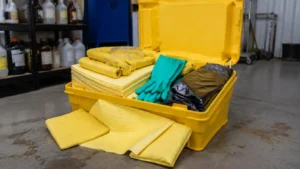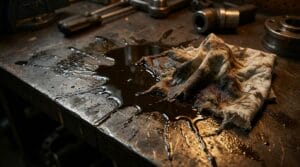

Drop an oil absorbent pad onto a puddle of motor oil and it darkens almost instantly, soaking up the spill while the water underneath stays clear. So how do oil absorbent pads work? The short answer: they are built from specially treated polypropylene fibers that attract oil, repel water, and lock liquid hydrocarbons inside a porous mat through capillary action. This guide breaks down that mechanism step by step, shows how much a single pad can hold, and explains how to choose and use pads correctly in real industrial settings.

What Is an Oil Absorbent Pad?
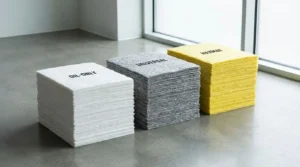
An oil absorbent pad is a flat, non-woven sheet — typically around 40 x 50 cm — engineered to capture oils and other hydrocarbons while leaving water behind. Most are made from melt-blown polypropylene, a plastic spun into ultra-fine fibers that form a tangled, sponge-like web. White pads are usually “oil-only” (hydrophobic), while gray “universal” pads are treated to absorb both oil and water-based fluids. The format is deliberately simple so the pads can be laid flat on a floor, draped over a leaking fitting, or floated on water, and most are perforated so a worker can tear off just the size needed instead of wasting a full sheet on a small drip.
Before we get into the mechanism, it helps to know what they are made from. For a full material breakdown, see our guide on what oil absorbent pads are made of.

How Do Oil Absorbent Pads Work? The Mechanism in Four Steps
A pad does not simply “mop up” oil. Four properties work together — oil attraction, water rejection, capillary pull, and retention. Here is what happens from the moment the pad touches a spill.
Step 1 — Oleophilic fibers attract the oil
Polypropylene is oleophilic, meaning “oil-loving.” Its non-polar surface chemistry is naturally compatible with the non-polar molecules in oils, fuels, and lubricants, so the two are chemically inclined to bond on contact. When the pad touches a spill, oil molecules are drawn onto the surface of every fiber instead of beading up and rolling off the way they would on a sealed plastic sheet. Because a melt-blown mat contains thousands of fibers packed into a small area, the total surface available to grab oil is enormous — far greater than the flat footprint of the pad would suggest. That hidden surface area is the first reason a thin sheet can outperform a thick rag.
Step 2 — Hydrophobic surfaces repel the water
The same fibers are hydrophobic — “water-fearing.” Water has a high surface tension and cannot wet the polypropylene surface, so it is pushed away rather than absorbed. This is why an oil-only pad can sit on a puddle, pull up the oil sheen, and still float when the job is done.
This selective behavior is exactly what makes a sorbent useful for spill response: an effective oil sorbent must be both oleophilic and hydrophobic so it recovers oil without taking on water.
Step 3 — Capillary action pulls oil into the pad
Surface attraction alone would only coat the outside. The real capacity comes from capillary action. The melt-blown web is full of microscopic pores and channels between fibers, and once oil wets a fiber, these tiny gaps act like thousands of narrow straws, drawing the oil deeper into the interior of the pad. It is the same physics that lets a paper towel wick up a spill, but tuned for hydrocarbons instead of water. The narrower the pores, the stronger the pull, which is why finely spun pads keep loading oil from the bottom layers even after the top surface looks wet. This is also why pressing a pad flat against a spill speeds things up: better contact opens more capillary pathways at once and helps the oil migrate inward before it can spread.
Step 4 — Retention: holding oil under pressure
Finally, the oil has to stay put. The dense fiber network traps liquid by a mix of capillary forces, van der Waals attraction, and physical entanglement, so a saturated pad can be lifted, stacked, or transported without dripping under its own weight. Higher-quality, higher-GSM pads retain better when squeezed or walked on.
Absorption vs. Adsorption — What’s Really Happening?
These two terms are often used interchangeably, but they describe different things, and a good pad relies on both. Adsorption is a surface effect: oil molecules cling to the outside of each fiber the instant they touch it. Absorption is a volume effect: that oil is then pulled into the bulk of the material and held inside the pore spaces between fibers. A polypropylene pad begins by adsorbing oil onto its enormous internal fiber surface, then absorbs it deeper into the pore network through capillary action. The two effects compounding together are precisely why a thin, lightweight sheet can hold many times its own weight in liquid rather than simply smearing the oil around.
How Much Oil Can One Pad Hold?
Capacity is usually quoted as a multiple of the pad’s own weight. Independent material studies of hydrophobic polypropylene sorbents report oil uptake in the range of roughly 15 to 27 grams of oil per gram of material, depending on fiber structure and oil type. In practical terms, a standard heavyweight pad commonly absorbs on the order of 0.2 to 1.5 liters of oil each — a striking amount for something the thickness of a few sheets of felt.
Several factors decide where a given pad lands in that range. Basis weight is the biggest lever: a higher GSM means more fiber mass, more pore volume, and therefore more room to store oil. Oil viscosity matters too — light fuels and diesel wick in quickly, while heavy crude or gear oil loads more total mass but takes longer to draw in. Temperature works alongside viscosity, since warm oil is thinner and absorbs far more readily than cold, sluggish oil. Finally, contact time is easy to overlook: capillary wicking is not instant, and a pad usually needs several seconds to a few minutes of dwell time on the spill to reach full saturation.
For published per-grade absorbency figures, see the specs on our oil-only absorbent pads category.
Oil-Only vs. Universal Pads — Why Water Matters
The single most important spec is whether the pad rejects water:
| Type | Absorbs | Best for |
| Oil-only (white) | Oil, fuel, lubricants — NOT water | Spills on water, wet floors, outdoor and marine work |
| Universal (gray) | Oil AND water-based fluids | Coolants, solvents, general maintenance where water is fine |
| Hazmat (yellow) | Aggressive chemicals, acids, bases | Lab and chemical handling |
If you need to recover oil from a rain-soaked yard or a harbor, only an oil-only pad will work — a universal pad would saturate with water before it captured the oil. We compare these in detail in oil-only vs. universal pads.

What Affects How Well a Pad Works?
Two pads that look identical can perform very differently, and the difference usually comes down to how they were made. Fiber fineness and loft are the foundation: finer melt-blown fibers create more surface area and smaller pores, which strengthens the capillary pull that draws oil inward. Basis weight then determines how much that structure can hold and how well it resists releasing oil under load — a heavier pad keeps its grip even when stacked or stepped on. Surface finish plays a practical role too, as dimpled or perforated pads wick faster and tear cleanly into smaller pieces for tight spaces. And as always, the oil itself sets the pace: thin, warm fluids absorb almost immediately, while cold, heavy oils need more dwell time before the pad reaches capacity.
How to Use Oil Absorbent Pads Correctly
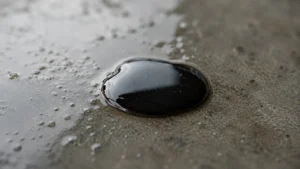
- Lay the pad directly on the thickest part of the spill and let capillary action pull the oil in.
- For spills on water, place pads at the leading edge of the slick and let them float and load.
- Press lightly or leave in place — do not scrub, which can shed fibers and slow wicking.
- Replace the pad once it darkens fully and stops taking up liquid (it is saturated).
- Wear gloves and dispose of saturated pads as oily waste per local regulations.
A little technique goes a long way here. Because absorption relies on contact and dwell time, the worst thing you can do is wipe a spill around with a dry pad and pull it away too soon — that spreads the oil and wastes the pad before capillary action has finished its job. Letting the pad sit and darken fully is what delivers the capacity the material is capable of. We cover end-of-life handling in our guide on how to dispose of oil absorbent pads.
When a Pad “Stops Working”
Most “the pad isn’t absorbing” complaints come down to one of four causes, and only one of them is a real product issue. The most common is simple saturation: a full pad physically cannot hold more, so the fix is just to swap it for a fresh one — that is normal behavior, not a defect. The second is temperature, since absorption slows noticeably with cold, heavy oil; giving the pad more contact time or warming the area restores its speed. The third is using the wrong pad type, where a universal pad placed on a wet surface fills with water before it ever reaches the oil — the answer there is an oil-only pad. The last cause is genuine quality: thin, low-GSM pads built from coarse fibers wick poorly and tend to release oil again under foot traffic, which is why consistent fiber quality matters when you buy in volume.
Choosing Pads for Bulk and OEM Buyers
For distributors and high-volume users, performance per dollar comes down to consistent GSM, clean melt-blown fiber, and reliable hydrophobicity batch to batch. A pad that tests well in a single sample but drifts in weight or fiber quality across a container load will generate returns and complaints, so consistency is worth more than a marginally lower unit price. As a Shenzhen-based manufacturer, AbsorbentX produces oil-only, universal, and chemical pads to spec with private-label and OEM options for bulk orders.
Compare grades and request samples on our oil absorbent pads collection, or read how to choose an oil absorbent pads supplier before placing a wholesale order.
Frequently Asked Questions
Do oil absorbent pads absorb water?
Oil-only (white) pads are hydrophobic and repel water — they absorb only oils and hydrocarbons. Universal (gray) pads absorb both oil and water-based fluids.
How much oil can one pad absorb?
Most polypropylene pads hold many times their own weight — laboratory studies report roughly 15–27 g of oil per gram of material. A standard heavyweight pad typically takes up about 0.2–1.5 liters, depending on GSM, oil type, and temperature.
Why do oil absorbent pads float?
Because they are hydrophobic and made of low-density polypropylene, they reject water and stay buoyant even when loaded with oil — ideal for spills on water.
Are oil absorbent pads reusable?
Some oils can be wrung or pressed out for limited reuse, but most pads are treated as single-use and disposed of as oily waste once saturated.
What is the difference between absorption and adsorption in a pad?
Adsorption is oil clinging to the fiber surfaces; absorption is oil drawn into the pore spaces inside the pad. Polypropylene pads use both.