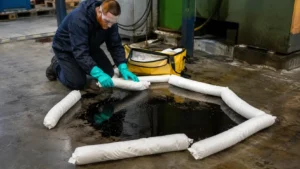
A diesel spill gets treated as the less dangerous cousin of a gasoline spill more often than it should. Diesel does not flash into vapor the way gasoline does, so the adrenaline response is lower and the cleanup often gets slower, sloppier, and less protected than it needs to be. That gap between perceived and actual risk is exactly where diesel spills go wrong — not because diesel is explosive on contact, but because it soaks into gravel, concrete, and soil faster than most people expect and lingers there for weeks after the surface looks dry.
This guide covers what actually changes about diesel compared with gasoline, which absorbents work and why, the mistakes that come from underestimating diesel specifically, and how to handle everything from a five-gallon drip at a fuel island to a hydraulic line failure on a piece of yard equipment. The goal is a cleanup that protects people, pavement, and groundwater without over-treating or under-treating the hazard.
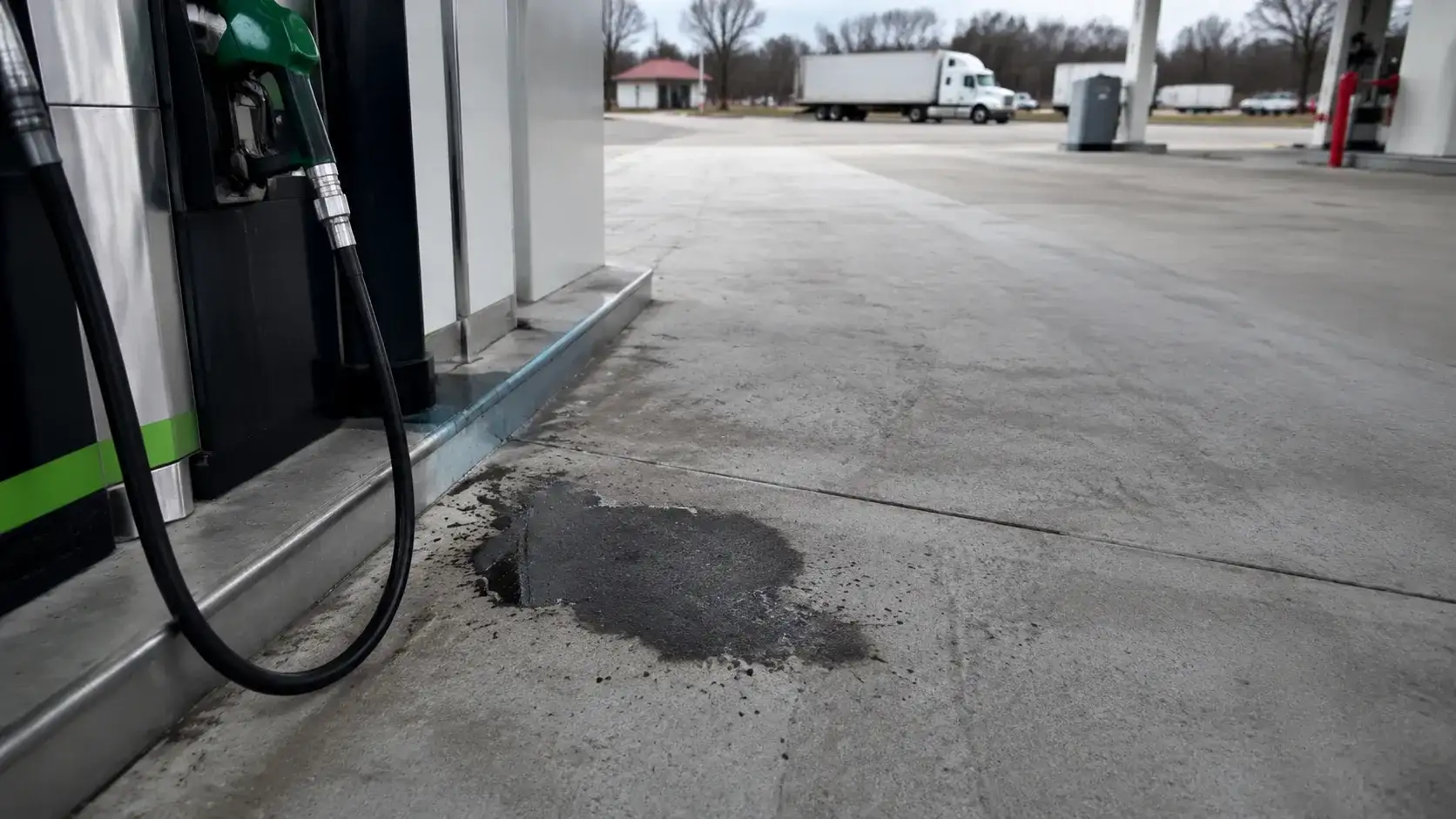
Why Diesel Spills Behave Differently Than Gasoline
Diesel’s flash point sits between roughly 52°C and 96°C (126-205°F), depending on grade and additive package, compared with gasoline’s flash point around -43°C. That means diesel does not give off ignitable vapor at normal outdoor temperatures the way gasoline does, and a stray spark next to a diesel puddle is far less likely to cause flash ignition. This is the single fact that leads people to underestimate a diesel spill, and it is only half the picture.
The other half is viscosity. Diesel is roughly two to four times more viscous than gasoline and noticeably oilier, which means it does not evaporate off a surface the way gasoline does — it soaks in. On concrete, that shows up as a stain that keeps bleeding upward for days. On gravel or bare soil, it means the fuel is already moving downward through pore spaces while the surface still looks like a shallow puddle, which is why diesel spills are treated as more of a groundwater and containment problem and less of a fire problem.
Diesel is also a hydrocarbon and not water-miscible, exactly like gasoline and motor oil, so it floats on water, spreads across wet pavement, and will not dilute or wash away on its own. That single property is why hydrophobic, oil-only absorbents work on diesel the same way they work on gasoline and oil, even though the fire-risk framing and the spread pattern are different. Confusing “lower flash point risk” with “lower cleanup priority” is the mistake that turns a contained diesel spill into a soil remediation job.
Immediate Safety Steps for a Diesel Spill
Diesel’s higher flash point does not mean skip the safety steps — it means the risk profile shifts rather than disappears. Diesel vapor can still ignite near a hot exhaust manifold, a running engine, or in an enclosed space where vapor concentration builds up, so shut down engines and pumps in the immediate area and keep obvious ignition sources clear before starting cleanup. Ventilate enclosed spaces such as maintenance bays or tank rooms the same way you would for any fuel spill, since diesel vapor is still heavier than air and will pool in pits and trenches.
PPE gets skipped on diesel spills more often than on gasoline spills, and that is backwards. Diesel is an eye and skin irritant with prolonged-contact health effects, and its odor lingers on skin and clothing for days if you handle it bare-handed. Use nitrile or fuel-resistant gloves, safety glasses, and skip the assumption that “it’s just diesel” means gloves are optional — the low fire risk does not extend to the chemical exposure risk.
The OSHA standard on flammable and combustible liquids (29 CFR 1910.106) classifies diesel as a Class II combustible liquid rather than a Class I flammable liquid like gasoline, which is the regulatory version of the same distinction — lower ignition risk, still a hazardous material that requires proper storage, handling, and spill response. Review that classification if your site stores or transfers diesel in bulk, since it affects everything from container specification to spill-kit placement.
What to Use on a Diesel Spill
Because diesel is a hydrocarbon fuel spill and not water-miscible, oil-only hydrophobic absorbents are the correct choice, exactly as they are for gasoline and motor oil. Meltblown polypropylene pads and socks repel water and grab only hydrocarbons, which matters more with diesel than with gasoline because diesel spills on wet pavement or near rain-soaked gravel are common — a fuel-rated pad puts all of its capacity into the diesel instead of wasting it on standing water. AbsorbentX’s oil-only absorbent pads are built from consistent-GSM meltblown fiber specifically for this kind of fuel containment and absorbed capacity.
Selection changes depending on whether the diesel is pooled on a hard surface or already absorbed into a porous substrate. For pooled diesel on concrete or asphalt, lay heavyweight pads flat over the liquid and let them wick it up, replacing each one as it saturates rather than pushing a partially loaded pad around the spill. For a spreading edge or a spill near a drain, socks form a barrier that stops lateral movement, and pillows handle deeper pools such as diesel collecting in a low spot or containment sump.
Diesel saturates absorbent media differently than gasoline does — it is denser and oilier, so a given pad typically holds a comparable weight of diesel but takes visibly longer to fully wick it up, and the pad darkens more clearly than it does with gasoline, giving a better visual cue for saturation. Judge replacement by both weight and visible darkening rather than a fixed time interval. For diesel that has already soaked into gravel, mulch, or loose substrate rather than sitting as a surface pool, loose granular absorbent or excavation of the contaminated material typically outperforms pads, since a flat pad cannot reach fuel that has already moved below the surface.

What to Avoid When Cleaning Up Diesel
Hosing a diesel spill toward a drain is the single most common mistake, and it is worse with diesel than with gasoline in one specific way: diesel’s higher viscosity means water spreads it into a thin, hard-to-see sheen across a much larger area instead of diluting it, and that sheen carries straight into storm drains that discharge to surface water untreated. What looked like a contained ten-square-foot spill becomes a reportable discharge the moment a hose or pressure washer touches it. Block any nearby drain with an absorbent sock before doing anything else, never after.
Universal absorbents — the gray pads rated for oil, water, and general use — are a second common mismatch. They soak up water right alongside diesel, which cuts real capacity dramatically on wet pavement or damp gravel and forces a crew to burn through two or three times as many pads as an oil-only product would need for the same spill. AbsorbentX’s broader oil-only absorbents guide covers the capacity difference between universal and oil-only media in more detail if a facility is deciding what to stock.
The third mistake is mismatching absorbent to the substrate itself. Laying flat pads on gravel or loose soil looks like a reasonable response, but a pad only pulls fuel from the surface it touches — it does nothing for diesel that has already migrated between gravel particles or a few inches down into soil. On porous ground, plan for excavation of visibly contaminated material as part of the response rather than assuming a pad alone finished the job, and treat the underlying soil test as the real measure of whether the spill is actually contained.
Diesel on Soil and Gravel: The Groundwater Question
Diesel typically penetrates 3 to 8 inches into loose or sandy soil within the first hour of a spill, and considerably faster through gravel or coarse fill where large pore spaces offer little resistance. That is slower than gasoline’s evaporation-driven disappearance but far more persistent — diesel does not evaporate off soil the way gasoline does, so what soaks in tends to stay there, migrating further downward with each rain event rather than breaking down quickly. This is the core reason diesel spills on unpaved ground get treated as an environmental containment problem first and a fire problem a distant second.
Once diesel reaches groundwater, remediation shifts from an in-house cleanup to a specialist job involving soil borings, monitoring wells, and multi-year monitoring in some jurisdictions — a cost and timeline gap that is entirely avoidable if the spill is caught and excavated within the first day. For any spill on bare soil or gravel larger than a small drip, remove visible pooled fuel with pads first, then excavate and bag the visibly stained soil beneath it rather than leaving it in place on the assumption that it will break down on its own.
The EPA’s guidance on oil spill prevention and preparedness regulations outlines the reporting and containment framework that applies once a spill threatens soil or water, and it is worth reviewing before a diesel release happens rather than during one. Facilities with tanks, fuel islands, or equipment yards on unpaved ground should treat gravel and soil areas as higher-priority spots for pre-positioned spill kits than paved areas, since the margin for error before contamination reaches subsurface soil is measured in minutes, not hours.
Diesel on Concrete and Asphalt
Hard surfaces are more forgiving with diesel than soil is, but not as forgiving as they are with gasoline. Diesel’s higher viscosity means it sits and soaks into porous concrete for longer before a crew gets to it, so a stain that would rinse largely clean with gasoline can leave a deep, dark residue with diesel that keeps bleeding to the surface for days after the visible liquid is gone. Absorb the bulk of the liquid with pads first, then follow with a fuel-appropriate degreaser or a poultice application that draws residual diesel back out of the concrete’s pores rather than just scrubbing the surface.
Asphalt reacts to diesel the same way it does to gasoline — the fuel acts as a solvent on the bitumen binder — but because diesel lingers on the surface longer before evaporating or being absorbed, an unattended diesel spill on asphalt often does more binder damage than an equivalent gasoline spill simply because it has more contact time. Fast absorption on asphalt is as much about protecting the pavement structure as it is about environmental cleanup, and it is one more reason diesel spills should not get a slower response just because there’s no immediate fire risk.
Hydraulic and Equipment Diesel Leaks
A large share of workplace diesel spills are not tank failures or fueling accidents — they are slow leaks from hydraulic lines, fuel filters, and injector seals on diesel-powered equipment sitting in a yard or shop. These leaks are easy to underestimate because they show up as a small drip pattern rather than a dramatic release, but a piece of equipment leaking a cup of diesel a day onto the same patch of gravel for a month has put more fuel into the ground than a single fast-contained spill would.
Drip trays or absorbent mats placed under parked equipment with known or suspected leaks catch this volume before it reaches the ground at all, and a simple weekly walk of the equipment yard checking for fresh staining catches slow leaks long before they become a soil contamination issue. Where equipment must sit on unpaved ground, treat a visible diesel stain under a machine as a signal to excavate that spot, not just wipe the surface and move on.
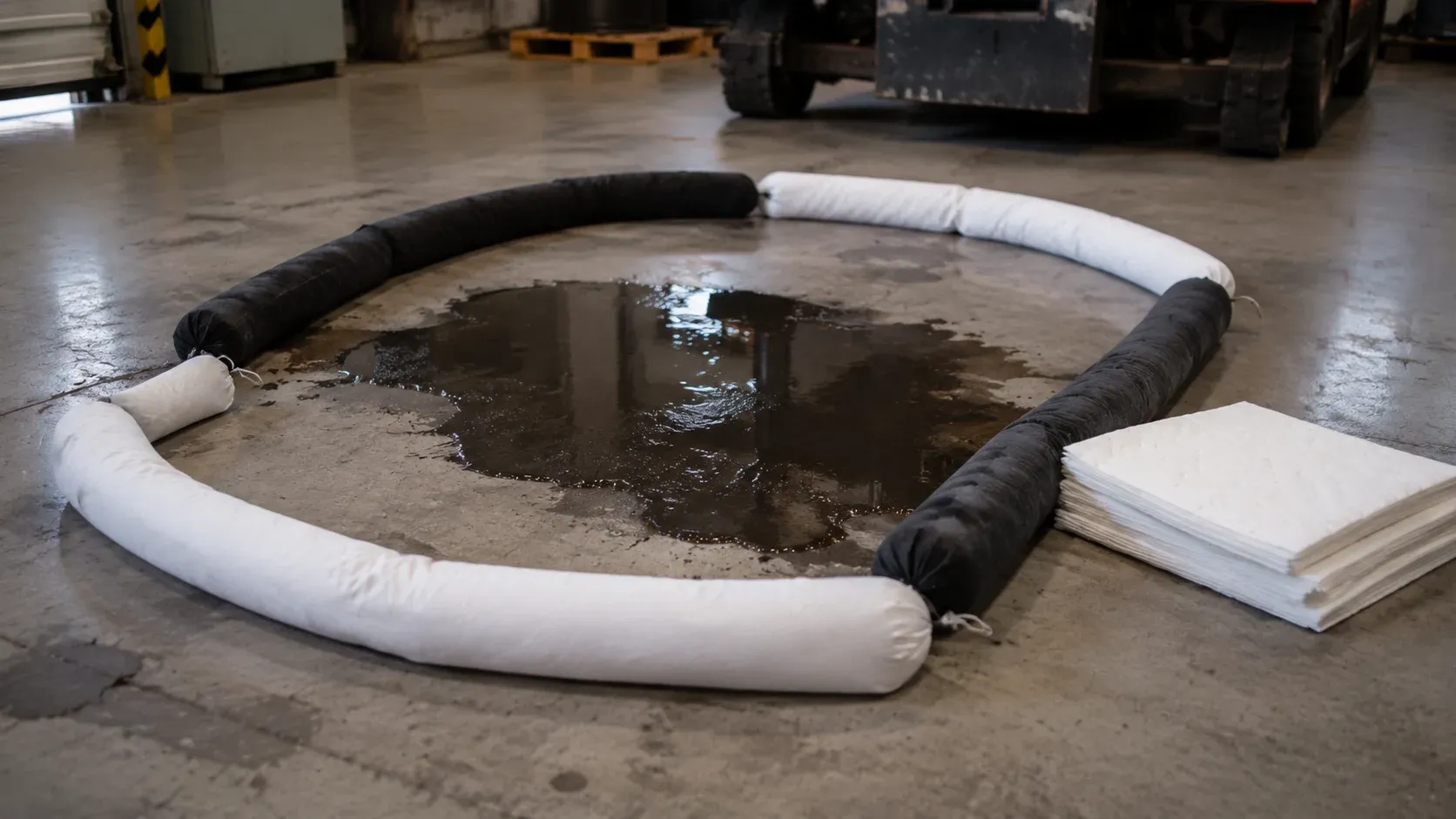
Disposing of Diesel-Soaked Absorbents
Diesel’s higher flash point changes the regulatory picture slightly compared with gasoline. The EPA’s ignitability characteristic (waste code D001) applies to liquids with a flash point below 60°C (140°F), and diesel’s flash point of roughly 52-96°C sits right around that line depending on grade, so some diesel-soaked absorbent will test as hazardous and some will not. Treat it as hazardous waste unless your waste contractor has specifically tested and confirmed otherwise, since guessing wrong on this line is a compliance risk not worth taking.
Whether or not the waste stream is formally hazardous, diesel-soaked pads, socks, and excavated soil should be bagged or drummed, labeled, and stored away from ignition sources and weather until a licensed waste hauler collects them. Never send diesel-contaminated material to general trash or attempt to dry pads out for reuse, and never dump excavated diesel-stained soil elsewhere on site — that simply relocates the contamination rather than resolving it.
Preventing Diesel Spills
Most diesel spills cluster around a small set of repeat locations: fuel islands, tank fill points, and equipment parked on the same patch of ground week after week. Drip trays under fill points and stationary equipment, secondary containment berms under bulk tanks, and automatic shut-off nozzles remove a large share of routine spillage for a modest upfront cost, and they pay for themselves the first time they prevent a soil excavation job.
Procedure closes the rest of the gap. Filling containers on the ground rather than on a truck bed, never leaving a fill operation unattended, and training staff to stop at the shoulder rather than the brim of a tank all reduce overfill events, which remain the single most common cause of small diesel spills at fueling points and transfer stations.
Building a Diesel Spill Response Kit
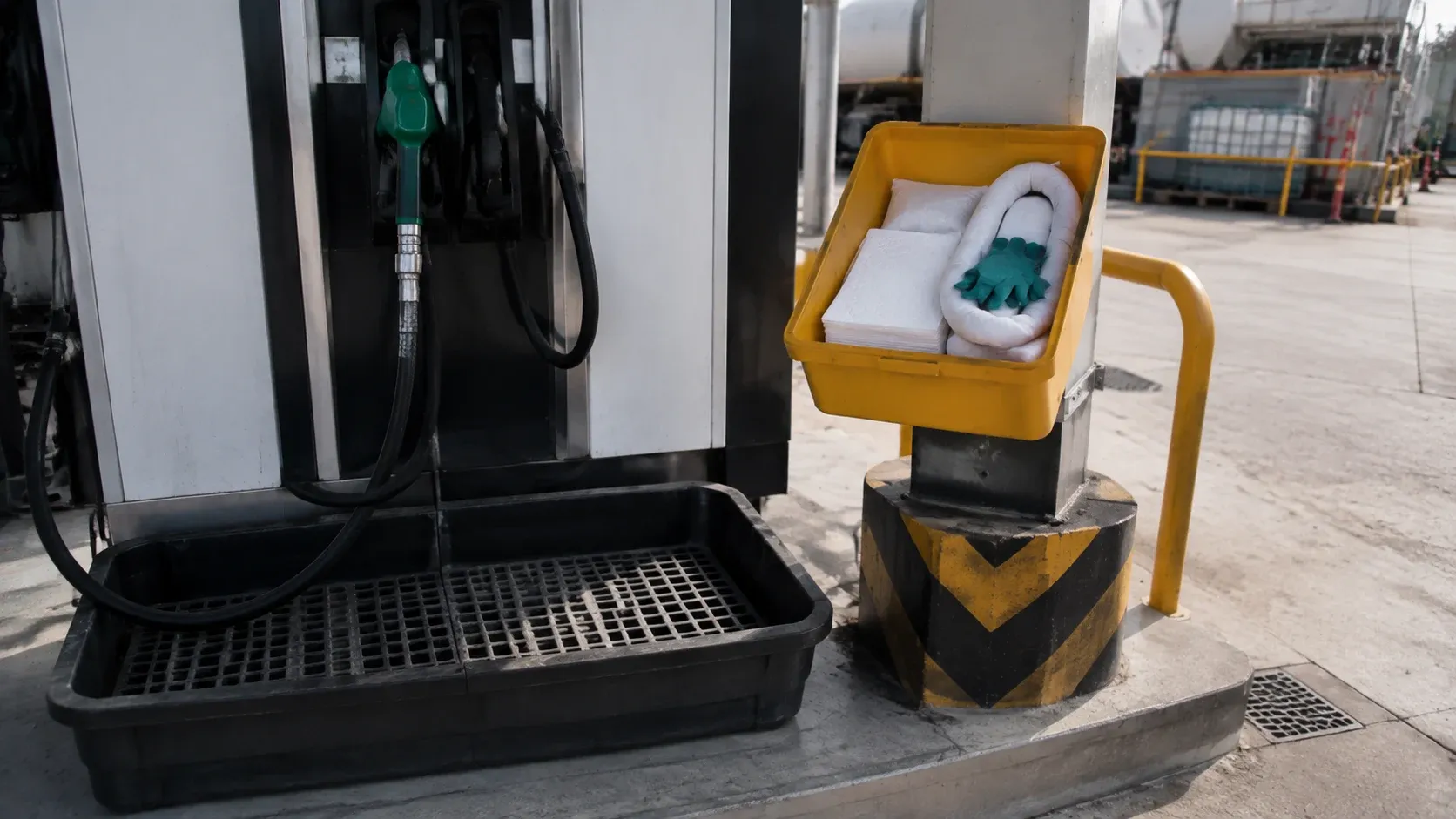
A practical diesel spill kit for a fuel island or equipment yard includes 10-15 heavyweight oil-only pads, two or more absorbent socks for containment and drain protection, a pillow for deeper pools, PPE (fuel-resistant gloves, safety glasses), non-sparking scoops, and heavy-duty disposal bags — enough to handle a spill up to roughly 15-20 gallons without running out of media mid-cleanup. Facilities with gravel or unpaved equipment yards should add a small stock of loose granular absorbent for substrate that pads alone cannot reach.
AbsorbentX’s oil absorbent pads range covers both general-purpose and oil-only grades sized for exactly this kind of kit, with bulk and private-label options for facilities stocking multiple fueling or equipment points to the same standard. Sites managing several locations should also review AbsorbentX’s fuel spill guide and gasoline spill cleanup guide for how diesel response fits alongside other fuel types in a single site-wide plan, and the industrial absorbents guide for broader facility stocking guidance.
The Bottom Line
Diesel’s higher flash point genuinely lowers the flash-fire risk compared with gasoline, but it does not lower the cleanup priority — if anything, diesel’s viscosity and persistence in soil make containment and speed matter more, not less. Use oil-only hydrophobic pads, socks, and booms sized to the scenario, avoid water hosing and universal absorbents, and treat any diesel that reaches gravel or bare soil as an excavation job rather than a wipe-down.
Stock kits at every fueling and equipment point, check parked machinery for slow leaks before they become stains, and route saturated absorbents through a licensed hauler rather than the general bin. A diesel spill handled with the same seriousness as a gasoline spill, adjusted for what actually differs, stays a ten-minute cleanup instead of becoming a soil remediation project.
Frequently Asked Questions
What should you use to clean up a diesel spill?
Use oil-only, hydrophobic meltblown polypropylene absorbents — pads for pooled diesel on hard surfaces, socks to contain the edge and protect drains, and pillows for deeper pools. For diesel that has soaked into gravel or soil, loose granular absorbent or excavation of the contaminated material works better than a flat pad alone.
Is diesel as dangerous as gasoline in a spill?
Not in the same way. Diesel’s flash point of roughly 52-96°C is far higher than gasoline’s -43°C, so it is much less prone to flash ignition. Diesel is more of a soil and groundwater persistence risk because it is oilier and soaks in rather than evaporating, so treat it seriously even though the fire risk is lower.
Can you hose a diesel spill off concrete?
No. Water spreads diesel into a thin sheen across a wider area instead of cleaning it up, and that sheen often reaches a storm drain that discharges untreated to surface water. Block nearby drains with an absorbent sock and absorb the diesel with pads before any wash-down.
How deep does diesel penetrate into soil?
Diesel typically penetrates 3 to 8 inches into loose or sandy soil within the first hour of a spill, faster through gravel. Because it does not evaporate the way gasoline does, excavating the visibly contaminated soil is usually necessary rather than relying on absorbent pads alone.
Are diesel-soaked absorbent pads hazardous waste?
Sometimes. The EPA’s ignitability threshold for hazardous waste is a flash point below 60°C, and diesel’s flash point range straddles that line depending on grade. Treat diesel-soaked absorbents as hazardous waste unless your waste contractor confirms otherwise, and store them sealed and labeled away from ignition sources.
Can you use the same absorbents for diesel and gasoline spills?
Yes. Both are non-water-miscible hydrocarbons, so the same oil-only hydrophobic pads, socks, and booms work on either fuel. The difference is in response priority and speed — gasoline demands immediate ignition control, while diesel demands fast containment to stop soil and groundwater migration.