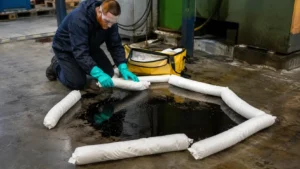
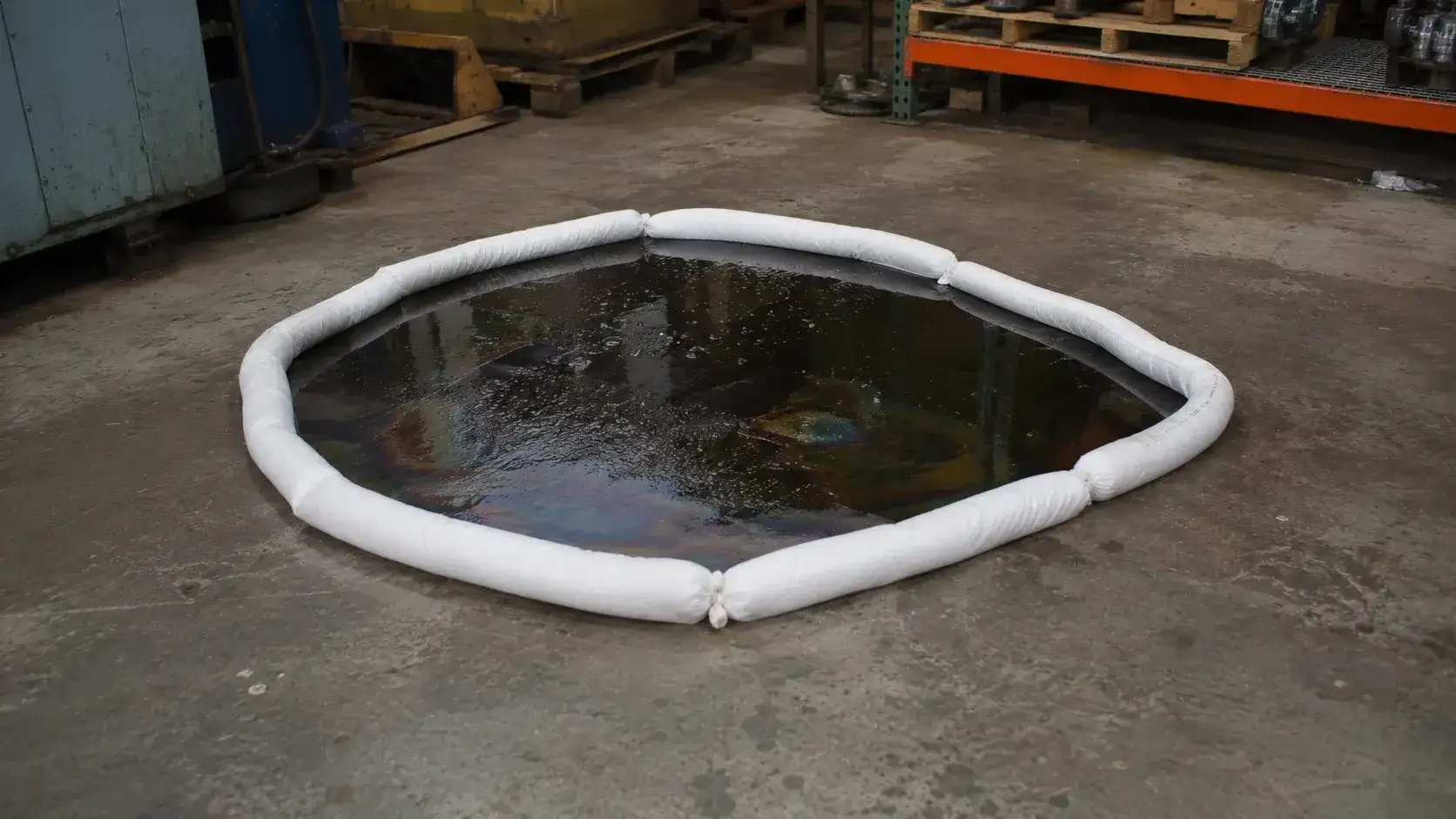
Containment is the part of spill response that decides how big the job will be. Oil spreads continuously until something stops it, and the area it covers determines how much absorbent you use, how long the cleanup takes, and whether it reaches a drain or a watercourse. Every minute spent containing early saves considerably more later.
The tools are simple and the principle is consistent whether the oil is on a workshop floor or on open water: build a barrier at the leading edge, work from the outside inward, and only start recovering once the spread has stopped. What changes between environments is the equipment and the physics.
This guide covers what containment means in an active response, how land and water containment differ, what socks, booms, berms, and pads each actually do, the step-by-step process, and how to handle the awkward conditions — slopes, rough ground, rain — that make containment harder than the textbook version.
What Oil Containment Means in a Spill Response
Containment is the act of physically stopping a spill from spreading further, using a barrier placed at or ahead of the leading edge. It is distinct from absorption, which removes the liquid, and from recovery, which is the broader process of getting the oil off the surface and into a waste stream.
It is also different from secondary containment, and the two get conflated constantly. Secondary containment is permanent hardware — bunds, trays, spill pallets — built to catch a leak from a stored container before anything spreads at all. Active containment is what you do with portable equipment once oil is already loose on a surface.
The reason containment comes first is straightforward arithmetic. A spill left to spread for two minutes may cover four times the area it did at the start, and the absorbent needed scales with that area. Containing first is not a safety formality but the single most effective way to reduce the size of the job.
Containment on Land Versus Containment on Water
On land, oil is bounded by gravity and surface texture. It runs downhill, follows joints and channels, soaks into porous surfaces, and stops when it meets a physical barrier laid flat against the ground. Containment is therefore about barrier placement and understanding where the ground falls.
On water, oil floats and moves with current and wind rather than gradient, spreading into a thin film across a very large area very quickly. Containment relies on floating barriers with a skirt hanging below the surface, and the oil must be corralled rather than simply stopped, because the water underneath keeps moving.
The National Oceanic and Atmospheric Administration’s overview of oil spill containment methods describes how hard booms, sorbent booms, and fire booms differ, and makes the important point that all containment techniques work only when conditions allow.
The practical consequence is that water containment is far less forgiving. Waves splash oil over a boom, current drags it underneath the skirt, and a barrier that is not anchored simply drifts with the slick it is meant to hold. Land containment tolerates rough execution in a way water containment does not.
Absorbent Socks: The Workhorse of Land Containment
Socks are the primary land containment tool and are used far more than any other. A flexible tube of absorbent fill in a durable sleeve, a sock lies flat against the floor, conforms to minor unevenness, and forms a barrier that both stops the oil and absorbs what it touches.
That dual function is their advantage and their limit. Because a sock absorbs at the contact line, it will eventually saturate and begin passing liquid through if oil keeps arriving, so socks suit spills of bounded volume and need monitoring against a continuing leak. For a genuinely ongoing release, a non-absorbing barrier holds better.
Placement technique matters more than quantity. Lay socks in a continuous line with overlapping ends rather than butted together, since oil finds any gap, and place them slightly ahead of the leading edge rather than against it so you are not chasing a moving target.
Our complete guide to oil absorbent socks covers sizing, placement, and capacity in more detail.
Containment Booms on Water
Booms are floating barriers designed for open water, and their construction reflects the forces involved. Freeboard above the waterline stops waves washing oil over the top, a skirt below prevents it escaping underneath, ballast keeps the boom upright, and a tension member along its length stops it being torn apart by current.
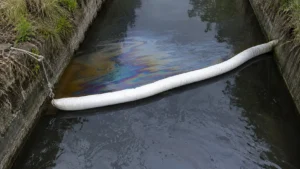
Sorbent booms are the type most industrial sites actually hold. Essentially a large-diameter sock designed to float, they contain and absorb simultaneously and suit the scale of spill that reaches a site drainage ditch, a settlement pond, or a small outfall. They are not the right tool for a large open-water release.
Deployment angle matters considerably. Setting a boom straight across a flowing watercourse causes oil to be dragged under it by the current, so booms are normally deployed at an angle to deflect the slick toward a bank where it can be recovered. Anchoring at both ends is essential rather than optional.
Sites with waterside operations should read our application guidance on water surface oil spills and marine operations.
Berms and Physical Barriers
Berms are non-absorbing barriers — a raised edge, usually flexible polymer or a weighted foam profile — that hold liquid without soaking it up. Because they have no capacity limit, they suit continuing releases and larger volumes where socks would saturate, and they can be reused after cleaning rather than disposed of.
Portable berms and drive-over models are common for temporary work: vehicle maintenance in the field, a leaking unit awaiting repair, or a transfer operation in an unprotected area. They are laid out, the work happens inside them, and anything spilled stays in a defined space.
Improvised barriers deserve a mention because they are used constantly in real incidents. Sand, earth banks, and even a rolled tarpaulin will hold oil in the short term, and on a large outdoor spill an earth dam thrown up across a gradient may contain more than every sock on site. Preparedness is better, but improvisation beats watching it spread.
Where Pads Fit in Containment
Pads are a recovery tool rather than a containment tool, and the distinction matters because using them for containment is a common and expensive mistake. Laying pads at the edge of a spreading spill to hold it back works poorly — they saturate quickly, do not form a seal against the floor, and the oil simply flows around them.
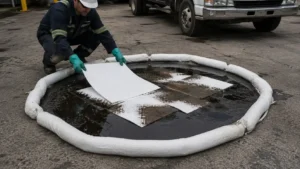
Their proper role begins once the spread has stopped. With the spill bounded by socks or a berm, pads are laid over the contained oil to absorb it efficiently, which is what they are designed for and where their capacity per unit cost is best.
The one containment-adjacent use is as a supplement at the barrier line. A row of pads laid immediately inside a sock line catches oil arriving at the barrier and reduces how fast the socks saturate, extending how long the containment holds without adding another barrier.
Our oil absorbents guide compares capacity across formats, and the oil-only absorbents guide explains why hydrophobic grades matter outdoors and on wet ground.
How to Contain an Oil Spill, Step by Step
Assess the direction of travel before placing anything. Look at where the ground falls and where the nearest drain sits, because containment placed on the wrong side of a spill wastes both the material and the time. The leading edge heading downhill is the priority, not the visually largest part of the pool.
Protect the drain first if one is within reach of the spill. A drain is the only irreversible outcome available, so covering or ringing it takes precedence over containing the spill generally, and it is worth doing even if it means the spill spreads slightly further in the meantime.
Then build the barrier from the outside inward. Place socks or a berm ahead of the leading edge, closing the ring or the downhill arc, and only tighten inward once the spread has stopped. Working inward from a wide barrier is straightforward; trying to chase a spreading edge with a barrier laid too close never works.
Once containment holds, begin recovery. Absorb with pads, use pillows for deep pools, and for large volumes consider mechanical recovery before absorbents, since pumping or vacuuming the bulk is far faster and cheaper than absorbing it a pad at a time.
Containment in Difficult Conditions
Slopes are the hardest land case because oil accelerates as it runs and a single barrier at the bottom often fails under the volume arriving. The better approach is staged containment — several barriers at intervals down the gradient, each holding part of the flow — rather than one line expected to stop everything.
Rough ground defeats socks, since a barrier that cannot lie flat leaks underneath at every void. On gravel, broken concrete, or soil, an earth bank or a berm bedded into the surface works far better, and granular absorbents handle what soaks into voids that pads cannot reach.
Rain complicates everything outdoors. It spreads the oil, floats it toward drains, and saturates absorbents with water unless they are hydrophobic — which is the strongest argument for stocking oil-only grades for external areas. Contain wider than you think necessary in wet weather, because runoff carries the slick further than gradient alone would.
Common Oil Containment Mistakes
Absorbing before containing is the classic error, and it is what makes most spills bigger than they needed to be. The visible pool draws attention while the leading edge quietly advances, and by the time the pads run out the spill covers several times the original area.
Placing the barrier too close is next. A sock line laid tight against the edge of a moving spill is overtaken almost immediately, and the response then becomes a losing chase. Leave a margin and close the ring properly rather than reacting to where the oil is at this instant.
Leaving gaps at sock ends is a small mistake with large consequences. Oil finds every gap, so ends must overlap rather than butt together, and a barrier is only as good as its weakest joint.
Finally, forgetting the source. Containment around a spill fed by a still-leaking container or a running pump will be overwhelmed eventually, and stopping the source — where it is safe to do so — is what makes containment hold.
Choosing Oil Containment Products
For socks and booms, look at sleeve durability and fill consistency. A sock is dragged across rough ground into position while wet, so a sleeve that splits or fill that has settled to one end leaves a gap at exactly the wrong moment. Consistent fill distribution is worth more than a headline absorbency figure.
For outdoor and waterside use, hydrophobic oil-only grades are the right specification, since a universal boom in a rainy yard or on open water fills with water and stops absorbing oil almost immediately. Match the format to the environment rather than buying one product for everything.
As a Shenzhen-based manufacturer, AbsorbentX produces containment and recovery products to consistent specification, with private-label and OEM options for bulk buyers. Browse the absorbent socks range for land containment, the absorbent booms range for water and outfall work, and the absorbent pads range for recovery once containment holds.
The Bottom Line
Contain before you absorb, every time. Oil spreads until something stops it, and the area it reaches sets the cost and duration of everything that follows, which makes the first barrier the highest-value action in the whole response.
Use the right tool for the job: socks for land containment, booms for water, berms for continuing releases and larger volumes, and pads for recovery once the spread has stopped. Place barriers ahead of the leading edge, overlap the ends, and protect any drain first.
Stop the source where it is safe, contain wider than feels necessary outdoors and in rain, and switch to mechanical recovery when the volume makes absorbents inefficient. Our oil spill guide sets containment in the context of full spill response, and the oil spill kits guide covers stocking the containment products you will actually reach for.
Frequently Asked Questions
What is oil containment?
The act of physically stopping a spill spreading further by placing a barrier at or ahead of its leading edge. It comes before absorption and recovery, because the area a spill covers determines how much material, time, and cost the cleanup requires.
What is the difference between oil containment and secondary containment?
Active oil containment uses portable equipment — socks, booms, berms — to stop a spill already loose on a surface. Secondary containment is permanent hardware such as bunds, trays, and spill pallets, built to catch a leak from a stored container before anything spreads at all.
Should I contain a spill before absorbing it?
Yes, almost always. Oil spreads continuously until something stops it, so absorbing the visible pool while the leading edge advances means the spill covers several times the area it started with. Containing first is the single most effective way to reduce the size of the job.
What is the difference between an absorbent sock and a containment boom?
Socks are flat-lying tubes for land use, forming a barrier on a floor or yard surface. Booms are built to float, with freeboard above the waterline and a skirt below it, for use on water. Both contain and absorb, but they are not interchangeable between environments.
When should I use a berm instead of absorbent socks?
Use a berm for continuing releases and larger volumes, since it holds liquid without a capacity limit while socks eventually saturate and pass oil through. Berms also work better on rough ground where a sock cannot lie flat, and they can be cleaned and reused rather than disposed of.
Can absorbent pads be used to contain a spill?
Not effectively. Pads are a recovery tool — they saturate quickly at the edge of a spreading spill and do not seal against the floor, so oil flows around them. Contain with socks or a berm first, then use pads to absorb the oil once the spread has stopped, which is where their capacity is best used.