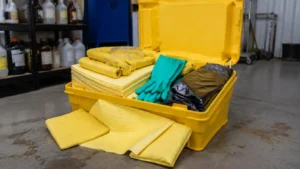
Absorbent pads are the most-used tool in spill control, and picking the right type, size, and weight is what makes cleanup fast instead of frustrating. A pad that matches the liquid and the spill soaks it up in seconds, while the wrong one wastes material or leaves a mess behind. Understanding the small set of choices behind these simple sheets pays off on every spill.
This guide covers the full picture: the main types of absorbent pads and their color code, the standard sizes and GSM weights, how pads compare with rolls and pillows, and a clear framework for choosing. Whether you are stocking a home garage or a multi-site facility, the same logic applies. By the end you will be able to read a pad by its grade and weight rather than guessing.
What Are Absorbent Pads?
Absorbent pads are flat, non-woven sheets designed to soak up liquid spills quickly and cleanly. Most industrial pads are made from meltblown polypropylene, a synthetic that traps liquid in a dense web of fine fibers and holds many times its own weight. The same base material is treated in different ways to handle different liquids.
Their appeal is simplicity: lay a pad on a spill, let it wick up the liquid, then replace or dispose of it. They come in different grades, sizes, and weights, but the basic action is always the same. For a full look at the material, see our guide on what oil absorbent pads are made of.
Because they are cheap, fast, and easy to store, absorbent pads are the default first response to almost any spill. The choices below simply help you match the pad to the job. Get those choices right and one pad often does the work of several cheaper ones.
The Main Types of Absorbent Pads
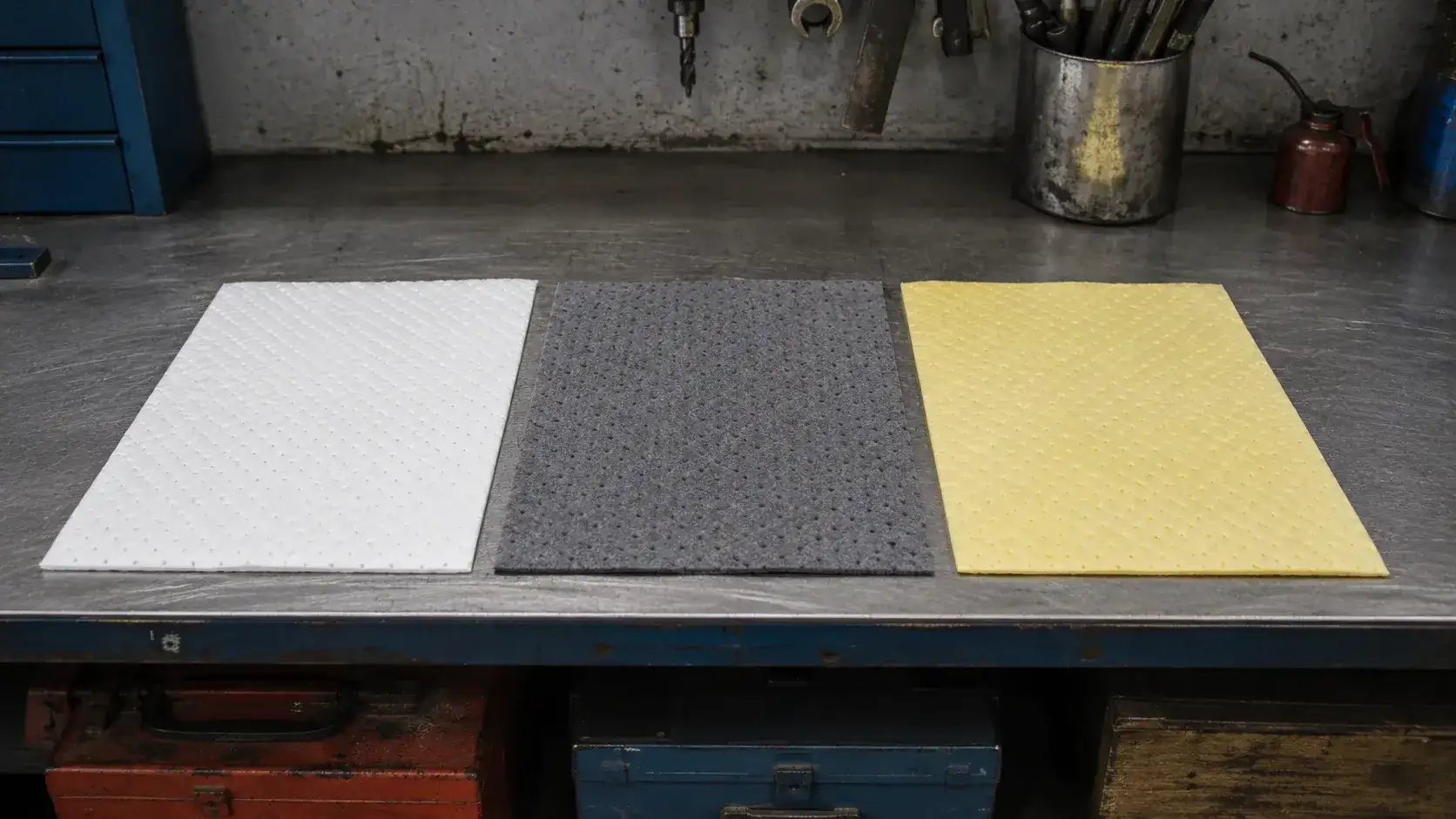
Absorbent pads come in a few grades, each matched to a type of liquid, and an industry color code makes them easy to grab in a hurry. The three core grades are universal, oil-only, and chemical, with drum-top pads as a specialised fourth. Getting the grade right is the single most important pad decision.
The table below summarises the grades and where each belongs. Below it, we look at each grade in more detail so you can see why many facilities keep more than one on hand.
The color code is an industry convention rather than decoration — it lets a worker grab the correct pad in a hurry without reading labels. White for oil, gray for universal, and yellow for chemical is worth memorising, because a wrong grab during a spill costs both time and material.
| Grade | Color | Absorbs | Typical use |
| Universal | Gray | Oil and water-based fluids | Indoor maintenance, machine shops, fleet bays |
| Oil-Only | White | Oil/hydrocarbons only (repels water) | Marine bilges, outdoor fuel handling, wet areas |
| Chemical (HazMat) | Yellow | Acids, caustics, aggressive chemicals | Labs, chemical handling, unknown spills |
| Drum-Top | Varies | Matches grade | Covers 55-gallon drum tops to catch drips |
Universal, Oil-Only, and Chemical Grades
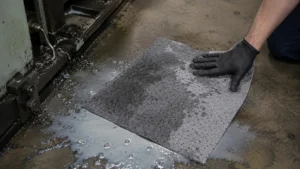
Universal pads (gray) are the everyday workhorse, absorbing both oil and water-based fluids, which makes them the default where a spill could be coolant, water, or hydrocarbon. They cover most indoor maintenance, machine-shop, and fleet-bay needs where you simply want to soak up whatever hits the floor.
Oil-only pads (white) are hydrophobic — they repel water and absorb only oil and fuels, so they shine in marine bilges, around stormwater drains, and in any wet or outdoor setting where you need the oil but not the water. Chemical or hazmat pads (yellow) are built to handle aggressive liquids like acids and caustics safely, and the yellow color signals chemical-spill use at a glance.
Using the wrong grade wastes material and time, so the color code is worth learning. Our guide on do oil absorbent pads absorb water explains the oil-only versus universal distinction in depth.
Absorbent Pad Sizes and GSM Weights
Beyond grade, pads vary in size and weight, and both affect how much a single pad holds. A common standard size is around 40 x 50 cm (roughly 15 x 20 inches), large enough for most spills yet easy to handle, though pads range from small wipe-down sheets to large heavy-duty formats. Perforated pads can be torn to size so you use only what a spill needs.
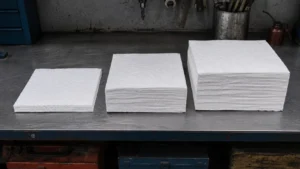
Weight is measured in GSM — grams per square meter — and it is the real capacity dial. Light pads around 200 GSM (about 2 mm) suit drips and wipe-downs, medium pads at roughly 300–350 GSM handle everyday production spills, and heavy or heavy-duty pads at 400–500 GSM (around 3 mm and up) take on large leaks and staged spill response. Higher GSM means more capacity and durability but a bulkier pad.
The practical rule is to match weight to volume: do not pay for heavyweight pads to mop up dribbles, and do not fight a big leak with thin sheets. A well-made polypropylene pad absorbs roughly 15–25 times its own weight in liquid across the range.
Thickness ties into weight as well, and it changes how a pad behaves in use. A thicker, higher-GSM pad holds more and resists tearing when saturated or walked on, which matters on a busy floor. A thin pad wicks fast and lies flat for wipe-downs but saturates sooner, so keeping both light and heavy weights on hand lets you grab the right tool for the spill in front of you.
.
Pads vs. Rolls vs. Pillows
The same absorbent material comes in more than one format, and each suits a different job. Pads are best for point-source drips, drum tops, equipment wipe-downs, and small-area cleanup, where you grab a sheet and go. They are the flexible default for the majority of spills, which is why most facilities buy them in the largest quantity.
Rolls are continuous sheeting for linear coverage longer than a pad — walkways, machine aisles, and bench runs — that you tear to length or lay down as matting. Pillows are filled cushions for high-volume puddles, sumps, and around leaking valves, holding far more per footprint than a flat pad. Choosing between them is really about the shape and volume of the spill.
Most facilities keep pads for everyday use, a roll for large-area or ongoing coverage, and a few pillows for known high-volume leak points. We cover the wider family in our oil absorbents guide.
How to Choose the Right Absorbent Pad
Choosing a pad comes down to three questions: what is the liquid, how big is the spill, and where is it. The liquid sets the grade — universal for mixed fluids, oil-only for oil on or near water, chemical for aggressive substances — and this is the decision that prevents most wasted material.
Spill size and frequency set the weight: light GSM for drips and housekeeping, heavy GSM for big or staged spills. The setting fine-tunes the format — pads on smooth indoor floors, rolls for long runs, pillows for sumps and puddles. Answer those three simple questions and the choice is usually obvious.
When in doubt, a medium-weight universal pad covers the widest range of everyday spills, with oil-only and chemical pads added for their specific jobs. Building that small mix keeps you ready for almost anything, and it avoids the cost of stocking specialised pads you rarely touch.
Material Quality: What Separates a Good Pad From a Cheap One
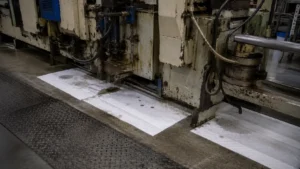
Two pads can both be “100% polypropylene” and perform very differently. Consistent GSM means a pad holds the capacity it promises and tears predictably, while low lint — from proper thermal or sonic bonding — keeps stray fibers out of the spill. These details decide how many pads a job actually takes.
Wet strength matters too: a quality pad keeps its shape fully saturated, while a poor one falls apart and re-releases liquid. A fine-over-coarse fiber build wicks fast and stores more, and clean perforations tear to size without waste. When comparing suppliers, weigh absorbency per pad and lint behaviour, not just the price per case.
For a fuller look at how construction affects performance, see our guide on how oil absorbent pads work.
Buying Absorbent Pads in Bulk and OEM
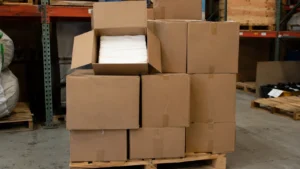
For distributors and high-volume users, consistency is what keeps pads performing across a full container load. Reliable GSM, clean meltblown fiber, low lint, and dependable grade treatment batch to batch are the specs to confirm before committing to an order. A pad that tests well as a single sample but drifts in quality generates complaints regardless of unit price.
As a Shenzhen-based manufacturer, AbsorbentX produces universal, oil-only, and chemical pads in multiple GSM grades and standard sizes, with private-label and OEM options for bulk buyers. Matching grade, size, and weight to your customers’ real spills is what drives repeat orders. Browse the range on our absorbent pads collection, or read how to choose an oil absorbent pads supplier before ordering at volume.
The Bottom Line
Absorbent pads are simple, but choosing well is what makes them effective. Match the grade to the liquid — universal, oil-only, or chemical — then the GSM weight to the spill volume, and the format to the setting, and you will use fewer pads and clean up faster on every spill you face.
Buy on consistency and absorbency per pad rather than price alone, and keep a small mix of grades and weights on hand. Do that, and whatever the spill, the right absorbent pad is always within reach.
If you are stocking from scratch, start with medium-weight universal pads as your base, add white oil-only pads for wet and outdoor areas, and hold a small supply of yellow chemical pads for anything aggressive. That simple three-grade kit, in a couple of weights, handles the overwhelming majority of real-world spills without over-buying.
Frequently Asked Questions
What are the different types of absorbent pads?
The main grades are universal (gray, absorbs oil and water), oil-only (white, repels water and absorbs only hydrocarbons), and chemical or hazmat (yellow, for aggressive chemicals), plus drum-top pads that sit on 55-gallon drums.
What size are absorbent pads?
A common standard is around 40 x 50 cm (about 15 x 20 inches), but pads range from small wipe-down sheets to large heavy-duty formats. Many are perforated so you can tear them to the size a spill needs.
What does GSM mean on an absorbent pad?
GSM is grams per square meter — the fiber weight. Light pads (~200 GSM) suit drips, medium pads (~300–350 GSM) handle everyday spills, and heavy pads (~400–500 GSM) take on large leaks with more capacity and durability.
What is the difference between universal and oil-only pads?
Universal (gray) pads absorb both oil and water-based fluids. Oil-only (white) pads are hydrophobic — they repel water and absorb only oil, ideal for spills on or near water.
How do I choose the right absorbent pad?
Match the grade to the liquid, the GSM weight to the spill volume, and the format (pad, roll, or pillow) to the setting. A medium-weight universal pad covers the widest range of everyday spills.