IPA wipes are presaturated cloths dosed with a controlled ratio of isopropyl alcohol and purified water, sealed in packaging that stops the solvent escaping before the wipe reaches the surface. They sit in a strange middle ground for buyers: everyone knows what they do, almost nobody specifies them properly, and the wrong choice quietly costs money in rework, failed particle counts, or damaged parts.
The two questions that decide almost every purchase are which alcohol concentration you need and which cloth that alcohol is sitting on. Get those two right and the rest — pack format, sterility, pack count — falls into place quickly.
This guide covers concentrations and the real reason 70% outperforms 99% as a disinfectant, substrate options, applications across electronics and life sciences, the materials IPA will damage, flammability and safe handling, storage, shelf life, disposal, and what to scrutinise on a bulk or OEM quote.
What IPA Wipes Actually Are
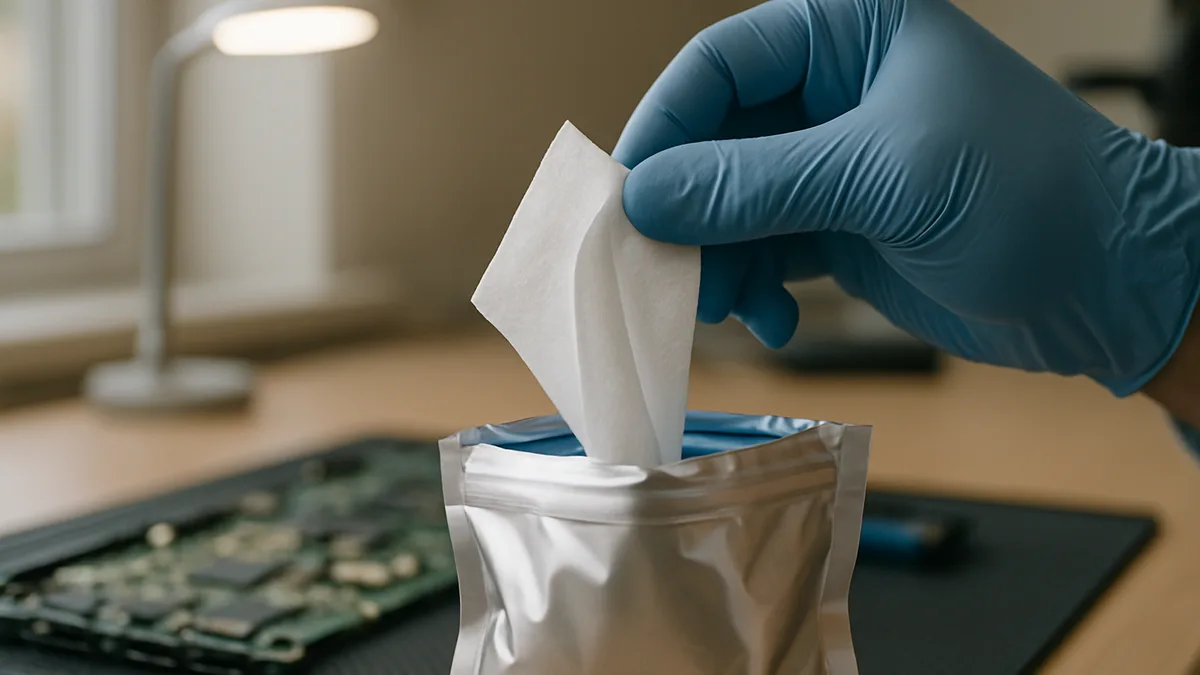
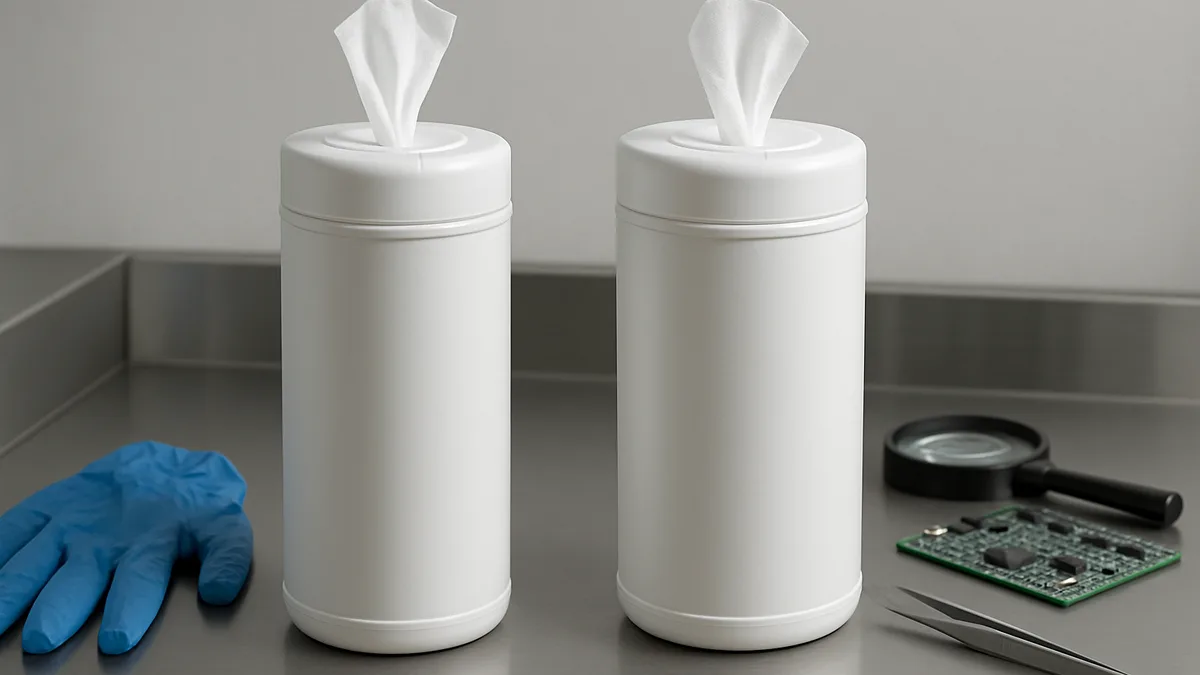
An IPA wipe is three engineered components, not one. There is the fluid — isopropyl alcohol blended with deionised or USP-grade purified water to a defined percentage. There is the substrate — a knitted, nonwoven, or hydroentangled cloth chosen for sorbency and particle behaviour. And there is the package, which controls how much fluid stays in the wipe over weeks of use.
Saturation level is the specification most buyers never ask about. A typical presaturated wipe carries somewhere between 200% and 400% of its dry weight in fluid, and that ratio determines how much surface area one wipe can cover before it stops working. Two wipes with identical alcohol percentages can behave completely differently if one is dosed at 220% and the other at 380%.
The water in the blend is not filler. Reagent-grade or deionised water keeps dissolved solids out of the mix so the wipe dries without leaving mineral haze. Cheap wipes made with tap-grade water leave visible spotting on glass and mirrors, which is usually the first sign a buyer has bought on price alone. If you are still comparing wipe families more broadly, our guide to lint-free wipes covers construction and fibre choice in detail.
70% vs 99% IPA: The Question Everyone Gets Backwards
Higher alcohol concentration feels like it should mean better disinfection, and that instinct is wrong. 70% isopropyl alcohol kills vegetative bacteria more reliably than 99% IPA, and the reason is the 30% water.
Alcohol works by denaturing and coagulating proteins in the cell membrane and cytoplasm. Water is required for that reaction to proceed, and it also slows evaporation so the alcohol stays in contact long enough to penetrate the cell wall. Apply 99% IPA to a surface and it flashes off in roughly 10 to 20 seconds at room temperature — often before it has done meaningful microbial work. It also tends to coagulate a protein shell on the outside of the organism that shields the interior.
70% blends stay wet noticeably longer, typically 30 to 60 seconds depending on airflow and surface temperature, which is closer to the contact times disinfection protocols call for. The WHO Guidelines on Hand Hygiene in Health Care hosted by the NIH National Library of Medicine describe the same principle for alcohol-based antiseptics: the effective range for alcohols sits well below neat concentration, not at it.
99% IPA is not the weaker product — it is the different product. With almost no water present it evaporates fast and clean, which is exactly what you want when residue and moisture are the enemy rather than microbes. That makes it the standard for flux removal, connector and contact cleaning, optics work, and any process where a drying droplet must leave nothing behind.
| Factor | 70% Isopropyl Alcohol | 99% IPA |
|---|---|---|
| Primary job | Disinfection and general surface wipe-down | Residue-free cleaning and solvent work |
| Water content | ~30% deionised or purified water | ≤1% water |
| Approx. dwell time on a hard surface | 30–60 seconds | 10–20 seconds |
| Antimicrobial performance | Strong against vegetative bacteria; not sporicidal | Weaker — evaporates before adequate contact |
| Residue risk | Very low with DI water; possible spotting with poor water quality | Lowest of the two |
| Static and moisture concerns | More moisture on the surface briefly | Preferred where trapped moisture is unacceptable |
| Typical users | Pharma, medical device, food processing, general cleanrooms | Electronics assembly, PCB rework, optics, fibre optics, aerospace |
| Flammability | Flammable; slightly less volatile vapour load | Flammable; higher vapour concentration in the same space |
A practical rule: if the contaminant is biological, buy 70%. If the contaminant is flux, oil, adhesive residue, or fingerprints on an optical face, buy 99%. Plenty of facilities stock both and colour-code the pouches so operators do not have to think about it under time pressure.
Neither concentration is sporicidal, and neither is a substitute for a validated sporicidal agent where one is required. Alcohol also loses effectiveness on visibly soiled surfaces, because organic soil blocks contact — clean first, then disinfect.
The Cloth Matters as Much as the Alcohol
Buyers fixate on percentage and ignore the substrate, then wonder why a 99% wipe left fibres across a lens. The alcohol carries the contamination into solution; the cloth has to hold it and carry it away without shedding anything of its own.
| Substrate | Construction | Particle / Fibre Behaviour | Best For |
|---|---|---|---|
| Knitted polyester | 100% continuous filament polyester, laser or ultrasonic sealed edges | Lowest shedding of the common options | ISO Class 5 and cleaner work, optics, wafer and disk handling |
| Polyester / cellulose blend | Hydroentangled nonwoven, usually 45/55 or 55/45 | Moderate — some cellulose fibre release | General cleanroom wipe-down, lab benches, ISO 6–8 |
| Polypropylene nonwoven | Meltblown or spunbond | Low fibre release, lower sorbency | Tool wipe-down, wet-bench chemical work |
| Microfibre | Split polyester/polyamide | Low, but can hold and redeposit debris if reused | Display glass, optical housings, cosmetic surfaces |
| Cotton or cotton blend | Woven or nonwoven | High shedding | Shop and maintenance use only, never cleanroom |
Edge finish is the second variable. Cut edges shed at the perimeter, which is precisely the part of the wipe you drag across a surface, so sealed-border or laser-sealed edges are worth the premium anywhere particle counts are audited. Sorbency capacity matters too — a substrate that holds more fluid per gram covers more surface per wipe and lowers your per-square-metre cost even at a higher unit price.
Chemical compatibility of the cloth itself is easy to overlook. Some binders and finishes used in cheap nonwovens are partly soluble in high-concentration alcohol and will leach extractables onto the surface you just cleaned, which shows up as haze under inspection lighting.
Sterile vs Non-Sterile IPA Wipes
Sterile presaturated wipes are gamma-irradiated after packaging and supplied with a sterility assurance level, typically SAL 10⁻⁶, plus lot documentation and certificates of irradiation. They are the default for aseptic filling areas, compounding pharmacies, and Grade A/B or ISO Class 5 environments where a validated sterility claim is required.
Non-sterile wipes use the same fluid and often the same substrate, cost substantially less, and are entirely appropriate for controlled-but-not-aseptic work: electronics assembly, general lab benches, tool prep, packaging halls, and support areas around a cleanroom.
Buying sterile everywhere is the most common overspend in this category. Map your zones first, then buy sterile only where your protocol genuinely calls for it — the saving on the support-area volume usually funds a better substrate in the critical zone.
Where IPA Wipes Are Used
Electronics and PCB work is the largest single application for 99% IPA wipes. They lift rosin flux residue after hand soldering, clean connector pins and card edges, prepare surfaces before conformal coating, and remove handling oils before inspection. The fast dry-down means a board can be powered up shortly after cleaning without trapped moisture.
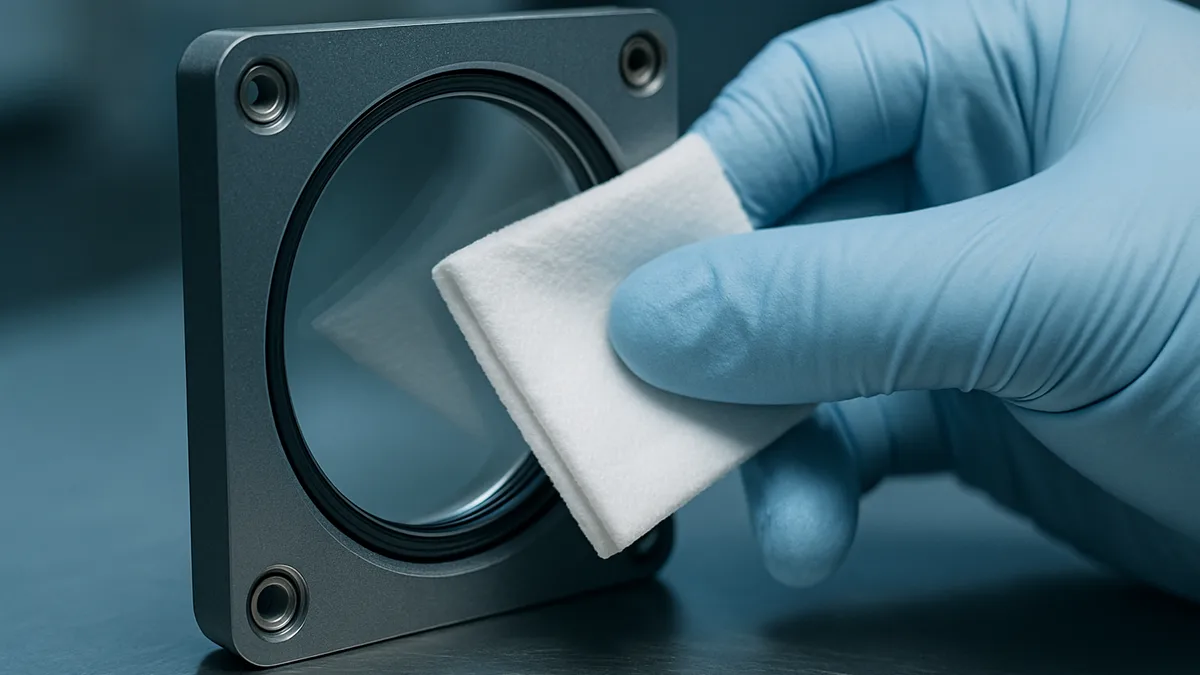
Optics and fibre optics run on 99% as well. Fibre end faces are cleaned with a short, single-direction stroke on a lint-free wipe, since a single sub-micron particle on a connector face is enough to wreck a link budget. Lens and window cleaning follows the same logic — one direction, one pass, fresh wipe.
Medical device manufacturing, laboratory surfaces, and pharmaceutical cleanrooms use 70% isopropyl alcohol wipes for routine surface disinfection, glove sanitisation between operations, wiping items into a controlled area through a pass-through, and disinfecting stainless benches, isolator surfaces, and equipment housings between batches.
Industrial and maintenance settings use IPA wipes for tool and fixture prep, degreasing before adhesive bonding, cleaning sensor faces and machine vision windows, and preparing surfaces before label or tape application. Adhesion failures on the line are very often a surface-prep problem rather than an adhesive problem.
IPA wipes are a precision tool, not a bulk cleanup tool. When the job is volume liquid — hydraulic fluid, coolant, or a floor spill around the same equipment — the right product is an absorbent, not a solvent wipe. AbsorbentX supplies oil absorbent pads for that side of the job, including oil-only absorbent pads that repel water and float on coolant sumps. Pairing the two correctly keeps expensive wipes off jobs a pad should be doing. Facilities weighing wipe formats against reusable rag stock will also find our comparison of shop towels and wipes useful for costing.
What You Should Not Clean With IPA
Isopropyl alcohol attacks several common plastics. Acrylic (PMMA) and polycarbonate are the two big failures — alcohol combined with moulded-in stress produces crazing, a spider-web of micro-cracks that appears hours or days after contact and cannot be polished out. Machine guards, instrument windows, and display bezels are frequently one of these materials.
Coated optics are the other high-risk category. Anti-reflective, oleophobic, and hydrophobic coatings on lenses, camera windows, and consumer displays degrade with repeated alcohol contact, and most display manufacturers specify water or a dedicated screen cleaner instead. Alcohol also lifts some paints, dulls certain powder coatings, dries out natural rubber and some elastomer seals, and can loosen adhesives on labels and gaskets.
Test on a hidden area first, keep contact brief, and never let alcohol pool in a seam or around a seal. If a surface must be cleaned repeatedly over a product's life, verify compatibility once at qualification rather than discovering it in the field.
Flammability and Safe Handling
Isopropyl alcohol is a flammable liquid, and a saturated wipe is a flammable liquid distributed across a large surface area — which is worse, not better. Neat IPA has a flash point of roughly 12 °C (53 °F) and an autoignition temperature near 399 °C (750 °F), so at normal room temperature the vapour above an open canister is already within its flammable range. The PubChem chemical record for isopropyl alcohol from the NIH is a reliable reference for these physical properties and hazard classifications.
Practical controls are unglamorous and effective. Keep canisters closed between uses so vapour does not accumulate. Work with general ventilation or local exhaust in enclosed areas. Keep wipes away from soldering irons, hot plates, heat guns, reflow ovens, grinding sparks, and open flame. Ground metal containers and dispensers where large volumes are decanted, since alcohol vapour can be ignited by a static discharge.
Health exposure matters alongside fire risk. The OSHA permissible exposure limit for isopropyl alcohol is 400 ppm as an 8-hour time-weighted average, and prolonged skin contact defats skin and causes dermatitis. Nitrile gloves and reasonable air movement handle routine use; heavy or enclosed-space use warrants a proper exposure assessment. This article is general product guidance, not medical or regulatory advice — follow your site safety data sheets and local rules.
Packaging, Evaporation, and Shelf Life
Alcohol escapes any package that is not built to stop it. Format choice is therefore a performance decision, not just a convenience one, because a pack that loses solvent loses both cleaning power and the concentration you specified — evaporation preferentially removes alcohol, so an aged, poorly sealed 70% wipe drifts downward in strength.
| Format | How It Behaves | Best Suited To |
|---|---|---|
| Individually sealed sachets | Effectively zero evaporation until opened; highest packaging cost per wipe | Field service, medical device kits, low-frequency use, OEM inclusion |
| Soft resealable pouch (flow-wrap) | Good barrier with a working press-to-close seal; lightweight and low waste | Cleanroom benches, moderate daily volume |
| Rigid canister / tub | Convenient one-hand dispensing; the lid seal is the weak point | High-traffic wipe-down stations |
| Bucket / refill roll system | Lowest cost per wipe at volume; needs disciplined lid closure | Production floors, high-volume routine disinfection |
| Dry wipes plus separate IPA | Full control of concentration and dose; inconsistent operator-to-operator | Facilities with strong SOPs and existing bulk solvent handling |
Typical unopened shelf life runs 12 to 24 months depending on format and how the manufacturer specifies it, with sterile products usually carrying a firm expiry tied to the irradiation lot. Once opened, treat the pack as a consumable with a working life of weeks, not months, and store cases upright, cool, out of direct sunlight, and in an approved flammable-liquids cabinet where quantities require it.
A quick field check: if the last wipe in a pouch comes out noticeably drier than the first, the seal or the storage discipline has failed. That drift is a real quality problem, not a cosmetic one, because dwell time on the surface drops with it.
Buying IPA Wipes in Bulk or OEM
Unit price is close to meaningless in this category. Compare cost per square metre of cleaned surface, which combines wipe size, saturation ratio, and substrate sorbency — a wipe that costs 30% more but covers twice the area is the cheaper product by a wide margin.
Ask suppliers for the specifics that separate a controlled product from a commodity one: exact alcohol concentration with tolerance, water grade used in the blend, substrate composition and edge treatment, saturation percentage, particle and fibre release data, extractables and non-volatile residue figures, sterility documentation where relevant, and lot traceability. A supplier who cannot produce those numbers is reselling someone else's wipe without knowing what is in it.
For OEM and private-label programmes, confirm what is genuinely configurable — wipe dimensions and fold, pack count, concentration, substrate grade, pouch or canister branding, and case configuration — along with minimum order quantities, lead times, and whether the manufacturer can hold buffer stock. Because these are flammable goods, also confirm packaging, labelling, and freight classification early, since shipping mode changes landed cost more than most negotiated discounts do.
Disposal of Used IPA Wipes
A used alcohol wipe still carries solvent and still burns. Collect them in a closed, listed oily-waste or solvent-waste container rather than an open bin, and empty it at the end of every shift so vapour and volume do not build up in the workspace.
Classification depends on what the wipe picked up. A wipe used only for surface disinfection is often ordinary waste once dry under local rules, while a wipe loaded with flux residue, heavy metals, process chemistry, or biological material is regulated waste and must follow the corresponding stream. Never mix the two containers.
Confirm the specific requirements with your environmental health and safety team and your local authority, since solvent-contaminated wipe rules differ meaningfully between jurisdictions and between reusable and disposable programmes.
Getting the Specification Right
The short version: 70% isopropyl alcohol for disinfection because the water is doing essential work, 99% IPA where residue and moisture are the problem, and a substrate matched to how clean the environment has to be. Then check saturation, edge finish, packaging integrity, and sterility only where it is actually required.
Handle every pack as the flammable liquid it is — closed containers, no ignition sources, ventilated space, disciplined waste collection. Those habits cost nothing and remove the only genuinely serious risk in the category.
If you are building a wipe and spill-control programme across a facility, AbsorbentX can help you match presaturated wipes to precision tasks and absorbent products to volume liquids, so neither product is doing the other's job at the wrong cost.
Frequently Asked Questions
Is 70% or 99% IPA better?
Neither is universally better — they solve different problems. 70% isopropyl alcohol is the better disinfectant because its 30% water content slows evaporation and helps alcohol penetrate microbial cell walls, giving 30 to 60 seconds of wet contact. 99% IPA is better for residue-free cleaning of electronics, optics, and flux, where it evaporates in 10 to 20 seconds and leaves virtually nothing behind.
Can you use IPA wipes on screens?
Cautiously, and often not at all. Many modern displays carry anti-reflective or oleophobic coatings that alcohol degrades over repeated use, and most manufacturers specify a damp lint-free cloth or a dedicated screen cleaner. Bare industrial glass and unpolarised instrument windows generally tolerate 70% IPA on a soft lint-free wipe, but check the device documentation before making it routine.
Do IPA wipes kill viruses and bacteria?
70% IPA wipes are effective against vegetative bacteria and many enveloped viruses when the surface stays visibly wet for the required contact time. They are not sporicidal and will not reliably handle bacterial spores such as C. difficile. Alcohol also underperforms on visibly soiled surfaces, so clean first, then disinfect. This is general information, not medical advice.
Are IPA wipes flammable?
Yes. Isopropyl alcohol has a flash point around 12 °C (53 °F), so both the wipe and the vapour above an open pack are flammable at normal room temperature. Keep packs closed, work away from soldering irons, heat guns and open flame, ventilate enclosed areas, and dispose of used wipes in a closed solvent-waste container.
What is the shelf life of presaturated IPA wipes?
Unopened packs typically last 12 to 24 months depending on format, with sterile products carrying a defined expiry tied to their irradiation lot. Once opened, the working life is weeks rather than months, and it depends entirely on whether the seal or lid is closed properly after each use.
Can I make my own IPA wipes with dry wipes and alcohol?
You can, and some facilities do to control concentration and cost. The trade-offs are inconsistent saturation between operators, an open container of flammable liquid on the floor, no lot traceability, and no sterility option. For controlled environments, factory-presaturated wipes are the more defensible choice.
What size and pack count should I order?
Match wipe size to the surface: 4×4 in or 6×6 in for connectors, optics and small assemblies; 9×9 in or 12×12 in for benches, equipment housings and general wipe-down. Choose pack count by how fast a station consumes a pack — a pouch that takes more than two or three weeks to finish will dry out before it empties.