Cleanroom standards measure one thing above all else: how many airborne particles of a given size are floating in a cubic metre of air. They are not a judgement on how tidy the room looks, how new the equipment is, or how disciplined the operators seem. A room earns its class from instrument readings taken under defined conditions, and it keeps that class only by being retested.
That distinction matters commercially. When a customer specifies ISO Class 7 or EU GMP Grade C, they are handing you a number that constrains your air handling, your gowning, your procedures and every consumable that crosses the airlock. This guide translates the three classification systems buyers actually encounter, ISO 14644-1, EU GMP grades and the retired US Federal Standard 209E, into decisions you can act on.
What a Cleanroom Standard Actually Governs
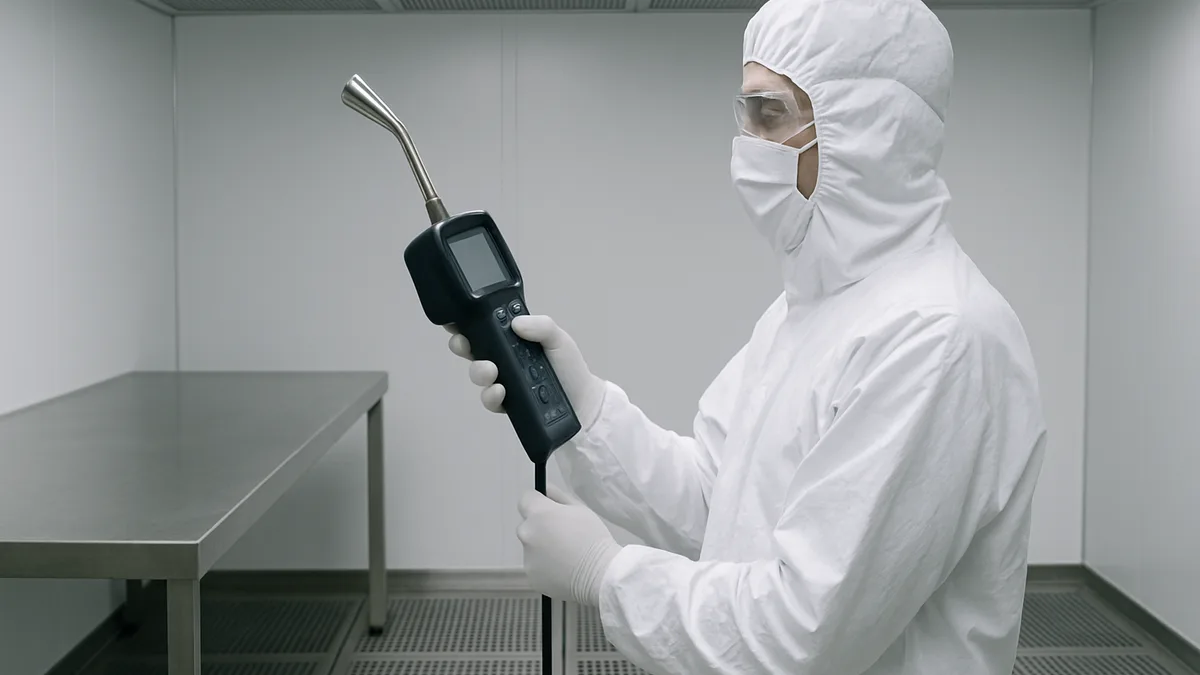
Every mainstream cleanroom standard is built on airborne particle concentration. ISO 14644-1 sets maximum counts of particles at or above specified sizes, measured per cubic metre of air, and assigns the room a class based on the worst-performing sample location. Nothing else, not surface cleanliness, not microbial load, not humidity, forms part of that core classification.
Related requirements do exist, but they live in adjacent documents. Microbial limits sit in GMP annexes and ISO 14698, surface cleanliness in ISO 14644-9, and chemical contamination in ISO 14644-8. Treating the particle class as the whole contamination control programme is the most common mistake buyers make when writing a specification.
The practical consequence is that a cleanroom class is a ceiling, not a description. A room certified to ISO Class 7 can run far cleaner than its limit on a quiet Tuesday and can fail on a Friday afternoon with four extra people and an open process. Classification tells you what the room is permitted to be; monitoring tells you what it currently is.
ISO 14644-1 Classes: The Verified Particle Limit Table
ISO 14644-1:2015 defines nine classes, ISO 1 through ISO 9, where a lower number means cleaner air. Limits are expressed as maximum particles per cubic metre at or above each measured size. The table below reflects the 2015 revision, which is the version in force.
| ISO Class | 0.1 µm | 0.2 µm | 0.3 µm | 0.5 µm | 1.0 µm | 5.0 µm |
|---|---|---|---|---|---|---|
| ISO 1 | 10 | — | — | — | — | — |
| ISO 2 | 100 | 24 | 10 | — | — | — |
| ISO 3 | 1,000 | 237 | 102 | 35 | 8 | — |
| ISO 4 | 10,000 | 2,370 | 1,020 | 352 | 83 | — |
| ISO 5 | 100,000 | 23,700 | 10,200 | 3,520 | 832 | — |
| ISO 6 | 1,000,000 | 237,000 | 102,000 | 35,200 | 8,320 | 293 |
| ISO 7 | — | — | — | 352,000 | 83,200 | 2,930 |
| ISO 8 | — | — | — | 3,520,000 | 832,000 | 29,300 |
| ISO 9 | — | — | — | 35,200,000 | 8,320,000 | 293,000 |
All figures are maximum particles per cubic metre at or above the stated size. Dashes indicate limits that are not defined for classification, either because the concentration is too low to sample reliably or because the particle size is inappropriate for that class. Note the 5.0 micron column in particular: the 2015 revision withdrew the old 29 particles per cubic metre classification limit at ISO 5, because sampling losses and statistical uncertainty at that size and concentration made the figure unreliable. Large-particle monitoring still happens, but as a separate descriptor rather than as part of the class.
Three anchor numbers are worth committing to memory: ISO 5 at 3,520 particles of 0.5 micron and above per cubic metre, ISO 7 at 352,000, and ISO 8 at 3,520,000. Each step in class number is a factor of ten, which is why the scale is logarithmic and why moving a room from ISO 8 to ISO 7 is a serious mechanical project rather than a procedural tweak.
The full scope and current revision status are published on the ISO 14644-1:2015 standard page at iso.org, which is the authoritative reference for the classification limits above.
Federal Standard 209E: The Language Buyers Still Use
US Federal Standard 209E was formally withdrawn in 2001, yet purchase orders, legacy SOPs and shop-floor conversation still run on it. Its classes counted particles of 0.5 micron and above per cubic foot, so "Class 100" meant no more than 100 such particles in a cubic foot of air. Because the base units differ, the mapping to ISO classes is close but not mathematically exact.
| FED-STD-209E Class | Nearest ISO Class | Max particles 0.5 µm+ per m³ | Typical use |
|---|---|---|---|
| Class 1 | ISO 3 | 35 | Semiconductor photolithography |
| Class 10 | ISO 4 | 352 | Wafer fabrication, precision optics |
| Class 100 | ISO 5 | 3,520 | Aseptic filling, implant assembly |
| Class 1,000 | ISO 6 | 35,200 | Support zones around critical areas |
| Class 10,000 | ISO 7 | 352,000 | Medical device assembly, compounding support |
| Class 100,000 | ISO 8 | 3,520,000 | General controlled manufacturing and packaging |
When a specification arrives written in 209E language, confirm which ISO class the customer intends before quoting. The mapping above is the industry convention, but the two systems measure in different volumes and the equivalence is an approximation rather than a legal identity.
It also pays to check whether the buyer means the class of the room or the grade of the product going into it. Consumables are frequently described as "Class 100 compatible" when what is meant is that they are processed and packaged for use in an ISO 5 zone. That is a claim about the product, not a room certification.
EU GMP Grades A, B, C and D
Pharmaceutical manufacturing in Europe, and much of the world that follows the same annex, uses letter grades rather than ISO numbers. The critical difference is that GMP grades carry two sets of limits: one for the at-rest state, with equipment installed and running but no personnel present, and one for the in-operation state, with the process running and staff working.
| GMP Grade | At rest (0.5 µm+/m³) | In operation (0.5 µm+/m³) | ISO equivalent | Typical activity |
|---|---|---|---|---|
| Grade A | 3,520 | 3,520 | ISO 5 at rest and in operation | Aseptic filling, open product transfer |
| Grade B | 3,520 | 352,000 | ISO 5 at rest / ISO 7 in operation | Background environment to Grade A zones |
| Grade C | 352,000 | 3,520,000 | ISO 7 at rest / ISO 8 in operation | Solution preparation, filling of terminally sterilised product |
| Grade D | 3,520,000 | Set by risk assessment | ISO 8 at rest | Component handling and less critical stages |
The at-rest versus in-operation split is where most misunderstandings start. A Grade B room is not "an ISO 7 room" and it is not "an ISO 5 room". It is a room that must achieve ISO 5 counts when empty and must not exceed ISO 7 counts while people are working in it, and that dual requirement drives both the air handling design and the discipline of the people inside.
Grade A is the exception, holding the same 3,520 particles per cubic metre limit in both states. In practice that means unidirectional airflow protecting a small critical zone rather than a whole room. Grade D deliberately leaves in-operation limits to the manufacturer’s own risk assessment and historical data, which is why two Grade D rooms at different sites can run to visibly different internal targets.
The current text of the sterile manufacturing annex is published by the European Commission in its EudraLex Volume 4 GMP guidelines, which is where the grade definitions and their monitoring expectations originate.
How Rooms Are Classified and Requalified
Classification is a defined test, not an opinion. The room is measured in a nominated occupancy state, as-built, at-rest or operational, and the number of sample locations is derived from the floor area, with larger rooms requiring more points. Each location is sampled for a minimum air volume, and the room passes only if every location meets the limit for its class.
Requalification intervals follow the class. Rooms at ISO 5 and cleaner are typically reclassified every six months, while ISO 6 through ISO 9 rooms are usually reclassified annually. Those intervals sit alongside routine particle monitoring rather than replacing it, and they run in parallel with airflow velocity, filter integrity and room pressure differential testing on their own schedules.
Any significant change resets the clock. New equipment, a modified airflow pattern, a filter replacement, an extended shutdown or a repeated excursion all justify reclassification ahead of the calendar date. Treating the annual certificate as the compliance position, rather than as one data point among many, is the fastest route to an audit finding.
Air Changes per Hour and HEPA Filtration by Class
ISO 14644-1 does not mandate air changes per hour. It sets the outcome and leaves the engineering to the designer. In practice the industry has converged on well-understood ranges, because dilution rate is the main lever available once the process itself is fixed.
| Class | Typical air changes per hour | Airflow pattern | Ceiling filter coverage |
|---|---|---|---|
| ISO 5 / Grade A | 240–600 (unidirectional) | Unidirectional, around 0.45 m/s | 80–100% |
| ISO 6 | 150–240 | Mixed, partly unidirectional | 25–40% |
| ISO 7 / Grade C | 60–90 | Turbulent mixed flow | 15–25% |
| ISO 8 / Grade D | 20–40 | Turbulent mixed flow | 5–15% |
| ISO 9 | 10–20 | Turbulent mixed flow | Under 5% |
HEPA filters rated at 99.97 per cent efficiency on 0.3 micron particles are the baseline for classified space. ULPA filters, at 99.999 per cent on the most penetrating particle size, appear at ISO 4 and cleaner where dilution alone cannot hold the limit.
Read these ranges as design starting points rather than requirements. A low-occupancy ISO 7 room running a clean process may hold its class at the bottom of the range, while a busy one with particle-generating equipment can need the top of it or more.
What Each Class Demands of Gowning and Consumables
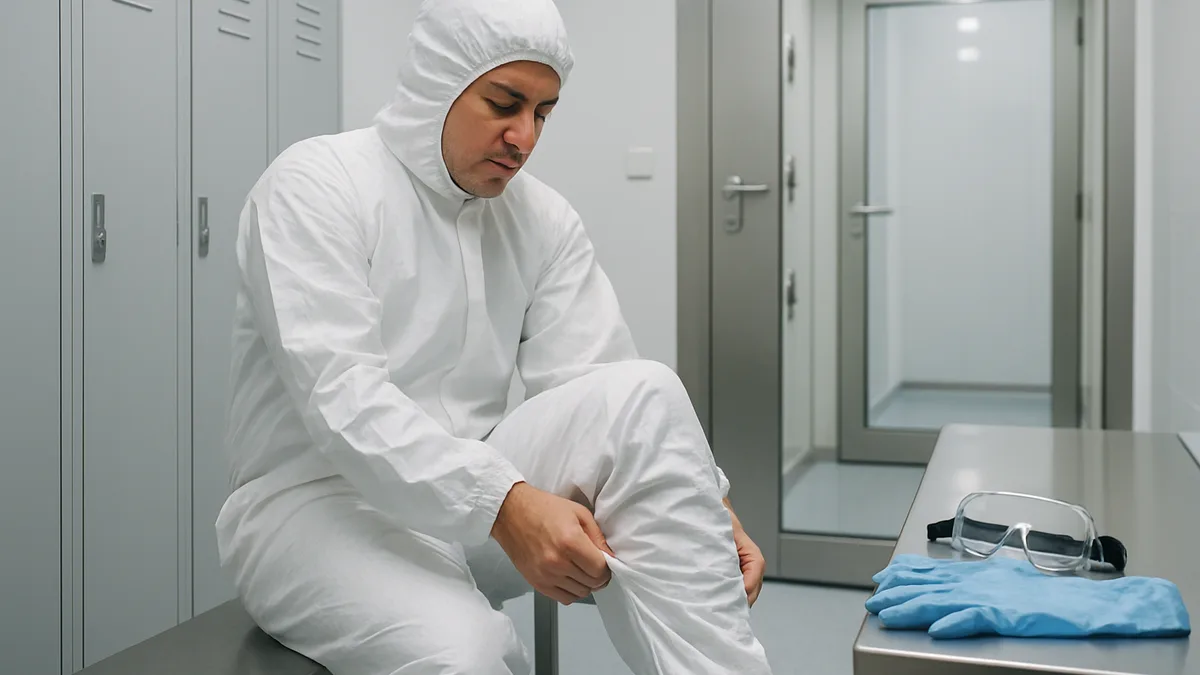
People are the dominant particle source in most rooms. A gowned operator still sheds particles continuously, and movement multiplies the rate several times over, which is why gowning requirements tighten sharply as the class number falls.
| Class | Gowning | Wipes and cleaning materials |
|---|---|---|
| ISO 8 / Grade D | Lab coat or coverall, hair cover, shoe covers, gloves | Low-lint knitted polyester or polyester-cellulose blend, bulk packed |
| ISO 7 / Grade C | Full coverall, hood, boots, goggles, gloves | Laundered or sealed-edge polyester wipes in cleanroom packaging |
| ISO 5 / Grade A or B | Sterile full-body suit, double gloves, face mask, goggles | Sealed-edge or laser-cut 100% polyester, double bagged, often gamma irradiated |
The consumable rule that catches buyers out is packaging. A wipe that passes a particle test on the bench can still fail in the room if its outer bag was opened outside the airlock, which is why higher classes specify double bagging with the inner bag opened only inside the classified zone.
Material construction matters as much as packaging. Our guide to lint-free wipes breaks down edge sealing, fibre type and particle shedding in detail, and the comparison of shop towels versus industrial wipes explains why general-purpose wiping stock has no place past a classified airlock.
Which Industries Sit at Which Class
Class selection follows risk, not prestige. The question is always what a single particle of a given size would do to the product, and how tolerant the downstream process is of the resulting defect.
- Semiconductor fabrication: ISO 1 to ISO 4 in photolithography and wafer handling, where a sub-micron particle can kill a die outright.
- Sterile pharmaceutical filling: Grade A, meaning ISO 5, at the point of fill, inside a Grade B background.
- Medical device assembly: commonly ISO 7 or ISO 8, with ISO 5 workstations for implantable or intraocular components.
- Precision optics and laser assembly: ISO 5 to ISO 7, driven by surface particulate as much as airborne count.
- Compounding pharmacies and biologics support: ISO 7 buffer rooms feeding ISO 5 primary engineering controls.
- Food, cosmetics and packaging: typically ISO 8 or ISO 9, often described as controlled environments rather than cleanrooms.
Rooms are also routinely built one class cleaner than the specification requires, giving headroom for occupancy, equipment ageing and the inevitable drift between certification dates. That margin is far cheaper to buy at the design stage than to retrofit later.
Common Misconceptions About Cleanroom Classification
The first is that a cleanroom class describes surface cleanliness. It does not. The class is an airborne particle measurement, and a visibly spotless room can still fail its count while a room with a scuffed floor can pass comfortably.
The second is that ISO 5 means sterile. Particle counts say nothing about whether the particles are viable. Sterility is established through separate microbial monitoring, and a room can sit comfortably within class while carrying an unacceptable microbial load.
The third is that certification is a state rather than a process. A certificate records the result of a test on a specific day in a specific occupancy state. Between tests, class is maintained by air handling, gowning discipline, cleaning procedure and the consumables you allow through the door. AbsorbentX supplies bulk and OEM wiping and absorbent materials to manufacturers working in and around controlled environments, and the recurring theme in those conversations is that the room design was the easy part.
Where Spill Control Meets Controlled Environments
Classified space rarely exists in isolation. The mechanical rooms, pump skids, filling-line support areas and warehouse zones that surround a cleanroom are unclassified, and they are where hydraulic fluid, lubricant and process liquid leaks actually happen.
Keeping those adjacent areas dry is part of contamination control, because tracked residue is a particle source that walks through the airlock on a shoe cover. For unclassified support zones, standard industrial oil absorbent pads handle general leak containment, while oil-only absorbent pads suit areas where water or coolant is present and the pad needs to lift hydrocarbons selectively.
These are not cleanroom consumables and should not be taken into classified space. Their role is upstream: stopping contamination at the source so the gowning and wiping regime inside the room deals with a manageable load.
This guide is informational and reflects widely used industry practice. It is not regulatory advice; confirm requirements against the applicable standard and your own quality system before acting on them.
Frequently Asked Questions
What is ISO Class 7?
ISO Class 7 permits a maximum of 352,000 particles at or above 0.5 micron per cubic metre of air, along with 83,200 at 1.0 micron and above and 2,930 at 5.0 micron and above. It typically runs at 60 to 90 air changes per hour with 15 to 25 per cent HEPA ceiling coverage, and it is the most common class for medical device assembly and for buffer rooms serving ISO 5 workstations.
Is GMP Grade A the same as ISO Class 5?
Grade A holds the ISO Class 5 particle limit of 3,520 particles of 0.5 micron and above per cubic metre in both the at-rest and in-operation states, so the particle numbers match. The terms are not interchangeable, though, because Grade A also carries microbial limits, unidirectional airflow expectations and monitoring requirements that ISO 14644-1 alone does not impose.
What replaced Federal Standard 209E?
ISO 14644-1 replaced it. FED-STD-209E was withdrawn in 2001 and its per-cubic-foot classes were superseded by the ISO per-cubic-metre classes. The conventional mapping is Class 100 to ISO 5, Class 10,000 to ISO 7 and Class 100,000 to ISO 8, but the equivalence is approximate because the measurement volumes differ.
How often does a cleanroom need to be reclassified?
Common practice is every six months for ISO 5 and cleaner, and every twelve months for ISO 6 through ISO 9. Reclassification is also triggered by significant change such as new equipment, HVAC modification, filter replacement or a pattern of monitoring excursions, regardless of where the calendar sits.
What is the difference between at rest and in operation?
At rest means the room is complete with all services and equipment running but with no personnel present. In operation means the process is running with the normal number of staff working. GMP grades specify limits for both states, which is why a Grade B room must reach ISO 5 counts when empty while only needing to hold ISO 7 counts during production.
Do cleanroom standards cover microbial contamination?
ISO 14644-1 does not, because it classifies airborne particles only. Microbial limits come from GMP annexes and from ISO 14698, and they are assessed using settle plates, contact plates and active air sampling rather than particle counters.