Cleanroom cleaning is a controlled manufacturing process, not housekeeping. Every stroke, every wipe face and every bucket of solution is governed by a rule whose purpose is the same: move contamination out of the room in one direction, and never redistribute it. A cleanroom cleaning procedure done badly does not simply fail to help — it actively raises particle counts, spreads microbial load across surfaces that were fine, and can put a batch or a wafer lot at risk.
This guide walks through the procedure itself: the principles that dictate technique, the gowning and entry steps that precede any cleaning, the correct room sequence, the tools and consumables involved, realistic frequency by ISO class, the technique errors that quietly make things worse, and the monitoring that proves the work actually landed. It is written for QA, facilities and procurement teams who need something they can turn into an SOP rather than a brochure.
Why Cleanroom Cleaning Is Not Ordinary Janitorial Work
Ordinary cleaning aims at what the eye can see. Cleanroom cleaning targets contamination measured in microns and colony-forming units, most of which is invisible right up to the moment it fails a product. The result is that a surface can look spotless and still be out of specification, and a surface can look slightly marked and be perfectly within limits.
The second difference is that in a cleanroom the cleaner is the largest single contamination source in the room. A person sheds roughly a million skin particles an hour at rest and several times that while moving, so the act of cleaning imports the very thing it is meant to remove. Every rule that follows exists to keep that import smaller than the removal.
The third difference is directionality. A janitor may mop back and forth without consequence; in a classified space, unidirectional airflow, room pressure cascades and cleanest-to-dirtiest sequencing mean that the order and direction of work determine whether contamination leaves the room or simply relocates within it.
The Governing Rules of Cleanroom Cleaning
Four rules underpin every credible cleanroom cleaning procedure, and they hold regardless of industry. Clean from the top down, because gravity and airflow move particles toward the floor and anything dislodged from a ceiling grid after the floor is done means starting again. Clean from cleanest to dirtiest, so a critical work surface is addressed before the general room and the gowning airlock is addressed last.
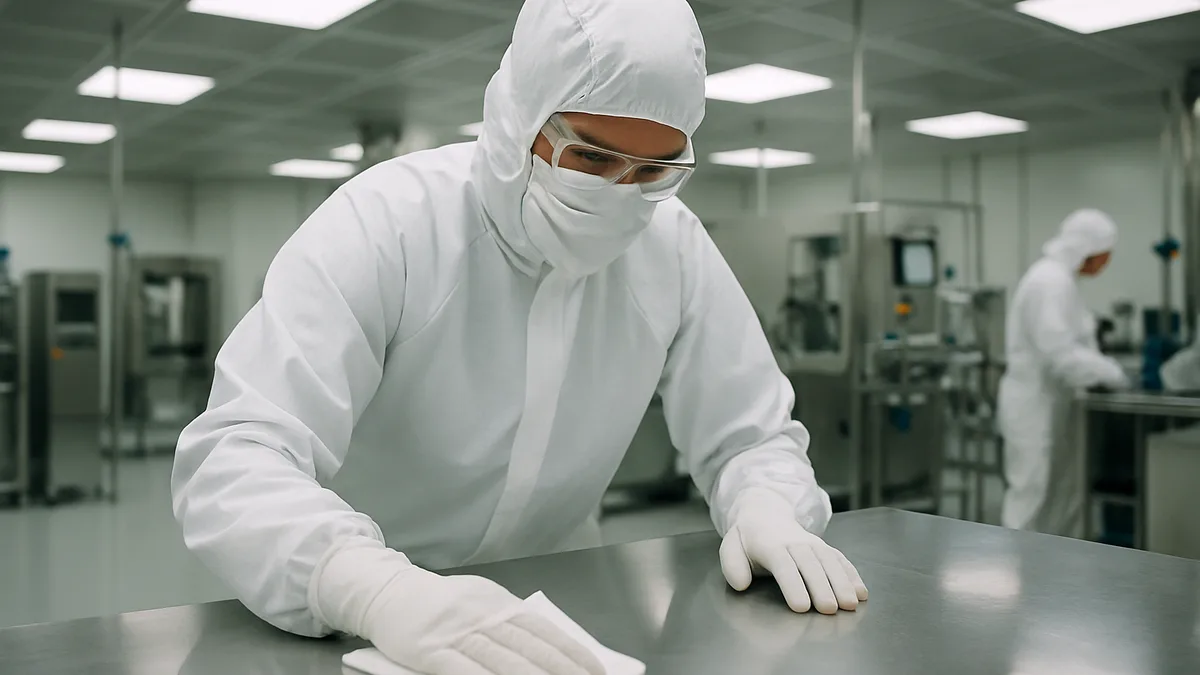
Wipe in straight, overlapping, unidirectional strokes — never circles, never back-and-forth. Overlap each stroke by roughly 10 to 25 percent of its width so no lane is left untouched, and pull the wipe toward yourself so you are not walking across a surface you have just cleaned. For a flat critical surface, work from the far edge to the near edge in parallel lanes; for a vertical surface, work top to bottom in the same lane pattern.
Never reuse a soiled wipe face. Fold a wipe into quarters and you get eight usable faces; when a face is loaded, turn to the next, and when all faces are used, the wipe is waste. A used face pushed back across a clean surface undoes the pass and is the single most common technique failure in real cleanrooms.
Gowning and Entry Protocol Before You Clean Anything
Cleaning starts outside the room. Supplies are wiped down and de-cartoned in the airlock or pass-through, with corrugated cardboard, wood, pencils, standard paper and untreated notebooks left outside entirely, because all of them shed. Cleaning solutions are made up fresh, labelled with the preparation time and the expiry, and never topped up from a previous batch.
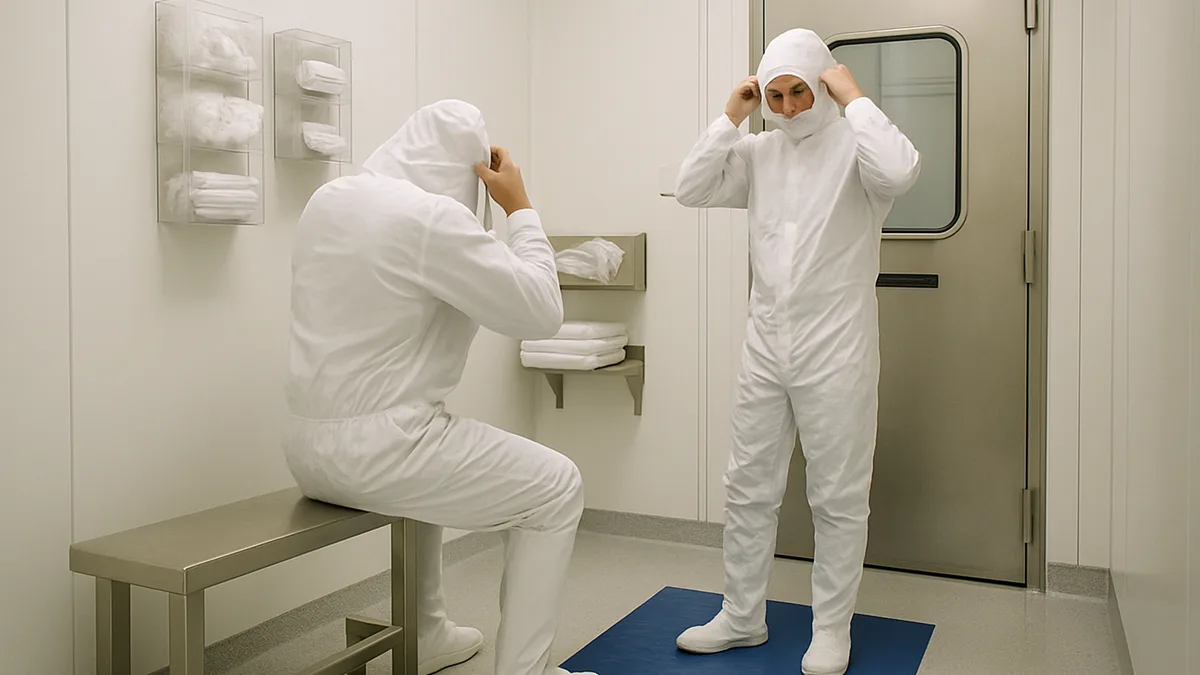
Gowning follows the room's classification and always runs cleanest-item-last: shoe covers and a step-over bench, then hood, coverall, boots, mask and safety glasses, then gloves, with a glove sanitisation step immediately before entry. Gowning is done in the order that stops an outer garment ever brushing a surface that has already been gowned, and any garment that touches the floor is discarded rather than salvaged.
Entry itself is a step, not a doorway. Tacky mats are stepped across one foot at a time so each sole makes full contact, air showers are run for their full cycle, and interlocked doors are never opened simultaneously. Cleaning carts and mop systems that live outside the room get their own wipe-down before they cross the line.
The Standard Cleanroom Cleaning Sequence
The sequence below is the backbone of most cleanroom cleaning SOPs. It runs strictly top to bottom and cleanest to dirtiest, and each stage is completed across the whole room before the next begins rather than working area by area. Two passes are normal: a cleaning pass with a detergent or solvent that physically lifts residue, then a disinfection pass with the approved agent left in place for its full contact time.
Contact time is where most schedules quietly fail. A disinfectant rated for a two-minute wet contact time does nothing measurable if the surface dries in forty seconds, so on fast-drying surfaces the answer is a second application, not a longer stare. Where a residue-leaving disinfectant is used, a periodic residue-removal step with a low-residue solvent belongs in the schedule too.
1. Ceilings, HEPA grilles and overhead fixtures
Overheads are cleaned first and least often, using a flat mop head on an extension handle rather than anything that flicks. Filter faces are treated gently and per the manufacturer's instruction — aggressive wiping of a HEPA face can damage media and turn a cleaning task into a qualification event. Light diffusers, sprinkler heads and cable trays collect the dust that later falls onto benches.
Work in the same lane pattern used everywhere else: overlapping unidirectional passes, one direction only, replacing the mop cover well before it looks dirty. Anything dislodged here lands lower down, which is precisely why this stage precedes everything else.
2. Walls, doors, windows and door furniture
Walls are cleaned top to bottom in vertical overlapping strokes, one wall completed before moving to the next. Door handles, push plates, light switches, intercom panels and pass-through handles are the highest-touch surfaces in the room and belong on a far more frequent schedule than the wall panels around them.
Corners, coving and the wall-to-floor junction accumulate more than flat panels do and deserve a dedicated pass with a small tool rather than the tail end of a wall mop.
3. Equipment exteriors, benches and fixtures
Equipment exteriors, tool frames, monitor housings, chair bases and cart wheels are cleaned before the work surfaces they sit near. Chair and cart wheels are frequently missed and are effective at carrying contamination from a gowning room straight to a critical bench.
Cable runs, keyboard covers and control panels need low-moisture technique — a presaturated wipe wrung to damp rather than a spray, so nothing runs into a connector. Spray-onto-the-wipe, never spray-onto-the-equipment, is the rule.
4. Critical work surfaces and laminar-flow hoods
Critical surfaces get the closest technique: far edge to near edge, parallel overlapping lanes, fresh wipe face per lane or per small zone. In a laminar-flow hood the work moves from the cleanest zone outward and never back, and the hood interior is cleaned at the start of every shift and after any spill or line changeover.
This is the stage where wipe quality decides the outcome. A wipe that sheds during use adds fiber to the exact surface that matters most, which is why sealed-edge, low-particle wipes are specified here — the principles are covered in more depth in this
guide to what makes a wipe genuinely low-linting, and the practical difference between an industrial rag and a controlled wipe is set out in this comparison of shop towels and engineered wipes. In a classified space that difference is not cosmetic; it is the whole point.
5. Pass-throughs, sinks, waste stations and floors
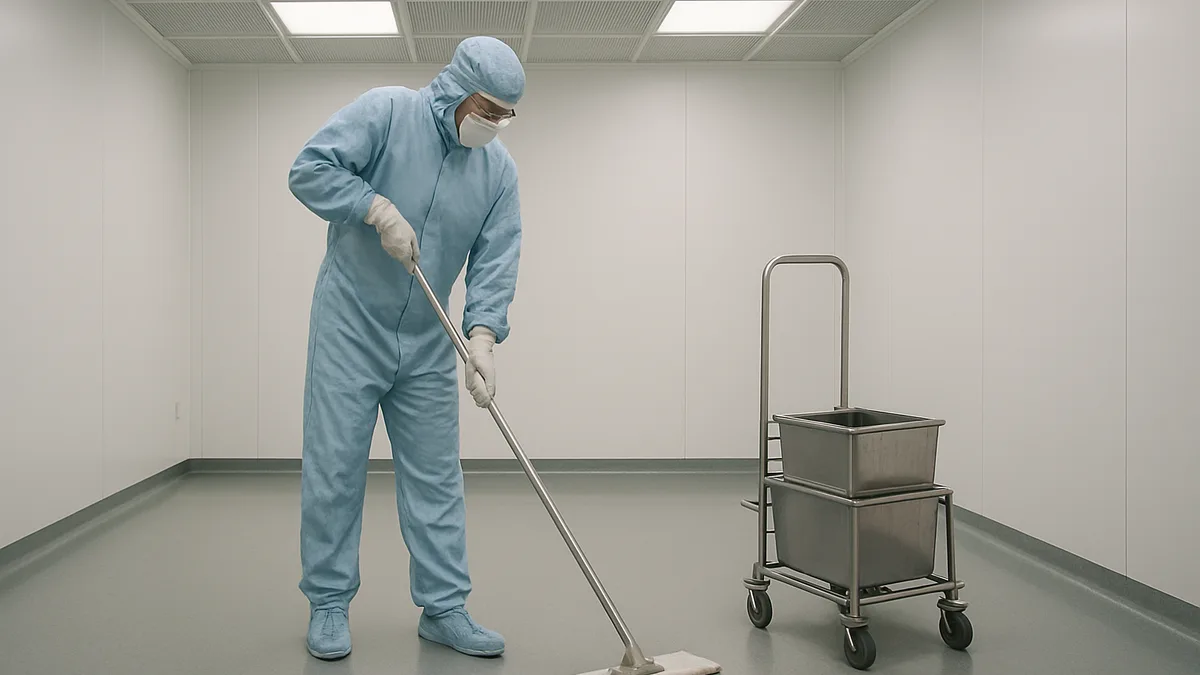
Pass-throughs, sinks and waste stations are dirtier than the room and come near the end. Floors are last, mopped from the point furthest from the exit toward the door in overlapping straight passes so the cleaner never walks back across finished floor.
A dry tacky-roller or HEPA vacuum pass precedes wet mopping so loose debris is lifted rather than smeared. Tacky mats are peeled and replaced at the end of the sequence, not the start, and the gowning room is cleaned last of all as the dirtiest space in the suite.
Tools and Consumables for Cleanroom Cleaning
Every tool used in a cleanroom must itself be cleanroom-compatible: stainless or moulded polypropylene frames, no wood, no painted metal, no frayed cord. Flat microfiber or polyester mop systems with disposable or single-use-then-laundered covers have largely replaced string mops, because a string mop redistributes as much as it removes. Extension handles, small detail tools for corners and coving, and HEPA-filtered vacuums with sealed collection complete the mechanical set.
Bucket configuration matters more than most teams expect. A two-bucket system separates clean solution from rinse; a three-bucket system adds a wringer stage; and a charging-bucket system, where mop covers are pre-soaked in a measured volume of solution and used one-per-area, removes the dirty-water loop entirely and is the cleanest option for low ISO classes. Presaturated wipes and mop covers give repeatable solution volume and avoid the on-site dilution errors that undermine disinfectant efficacy.
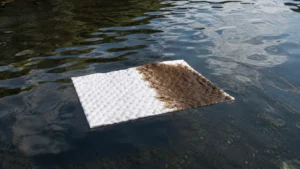
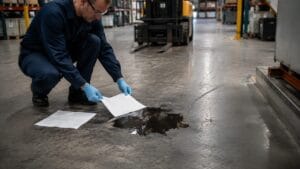
On the chemical side, expect three families: a detergent or low-residue solvent for physical soil removal, a routine disinfectant, and a sporicidal agent used on a periodic cycle. Rotating disinfectants — typically a quaternary ammonium or phenolic in routine use with a periodic sporicide such as a peroxide or hypochlorite — is standard practice for reducing the chance of resistant survivors, and rotation intervals should be written into the SOP rather than left to habit. Absorbent materials also belong on the consumables list for spill response: outside the classified envelope, in adjacent plant rooms, mechanical spaces and pump areas,
industrial oil absorbent pads are the practical tool for lubricant and hydraulic leaks, and where the spill is oil on a wet floor the oil-only grade keeps water behind. These are support-area materials, not cleanroom-interior consumables — do not carry them across the line.
Cleanroom Cleaning Frequency by ISO Class
Frequency is driven by ISO class, occupancy and process risk, not by the calendar alone. The tighter the class, the more often every surface category is touched, and the shorter the acceptable gap between a contamination event and its remediation. The table below is a realistic starting schedule; a facility's own environmental monitoring data should then push individual lines tighter or looser.
| Surface / task | ISO 5 (and better) | ISO 6–7 | ISO 8 |
|---|---|---|---|
| Critical work surfaces, hood interiors | Start of shift, between operations, after any spill | Daily, plus after spills | Daily |
| High-touch points (handles, switches, panels) | Multiple times daily | Daily | Weekly |
| Floors | Daily (often per shift) | Daily to 3x weekly | Weekly |
| Equipment exteriors, carts, chair bases | Daily | Weekly | Monthly |
| Walls and doors | Weekly | Monthly | Quarterly |
| Ceilings, HEPA grilles, overhead fixtures | Monthly | Quarterly | Semi-annually |
| Sporicidal / deep clean cycle | Weekly to monthly | Monthly to quarterly | Quarterly to annually |
| Full shutdown clean | Quarterly to annually | Annually | Annually |
Event triggers override the schedule every time. A spill, a filter change, a maintenance visit, a construction or hot-work activity nearby, an environmental monitoring excursion, a new product introduction or a change in headcount all mandate an unscheduled clean, and the SOP should say so explicitly rather than leaving it to judgment.
Occupancy is the variable most often ignored. A room running two shifts with twelve operators generates several times the particle load of the same room running one shift with four, so frequency should scale with people-hours in the space, not just with the class on the door.
Technique Errors That Add Particles Instead of Removing Them
The most damaging errors are all technique, not chemistry. Circular or back-and-forth wiping redistributes what it picks up; reusing a loaded wipe face re-deposits it; and spraying disinfectant directly onto a surface aerosolises particles into the airstream instead of capturing them in a wipe. Dry-wiping a dry surface is another quiet failure — it lifts particles into the air rather than binding them, so surfaces are wiped damp unless the SOP specifically calls for a dry pass.
Wrong-direction sequencing is the next tier: cleaning the floor before the ceiling, cleaning the gowning room before the core, or working from the door inward so the operator walks back over finished ground. Each of these means measurable rework, and each shows up in monitoring data as an unexplained trend rather than a single spike.
Then there are the consumable errors — over-diluted solution, expired or topped-up disinfectant, a mop cover used past its area limit, wipes shed from a non-sealed edge, and skipping contact time. None of them looks like a problem at the time, and all of them are visible later on a plate or a particle counter.
Validation, Monitoring and Proving the Clean Worked
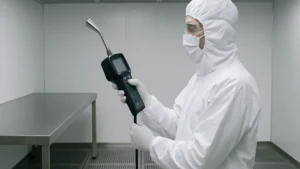
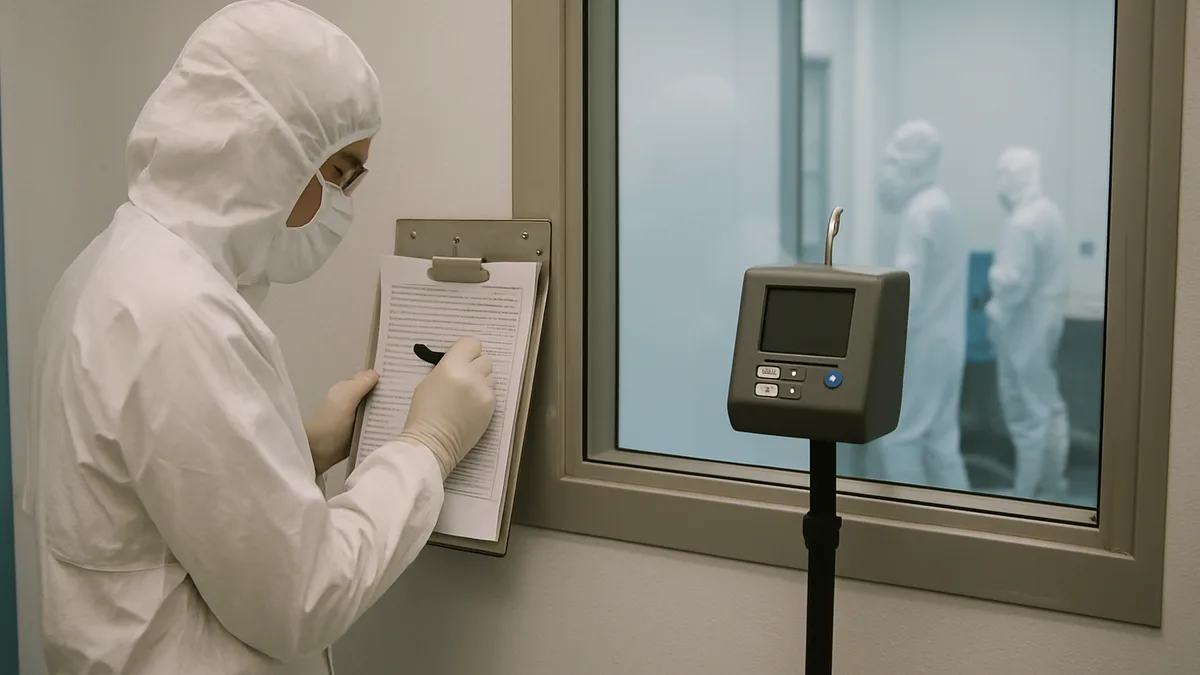
Cleaning without measurement is an assumption. Airborne particle counts at defined locations tell you whether the room is holding its class in operation; surface swabs and contact plates tell you what the cleaning actually removed; and ATP bioluminescence gives a fast in-shift indication of organic residue when a full microbiological result would arrive too late to act on. Visual inspection under strong angled light remains genuinely useful for catching streaking, residue and missed zones.
The operational side of all this — cleaning, monitoring, personnel and material flow as one control programme — is the subject of ISO 14644-5, the cleanroom operations standard, while regulated pharmaceutical environments will also work against the FDA's guidance on sterile drug products produced by aseptic processing. Both are worth reading alongside your own SOP rather than in place of it.
Cleaning validation itself means demonstrating that the written procedure, performed by trained staff with the specified agents, reliably brings surfaces within limits — typically by challenging surfaces, cleaning to the SOP, and sampling. Alert and action levels should be set from your own baseline data, and a trend that walks steadily toward the action level matters far more than one isolated result at it.
Documentation, Training and Waste Handling
A cleaning log is the evidence that the schedule was met: date, time, area, task, agent and lot, contact time, operator initials and verifier. Solution preparation records, disinfectant expiry, consumable lot numbers and mop-cover change points belong in the same record set, because the first question after any excursion is what changed.
Training carries as much weight as the SOP. Operators should be qualified on gowning and on wiping technique with a practical assessment, not a signature on a read-and-understand form, and requalified on a defined interval. Periodic technique audits — watching someone clean and scoring the stroke pattern, the wipe folding and the contact time — catch drift long before monitoring data does.
Waste leaves the room on the same cleanest-to-dirtiest logic. Used wipes and mop covers go into a lined, lidded container inside the room, bags are closed before transport rather than in the corridor, and containers exit through the designated route so nothing is carried back through a cleaner zone. Solvent-soaked and disinfectant-soaked waste is segregated according to the local chemical waste rules.
Building a Cleanroom Cleaning Procedure That Holds Up
A workable SOP names the room and its class, lists every surface category with its frequency, specifies the agent, dilution and contact time for each, describes the sequence and technique in enough detail that two operators clean identically, and defines the records and the acceptance criteria. Anything vaguer than that becomes interpretation, and interpretation is where variability enters.
Start from the sequence in this guide, adjust the frequency table against your own monitoring history, and pilot it for a month with technique audits before locking it. The schedule that survives is the one written around how the room is actually used, not the one copied from a facility with a different headcount and a different process.
AbsorbentX supplies bulk and OEM wiping and absorbent materials to industrial and controlled-environment buyers, and the same principle applies to consumables as to procedure: specify the material to the task, verify it in your own room, then standardise it so every shift performs the same clean.
Frequently Asked Questions
What is the correct order for cleaning a cleanroom?
Top to bottom and cleanest to dirtiest: ceilings and HEPA grilles, then walls and doors, then equipment exteriors, then critical work surfaces, then pass-throughs, sinks and waste stations, then floors, and finally the gowning room. Each stage is completed across the whole room before the next begins.
How often should a cleanroom be cleaned?
It depends on ISO class and occupancy. ISO 5 areas typically see critical surfaces cleaned at the start of every shift and floors daily or per shift; ISO 7 rooms commonly run daily surface and floor cleaning with weekly walls; ISO 8 rooms may run weekly floors with daily critical surfaces. Spills, maintenance and monitoring excursions override any schedule.
Why do you wipe in one direction in a cleanroom?
Unidirectional overlapping strokes carry particles off the surface and into the wipe in a single controlled path. Circular or back-and-forth wiping drags collected contamination back over ground already covered, which redistributes rather than removes it.
What is the difference between cleaning and disinfecting in a cleanroom?
Cleaning physically removes soil, residue and particles with a detergent or solvent. Disinfecting kills the microorganisms that remain and requires a specified wet contact time. Disinfectant applied to a soiled surface is largely wasted, which is why the cleaning pass always comes first.
Do you need to rotate cleanroom disinfectants?
Common practice is a routine disinfectant in daily use plus a periodic sporicidal agent on a defined cycle, to address spore-formers that routine agents do not kill and to reduce the chance of resistant survivors. The rotation interval should be written into the SOP.
What tools are used for cleanroom cleaning?
Flat microfiber or polyester mop systems with single-use covers, stainless or polypropylene handles and buckets in two-bucket, three-bucket or charging configurations, low-particle sealed-edge wipes both dry and presaturated, HEPA-filtered vacuums, tacky mats and rollers, and approved detergents, disinfectants and sporicides.
How do you verify that cleanroom cleaning was effective?
Through airborne particle counts, surface swabs and contact plates, ATP testing for a fast organic-residue indication, and visual inspection under angled light. Results are trended against alert and action levels rather than judged one reading at a time.
Can ordinary cleaning products be used in a cleanroom?
No. Consumer products, cotton rags, paper towels, string mops, cardboard and untreated paper all shed fibers or leave residue and are excluded. Every agent and tool must be approved for the room's classification and compatible with its surfaces.
Schema Suggestion
Recommended: a combined HowTo + FAQPage markup block on the page.
HowTo — name: "How to Clean a Cleanroom"; description: the correct cleanroom cleaning sequence, technique and frequency; totalTime: PT2H (adjust to the room); supply: low-particle cleanroom wipes, presaturated wipes, approved detergent, routine disinfectant, sporicidal agent, mop covers; tool: flat mop system, extension handle, charging or three-bucket system, HEPA-filtered vacuum, tacky mats, particle counter.
HowToStep sequence: (1) Prepare supplies and solutions in the airlock; (2) Gown and enter per protocol; (3) Clean ceilings, HEPA grilles and overhead fixtures; (4) Clean walls, doors and high-touch points; (5) Clean equipment exteriors, carts and chair bases; (6) Clean critical work surfaces and hood interiors; (7) Clean pass-throughs, sinks and waste stations; (8) Vacuum and mop floors toward the exit; (9) Remove waste and replace tacky mats; (10) Complete the cleaning log and sample for verification.
FAQPage — mark up each of the eight Q&A pairs above as Question / acceptedAnswer. Optionally add BreadcrumbList for site hierarchy and Organization for AbsorbentX. Keep the HowTo steps in the same order as the on-page H3s so the markup and the visible content match.