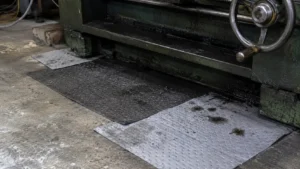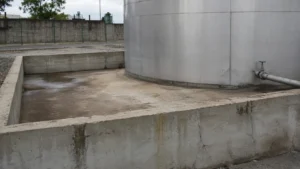
If you have ever compared spec sheets from two spill-control suppliers, you have probably noticed one calls its product an oil sorbent and another calls the same-looking item an oil absorbent. That is not a marketing accident. Every oil sorbent works by one of two physical mechanisms — adsorption or absorption — and the mechanism a material uses determines how much oil it holds, how it feels in your hand, and how it should be stocked on your shop floor. Understanding the difference between these two terms is not academic trivia; it directly affects how much product you buy, how you budget for waste disposal, and whether a spill actually gets contained before it reaches a drain.
This guide breaks down the chemistry in plain language, walks through real material examples on each side of the divide, and shows you how to read a spec sheet so you know exactly what you are buying the next time “oil sorbent” shows up on a quote.
Sorbent Is the Umbrella Term — Here Is Why That Matters
“Sorbent” is the correct catch-all word for any material that removes free liquid from a surface, regardless of how it does that job. It is the parent category, and both “absorbent” and “adsorbent” are its children — two different physical mechanisms that both fall under the sorbent umbrella. Suppliers and buyers use “sorbent” loosely, sometimes as shorthand for the whole product family and sometimes, confusingly, as a stand-in for just one of the two mechanisms.
The mix-up happens because “absorbent” and “adsorbent” are one letter apart and describe processes that look identical from across a warehouse floor. Both categories of material soak up oil, both come in granular, pad, and roll formats, and both show up in the same spill kits. The distinction only becomes obvious once you understand what is physically happening at the molecular level, which is the next section.
Getting this terminology right matters for procurement, not just vocabulary. A purchase order that says “oil sorbent, 55-gallon bag” without specifying absorbent or adsorbent grade leaves room for a supplier to ship you a heavier, lower-capacity adsorbent clay when your application actually needs the higher loading capacity of an absorbent fiber pad, or vice versa.
Absorption vs Adsorption: The Actual Chemistry
Absorption is a bulk process. Oil physically penetrates into the internal structure of the material — the open-cell channels of a polyurethane foam, the tangled fiber network of polypropylene, or the porous cell walls of cellulose — and is held there by capillary action, much the way a kitchen sponge pulls water into itself. The oil is not just sitting on top of the material; it becomes distributed throughout its three-dimensional structure, which is why absorbent products swell and become noticeably heavier and thicker once loaded.
Adsorption is a surface process. Oil molecules adhere to the outer and pore-wall surfaces of the sorbent particle through van der Waals forces or, in some engineered materials, weak chemical bonding, but the oil never migrates into the particle’s internal mass the way it does with an absorbent. Because adsorption depends on available surface area rather than internal volume, adsorbent materials are ground fine or manufactured porous specifically to maximize the amount of exposed surface per gram of product.
The practical tell is texture and behavior after exposure to oil. An absorbent pad that has taken on oil feels soft, swollen, and slightly spongy, and it holds its shape as a single mass you can pick up. An adsorbent material like clay granules stays granular and dry-looking on the outside even while coated in oil on a microscopic level, which is why it can still be swept or shoveled after use rather than lifted as one piece.
For anyone who wants the primary materials-science framing rather than a product-page summary, the EPA’s overview of sorbent use in oil spill response and the ASTM F726 standard test method for sorbent performance are both worth a look, since ASTM F726 is the benchmark test most manufacturers cite when they publish a loading-capacity number.
Material Examples: What Falls on Each Side
Adsorbent sorbent materials are almost always mineral or carbon-based. Clay, typically an attapulgite or bentonite blend, is the most common adsorbent floor-dry product in North American shops. Diatomaceous earth, made from fossilized algae shells, has an extremely high surface-area-to-weight ratio and adsorbs efficiently but produces fine dust that some facilities restrict for respiratory reasons. Activated carbon, vermiculite, and expanded perlite round out the common adsorbent lineup, each trading off cost, dust generation, and oil affinity slightly differently.
Absorbent sorbent materials are built from engineered or natural fiber. Polypropylene is the industry standard for manufactured absorbent pads, rolls, and socks because the fiber is naturally oleophilic and hydrophobic — it grabs oil and repels water, which is exactly the selectivity most industrial users want. Cellulose, typically wood-pulp based, is a lower-cost natural-fiber absorbent used in economy pads and loose fill. Polyurethane foam shows up in booms and specialty absorbent pillows where its open-cell structure gives it exceptional bulk capacity for thick or viscous oils.
A few materials genuinely straddle the line and work through both mechanisms at once. Some clay-based products are chemically treated to add a thin absorbent coating over an adsorbent core, and certain natural fibers like kenaf or milkweed floss show meaningful surface adsorption in addition to their primary absorbent action. On a spec sheet, a manufacturer should tell you which mechanism is doing most of the work, since that is what determines the loading-capacity number.
Why Absorption Usually Wins on Capacity and Handling
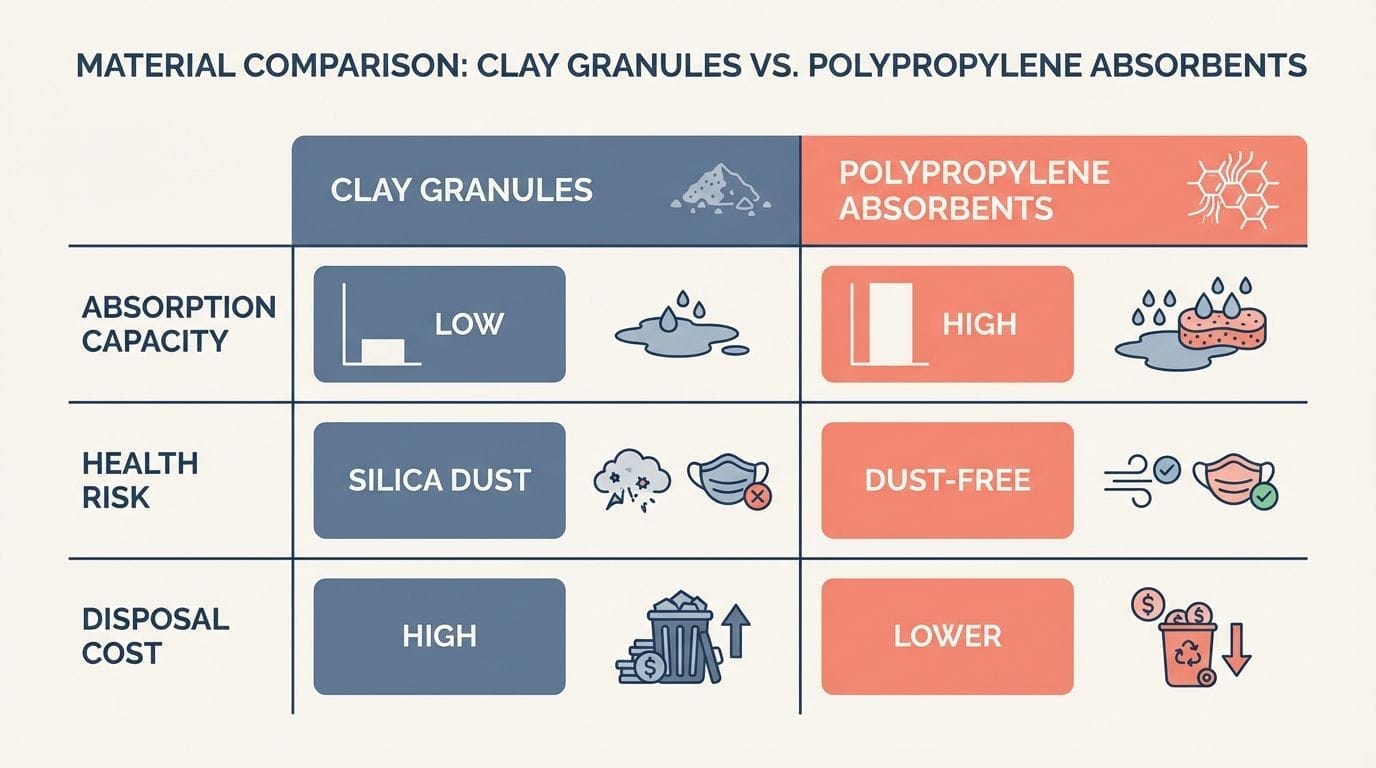
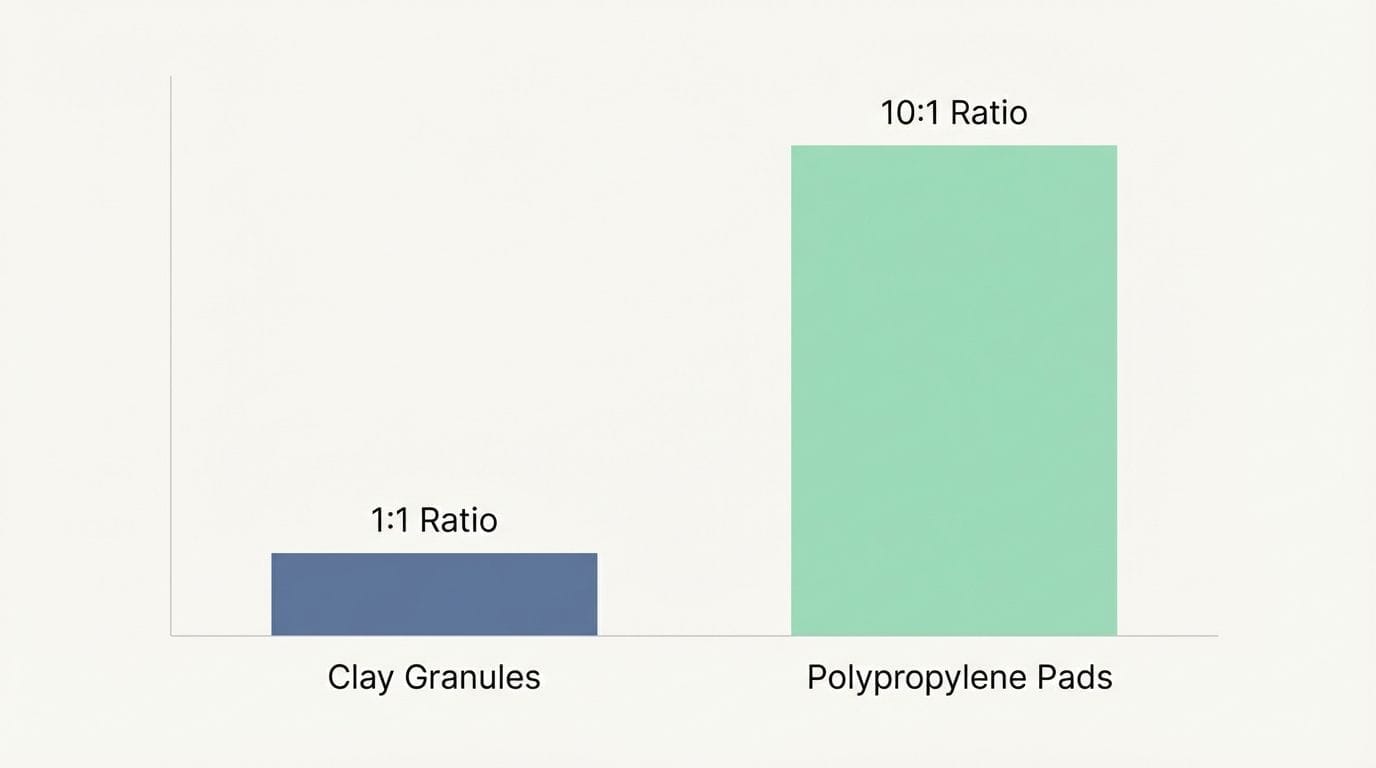
Loading capacity is the clearest, most measurable difference between the two mechanisms. A quality polypropylene absorbent pad typically holds somewhere between 5 and 18 times its own dry weight in oil, depending on fiber density and the viscosity of the oil being picked up. A typical clay-based adsorbent, by contrast, usually holds somewhere between 0.5 and 3 times its own weight before it is saturated, because it is limited to whatever oil its surface area can physically coat rather than drawing liquid into an internal reservoir.
That capacity gap compounds into real cost and labor differences on a spill job. A 30-gallon oil spill that might take four or five absorbent pads to fully contain could require several 50-pound bags of clay granules to achieve the same result, and every one of those bags becomes heavier, oil-saturated waste that has to be shoveled, bagged, and hauled off for disposal. Adsorbent granules can also generate airborne dust during application, which is a housekeeping and respiratory concern that absorbent pads simply do not present.
None of this makes adsorbents inferior products — it makes them a different tool. Where adsorbents earn their keep is in situations absorbent pads handle poorly: dusting a large open floor area as a standing housekeeping layer, working into tight gaps under machinery where a rigid pad cannot conform, or serving as a cheap, disposable bulk product for low-traffic areas where loading capacity per pound matters less than raw material cost per square foot of coverage.
When to Reach for Adsorbents vs Absorbents on the Floor
Reach for a granular adsorbent when the spill is spread thin over a large, open, and typically low-traffic surface, such as a parking lot after a vehicle leak, a loading dock apron, or the base of stationary equipment with awkward, hard-to-reach gaps a flat pad cannot get into. Adsorbent floor dry is also the right call as a permanent, standing housekeeping layer under presses, compressors, or hydraulic units that weep small amounts of oil continuously between scheduled maintenance visits.
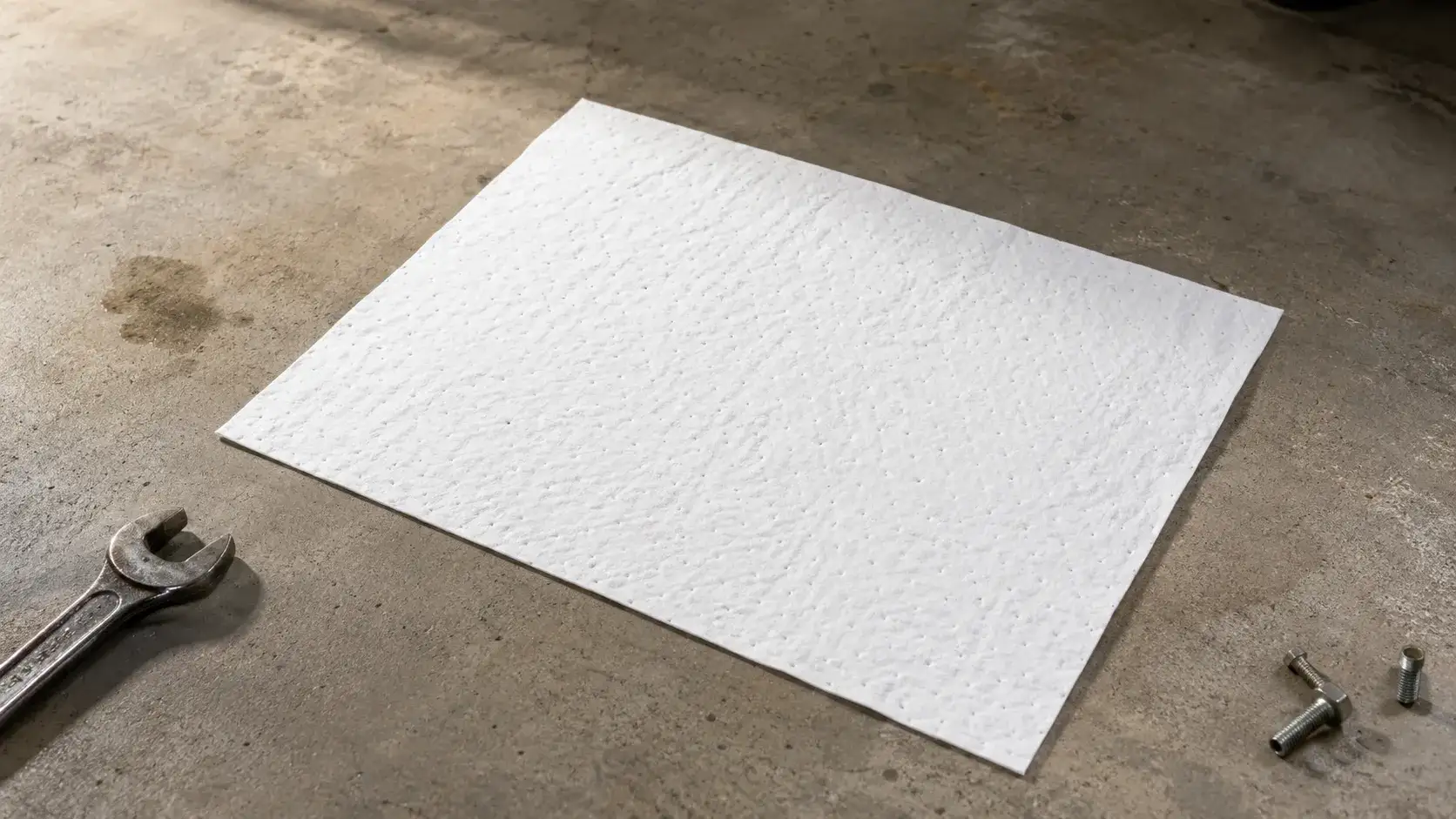
Reach for an absorbent pad, roll, sock, or pillow when you are dealing with a point-source leak or an active spill of meaningful volume — a dripping fitting, a burst hose, a tipped drum, or general wipe-down duty at a workstation. Pads and rolls are the practical choice anywhere the material needs to be handled, folded, wrung, or fitted around a specific shape, and socks are purpose-built for perimeter containment around a spill footprint before it spreads toward a drain.
Most facilities end up stocking both mechanisms rather than choosing one over the other, since they solve different problems. A well-stocked spill station typically pairs an absorbent pad supply for immediate point-source response with an adsorbent granular product held in reserve for larger floor coverage or containment berms, and knowing which is which on the shelf prevents the wrong product ending up in the wrong hands during an actual spill.
Reading a Spec Sheet: How to Spot Absorption vs Adsorption Claims
The single most useful number on any sorbent spec sheet is the loading capacity or absorption capacity figure, usually expressed as a ratio like “absorbs up to 15 times its weight” or as gallons per case. If that ratio sits below roughly 3x, you are almost certainly looking at an adsorbent material regardless of what the product is called on the label, because that ceiling is a physical limit of surface adsorption, not a marketing choice.
Watch the material-composition line as well. Anything listing clay, diatomaceous earth, vermiculite, or perlite as the primary ingredient is an adsorbent, while anything built on polypropylene, cellulose, or polyurethane is an absorbent. Some sheets will explicitly state the mechanism using the words “adsorption” or “absorption” in the product description, which is the most direct confirmation when it is present.
Also check the form factor and application method described. Loose, bulk, granular, or “floor dry” language signals an adsorbent meant to be spread and swept. Pad, roll, sock, pillow, or boom language signals an absorbent meant to be placed, wrung out, or left in position. A sheet that mismatches these signals — for instance, calling a granular product a 15x-capacity absorbent — is worth a follow-up call to the supplier before you commit to a bulk order.
A Note on “Sorbent Pads” as a Product Term
You may also see the phrase “sorbent pads” used interchangeably with “absorbent pads” on product listings, which is a separate, purely terminology-level question from the adsorption-versus-absorption chemistry covered above. For a full breakdown of whether those two product names describe the same item or something different, see our companion guide on sorbent pads vs absorbent pads.
Choosing the Right Product for Your Application
Start with the spill profile you actually deal with most often, not the one you occasionally worry about. Facilities dominated by drips, leaks, and workstation cleanup should build their core stock around oil absorbent pads and rolls, since that is where the higher loading capacity and cleaner handling pay off day to day. For applications where only hydrocarbons should be picked up and water needs to be repelled, oil-only absorbent pads are the more precise choice.
Facilities with large open floor areas, frequent light residue, or tight equipment clearances should keep a granular adsorbent on hand as a secondary, lower-cost layer, reserved for the jobs pads genuinely cannot do well.
Our oil absorbents guide covers full product selection across grades, and our polypropylene absorbent guide goes deeper on why that fiber dominates the absorbent side of the market. For oil-only jobs where hydrophobic selectivity matters, see our oil-only absorbents guide on when to use them over universal pads.
Whichever mechanism you lean on, buy from a supplier whose spec sheets state loading capacity and material composition plainly. A sorbent that hides both numbers behind vague language like “superior absorbency” is harder to budget against and harder to compare across vendors when you are placing a bulk or OEM order.

Bulk and OEM Considerations
For distributors and OEM buyers purchasing pallet-scale volumes, the absorption-versus-adsorption decision usually gets made once per facility profile and then repeated on every reorder, which makes getting the mechanism right at the first order more important than it looks. A misordered adsorbent floor dry that a plant actually needed absorbent pads for means an oversized bag inventory sitting in a corner and a second emergency order for the product that was actually needed.
Custom private-label programs typically build around polypropylene absorbent pads and rolls as the base SKU because that fiber’s loading capacity, weight, and cost per gallon-absorbed tend to make the most sense across a broad customer base, with granular adsorbent offered as a complementary line item rather than the anchor product.
Frequently Asked Questions
Is an oil sorbent the same thing as an oil absorbent?
Not exactly. Oil sorbent is the umbrella term for any material that removes free oil from a surface, while oil absorbent describes one specific mechanism within that category — materials that draw oil into their internal structure. Every oil absorbent is a sorbent, but not every sorbent works by absorption, since adsorbent materials like clay remove oil through surface adhesion instead.
Which holds more oil, an adsorbent or an absorbent?
Absorbents generally hold significantly more oil per unit of weight. A polypropylene absorbent pad commonly reaches 5 to 18 times its dry weight in oil, while a clay-based adsorbent typically tops out around 0.5 to 3 times its weight, because adsorption is limited to available surface area rather than internal capillary volume.
Can a sorbent use both adsorption and absorption at once?
Yes, a small number of engineered and natural-fiber sorbents exhibit both mechanisms to some degree, such as chemically treated clay with an absorbent coating or natural fibers with meaningful surface adsorption alongside their primary absorbent action. A manufacturer’s spec sheet should indicate which mechanism is doing most of the work.
Why do adsorbents generate dust and absorbents do not?
Adsorbent materials such as clay and diatomaceous earth are manufactured as fine granules specifically to maximize surface area, and that same fine particle size makes them prone to airborne dust during pouring and sweeping. Absorbent pads and rolls are solid fiber structures with no loose particulate to become airborne.
Is clay or polypropylene better for an OEM spill-kit program?
Most OEM and bulk spill-kit programs anchor on polypropylene absorbent pads because their higher loading capacity and cleaner handling suit the widest range of end users, then add granular clay adsorbent as a secondary line item for facilities that specifically need floor-dry coverage or tight-clearance application.