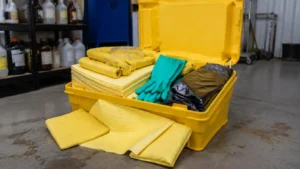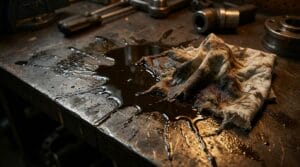
Spill kits turn a sudden leak into a controlled, contained cleanup, and having the right one within reach is often the difference between a two-minute job and a reportable incident. A kit gathers the absorbents, containment tools, protective gear, and disposal bags you need in one grab-and-go package. The trick is matching the kit type to the liquids you actually handle.
This guide covers the three main types of spill kits, exactly what belongs inside each one, how to size and place them, and how to use and restock a kit so it is always ready. Whether you are stocking a single workshop or a multi-site operation, the same decisions apply. By the end you will know which kit you need and what a complete one looks like.
What Is a Spill Kit?
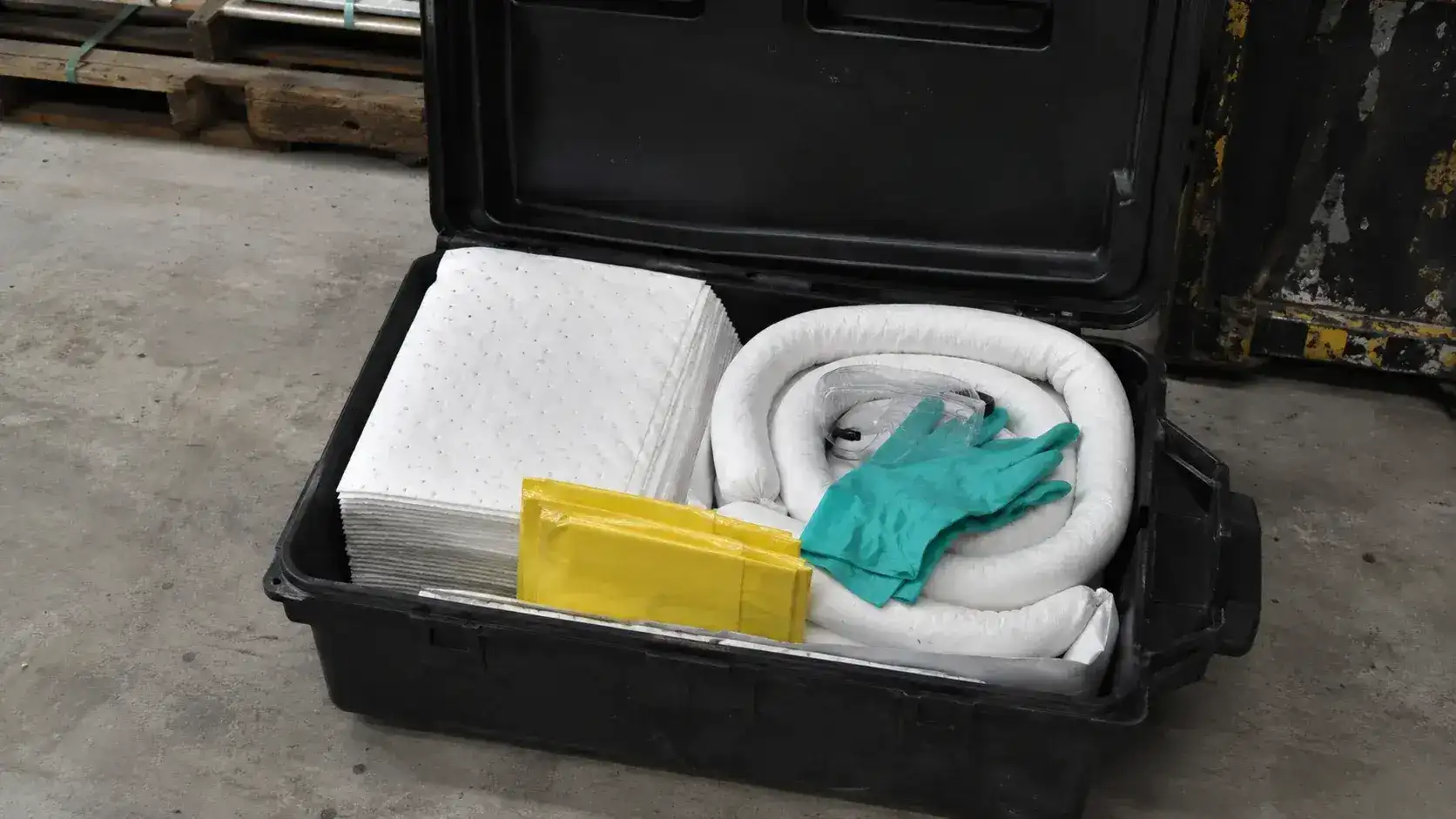
A spill kit is a pre-assembled set of absorbents, containment items, protective equipment, and disposal materials packed into a container for immediate spill response. Instead of hunting for pads and gloves while a leak spreads, staff grab one kit and begin work. Kits are usually colour-coded and labelled by the liquids they are designed to handle.
The point of a kit is speed and completeness. A pad alone soaks up a puddle, but a kit gives you the socks to contain the spread, the PPE to work safely, and the bags to dispose of the waste correctly. That combination is what makes response quick and compliant.
Kits come in portable, drum, and wheeled-cart formats, sized to the volume of spill you realistically face. The type, contents, and size are the three decisions covered below. Everything else is detail that follows from those three.
The Three Main Types of Spill Kits
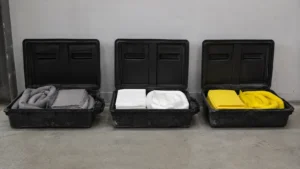
Spill kits follow the same colour code as the absorbents inside them, which makes choosing straightforward. Universal kits use gray sorbents and handle a range of fluids, oil-only kits use white sorbents that repel water, and hazmat kits use yellow sorbents for aggressive chemicals. Each is built for a distinct working environment.
The table below summarises the three types. Below it, we look at each one in more detail so you can see which belongs in your facility.
| Kit type | Sorbent color | Handles | Best setting |
| Universal | Gray | Oil, water, coolants, solvents, non-hazardous chemicals | Factory floors, workshops, enclosed workspaces |
| Oil-Only | White | Oil and hydrocarbons only (repels water, floats) | Pavement, gravel, near waterways, marine and outdoor |
| HazMat | Yellow | Acids, caustics, aggressive chemicals | Labs, chemical storage, transfer and mixing areas |
Universal, Oil-Only, and HazMat Kits Explained
Universal kits are the general-purpose choice, containing gray sorbents that soak up coolants, paint, solvents, oil, and water alike. They suit workshops and indoor areas where a spill could be almost anything and you do not need to separate oil from water. For most factory floors, a universal kit is the sensible default.
Oil-only kits contain white, hydrophobic sorbents that absorb hydrocarbons while repelling water, so they float and recover oil from the surface of water without sinking. Use them on pavement, gravel, near waterways, and in marine settings. Hazmat kits carry yellow, chemically resistant sorbents for caustic and aggressive spills, and belong anywhere chemicals are mixed, stored, or transferred.
Choosing the wrong kit wastes material and can be unsafe, so the colour code is worth training into staff. Our guide on do oil absorbent pads absorb water explains why the oil-only distinction matters so much.
What Is Inside a Spill Kit? The Contents Checklist
At a minimum, every spill kit should contain heavy-duty absorbent pads, absorbent socks, absorbent pillows, disposal bags, and personal protective equipment. The pads handle the bulk of the liquid, the socks build a barrier to stop it spreading, and the pillows soak up deep puddles and sit under leaking valves. Together they cover containment and absorption.
Disposal is part of the kit, not an afterthought. At least two heavy-duty plastic disposal bags with twist ties or zip ties should be included so contaminated absorbents can be sealed immediately. A simple instruction card and an inventory list round out a well-built kit.
The sorbent colour inside must match the kit type, since a gray sock in an oil-only kit defeats the purpose. Our oil absorbents guide covers each absorbent format in detail.
Beyond the minimum, many kits add a scoop or dustpan for granular absorbent, hazard tape or cones to mark the area, and a small container for recovered liquid. These extras are not strictly required, but they speed up a response and keep bystanders clear while you work.
PPE: The Part Most Kits Get Wrong
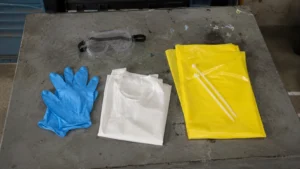
Protective equipment is where cheap kits cut corners, yet it is what keeps responders safe. Every kit needs chemical-resistant gloves — nitrile for general use, and neoprene or butyl rubber where acids and solvents are handled. Matching glove material to the chemical is not optional.
Safety goggles, not merely safety glasses, are required, because only goggles give the splash protection liquid chemical exposure demands. A disposable apron or coveralls protects clothing and skin from contact. These items should be checked and replaced just as diligently as the absorbents.
If your kit came with thin gloves and open-sided glasses, upgrade them before you need them. The moment of a spill is the wrong time to discover the PPE is inadequate.
Kit Formats, Sizing, and Placement
Spill kits come in several formats sized to the spill you realistically face. Small portable kits and bags suit vehicles, service vans, and single workstations, while drum kits hold enough absorbent for a substantial leak in one wheeled or static container. Larger wheeled carts serve production floors where a big spill demands volume and mobility.
Sizing should reflect your worst credible spill, not your average one. A kit that runs out halfway through a response is little better than no kit, so size to the largest container of liquid stored nearby. It is common to keep a small kit at each risk point and one large kit centrally.
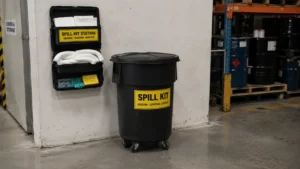
Placement matters as much as size. Kits belong where spills actually happen — beside transfer points, storage areas, loading bays, and machines with known leaks — clearly marked and never blocked. A kit locked in a distant store room will not be reached in time, and a slow response is what turns a minor leak into a costly incident.
How to Use a Spill Kit
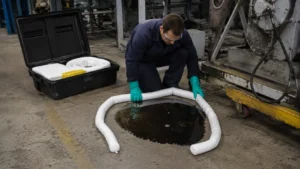
Responding with a kit follows a simple order. Put on the PPE first, then use the socks to surround and contain the spill, working from the outside in so it cannot reach drains or spread further. Containment before absorption is the habit that keeps a small spill small.
Once the perimeter is set, lay pads over the liquid and add pillows to any deep puddles, letting the absorbents wick up the spill rather than scrubbing it around. Replace saturated items as they darken and stop absorbing. Work steadily until no free liquid remains on the surface.
Finally, seal the used absorbents in the disposal bags, remove and bag your PPE, and handle the waste according to the liquid it absorbed and your local rules. Our guide on [INTERNAL LINK: how to dispose of oil absorbent pads → /blog/how-to-dispose-of-oil-absorbent-pads] covers this final step in detail.
Restocking and Staying Inspection-Ready
A spill kit is only useful if it is complete, and the most common failure is a kit raided for pads and never refilled. Restock immediately after any use, replacing every absorbent, bag, and piece of PPE that was consumed. A sealed or tagged kit makes it obvious at a glance whether it has been opened.
Schedule regular inspections to confirm the contents match the inventory list, that PPE has not degraded, and that nothing has passed its shelf life. Check that the kit is still positioned correctly and remains unobstructed. Recording these checks gives you an audit trail if an inspector asks.
Treating the kit as a standing piece of safety equipment, rather than a box of supplies, is what keeps a facility genuinely prepared. It costs little and prevents the worst kind of surprise.
Buying Spill Kits in Bulk and OEM
For distributors and multi-site operators, kit quality comes down to the absorbents inside. Consistent GSM, clean meltblown fiber, low lint, and dependable hydrophobic or chemical treatment batch to batch are what make a kit perform when it matters. A kit assembled from inconsistent sorbents will disappoint no matter how good the container looks.
As a Shenzhen-based manufacturer, AbsorbentX produces the absorbents behind spill kits — pads, socks, pillows, and booms — in oil-only, universal, and chemical grades, with private-label and OEM options for bulk orders and custom kit configurations. Building kits around reliable sorbents is what earns repeat business. Browse the range on our absorbent pads collection, or read how to choose an oil absorbent pads supplier before ordering at volume.
The Bottom Line
Spill kits work when the type matches the liquid, the contents are complete, and the kit sits where the spill happens. Choose universal for mixed indoor fluids, oil-only for hydrocarbons on or near water, and hazmat for aggressive chemicals, then confirm the pads, socks, pillows, PPE, and disposal bags are all present.
Size the kit to your worst credible spill, place it within reach, and restock it the moment it is used. Do that, and a spill becomes a routine, contained job rather than an emergency you were not ready for.
If you are starting from nothing, a single universal kit near your highest-risk area is the right first purchase. Add an oil-only kit wherever hydrocarbons meet water, and a hazmat kit only if you genuinely handle aggressive chemicals. Building up in that order gives you real coverage without buying equipment you will never open.
Frequently Asked Questions
What are the main types of spill kits?
Three: universal kits (gray sorbents, for oil, water, coolants and non-hazardous chemicals), oil-only kits (white, hydrophobic sorbents for hydrocarbons on or near water), and hazmat kits (yellow sorbents for acids, caustics and aggressive chemicals).
What is inside a spill kit?
At minimum: heavy-duty absorbent pads, absorbent socks, absorbent pillows, disposal bags with ties, and PPE including chemical-resistant gloves, safety goggles, and a disposable apron or coveralls.
What PPE should a spill kit contain?
Chemical-resistant gloves (nitrile for general use, neoprene or butyl rubber for acids and solvents), safety goggles rather than safety glasses for splash protection, a disposable apron or coveralls, and at least two heavy-duty disposal bags.
Which spill kit do I need?
Use an oil-only kit for spills on pavement, gravel, or near waterways; a universal kit for factory floors and enclosed workspaces; and a hazmat kit anywhere chemicals are mixed, stored, or transferred.
How do you use a spill kit?
Put on PPE first, contain the spill with socks working from the outside in, absorb it with pads and pillows, then seal the used absorbents and PPE in the disposal bags and dispose of them according to local rules.
How often should spill kits be inspected?
Restock immediately after any use, and inspect on a regular schedule to confirm contents match the inventory list, PPE is intact, and the kit is correctly placed and unobstructed. Record each check for your audit trail.